
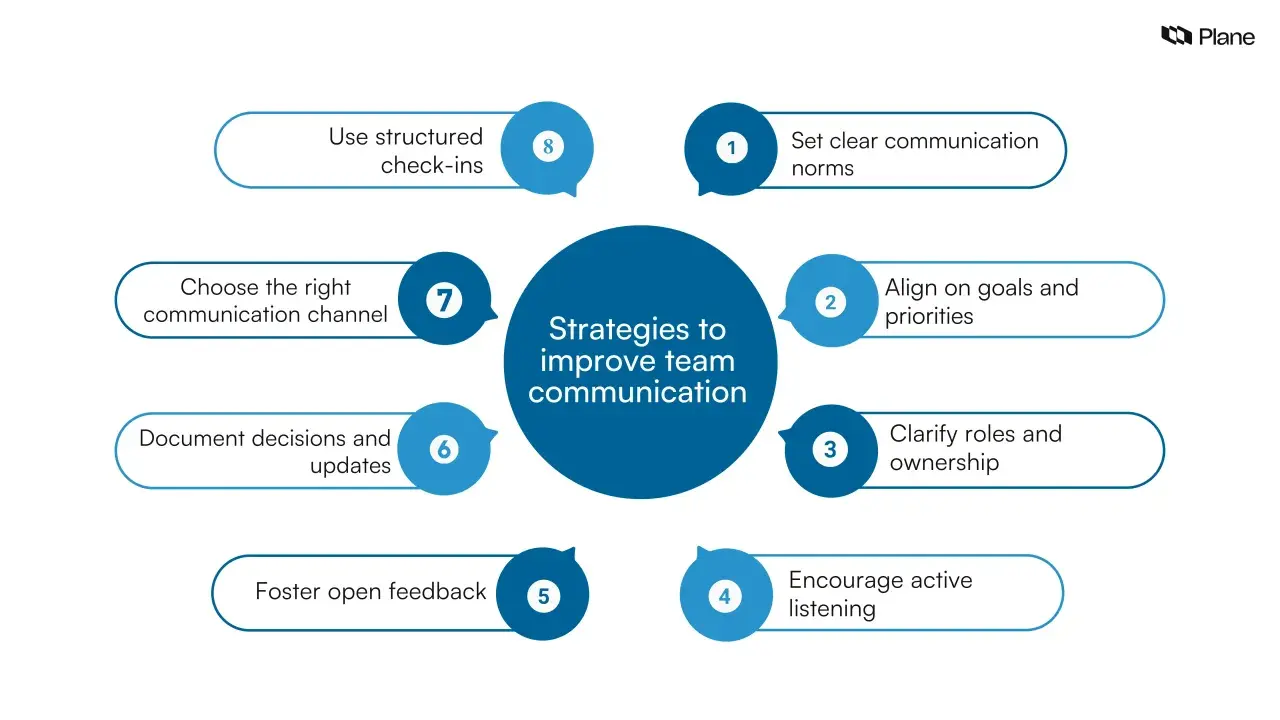
Strong teamwork rarely fails because people do not talk enough. It fails when the team leaves conversations with different assumptions, unclear ownership, or a shared goal that is more slogan than reality. In many U.S. workplaces, the real challenge is not getting people to talk more; it is making sure everyone leaves a conversation with the same priorities, the same decisions, and the same next step. The point of collaborative communication is not constant conversation.
What matters most for better teamwork
- Shared understanding matters more than volume, so every important conversation should end with a clear owner and next action.
- The best teams mix live discussion with written follow-up so people can think, respond, and stay aligned.
- Inclusive habits, like turn-taking and written agendas, make it easier for quieter voices to shape the outcome.
- Simple operating rules prevent rework, confusion, and the slow drift that breaks cross-functional work.
- Leaders set the tone by modeling listening, clarity, and accountability instead of relying on charm or speed.
What this looks like when a team is actually aligned
I usually think of effective team communication as a system, not a personality trait. A team is aligned when people can explain the goal, the current status, the owner of each decision, and the reason behind the work without needing a follow-up meeting to decode it.
That does not mean everyone must agree on every detail. It means people can disagree productively, surface risks early, and still move in the same direction. If a new hire, contractor, or cross-functional partner cannot understand the project from the shared notes alone, the team is probably relying too much on memory and too little on structure.
This is also where trust matters. Gallup’s recent work on collaborative culture keeps circling back to trust, respect, and shared understanding between people, and that matches what I see in practice: when people feel safe enough to ask blunt questions, communication becomes clearer, not just nicer. Once that baseline exists, the next question is which methods actually create that clarity.
The methods that create shared understanding
There is no single channel that solves everything. I prefer a mix of short live touchpoints, written context, and explicit decision tracking because each one fixes a different failure point.
| Method | Best for | Why it helps | Watch-out |
|---|---|---|---|
| Short stand-ups | Active projects with moving pieces | Surfaces blockers early and keeps priorities visible | Can turn into status theater if nobody flags real issues |
| Async docs and comment threads | Distributed teams and deep work | Gives people time to think before responding | Needs clear deadlines or it drifts forever |
| Decision logs | Cross-functional work and recurring trade-offs | Stops the team from reopening settled decisions | Only useful if someone keeps it current |
| Retrospectives | After launches, handoffs, or messy cycles | Turns friction into process improvement | Becomes performative if no action items are tracked |
| 1:1 check-ins | Sensitive feedback and early warning signs | Helps people raise issues they will not mention in a group setting | Cannot replace team-wide alignment |
Microsoft’s research on hybrid work points in the same direction: teams do best when they balance synchronous and asynchronous communication instead of trying to solve everything in meetings. I agree with that strongly. Too much live discussion burns people out and crowds out thinking time; too little leaves people isolated and unsure how to act.
My rule of thumb is simple. Use live time for ambiguity, conflict, and decision-making. Use writing for context, options, and follow-through. That split keeps meetings shorter and makes the work easier to revisit later. The catch is that none of it works well if only the loudest people are shaping the conversation, which is where inclusion comes in.

How to make the process inclusive in hybrid and diverse teams
Inclusive leadership changes the quality of communication because it changes who gets heard, when they get heard, and how much effort it takes to contribute. In practice, that means designing for participation instead of hoping it happens naturally.
Here is what I would put in place first:
- Send a short agenda or decision brief before meetings so people can prepare thoughts instead of reacting on the spot.
- Ask for written input before the meeting, especially from people who tend to think better asynchronously.
- Rotate the facilitator so the same voices do not control every room.
- Use turn-taking intentionally in larger meetings and invite dissent by name, not by vague invitation.
- Capture decisions in plain language, including what was decided, what was not decided, and who owns the next step.
- Check for accessibility needs, time-zone pressure, and language clarity so participation is not limited to the most comfortable speakers.
That last point matters more than many leaders realize. A team can look collaborative while still filtering out people who need more context, more processing time, or a different communication format. Good collaboration is not just about warmth; it is about designing a system where more of the team can contribute meaningfully. Once the system is open enough, the remaining problems are usually self-inflicted.
The mistakes that quietly break alignment
Most collaboration problems do not arrive as dramatic conflict. They show up as delay, repetition, and small misunderstandings that keep compounding. I see the same patterns over and over:
- Too many channels - information gets scattered across chat, email, docs, and verbal side conversations, so no one knows what is current.
- Meetings without outcomes - people talk through the issue but leave without a decision, owner, or deadline.
- Assuming silence means agreement - in reality, silence can mean confusion, caution, or fatigue.
- Mixing brainstorming and decision-making - one part of the meeting is open-ended, but the team behaves as if a final call has already been made.
- No conflict rules - disagreement is either avoided or allowed to become personal, with no shared norm for how to challenge ideas respectfully.
- Follow-up that is too vague - “Let’s circle back” is not a plan, and people know it.
The fix is rarely more meetings. It is usually fewer, better-designed touchpoints with explicit rules. If the team knows where to speak, when to write, and how decisions are recorded, the friction drops fast. That takes us to the part leaders can implement without waiting for a culture overhaul.
A simple rollout plan for a manager or team lead
If I were improving a team’s communication rhythm from scratch, I would keep the first month practical and boring in the best possible way. The goal is not to impress people with process; it is to make work easier to follow.
- Define the shared goal - write down the team’s purpose, the current priority, and what success looks like in plain English.
- Assign decision ownership - for every major decision, name one person who owns the final call, even if many people contribute.
- Choose the core channels - use one place for quick questions, one place for project documentation, and one place for final decisions.
- Set response norms - for example, non-urgent messages get a reply within one business day, while urgent blockers are escalated immediately.
- Shorten recurring meetings - a 15-minute stand-up or check-in is usually enough for active work if the team has a written source of truth.
- Close every meeting with action items - each action should have one owner, one deadline, and one visible place where progress is tracked.
- Run a retro after 2 to 4 weeks - ask what felt clear, what created confusion, and which rule needs to change.
This is also where discipline matters more than inspiration. A team does not become aligned because everyone agrees to value communication; it becomes aligned because the working habits make clarity easier than confusion. Once those habits are in place, the real test is whether they survive a busy week.
What I would protect when the work gets hectic
Under pressure, teams usually lose clarity before they lose capability. That is why I would protect a few non-negotiable habits even during deadlines, layoffs, launches, or high-stakes change.
- Keep written decisions current so nobody has to guess what changed.
- Keep one short live check-in for blockers, not for every update.
- Keep a visible list of owners and deadlines so accountability does not depend on memory.
- Keep space for dissent so speed does not quietly replace judgment.
- Keep managers available for direct questions, especially when the team is navigating ambiguity.
When collaborative communication is working, people spend less time decoding one another and more time solving the actual problem. That is the real payoff for teams that want stronger shared understanding: fewer hidden assumptions, better decisions, and a culture where more people can contribute without fighting the process to be heard.
