
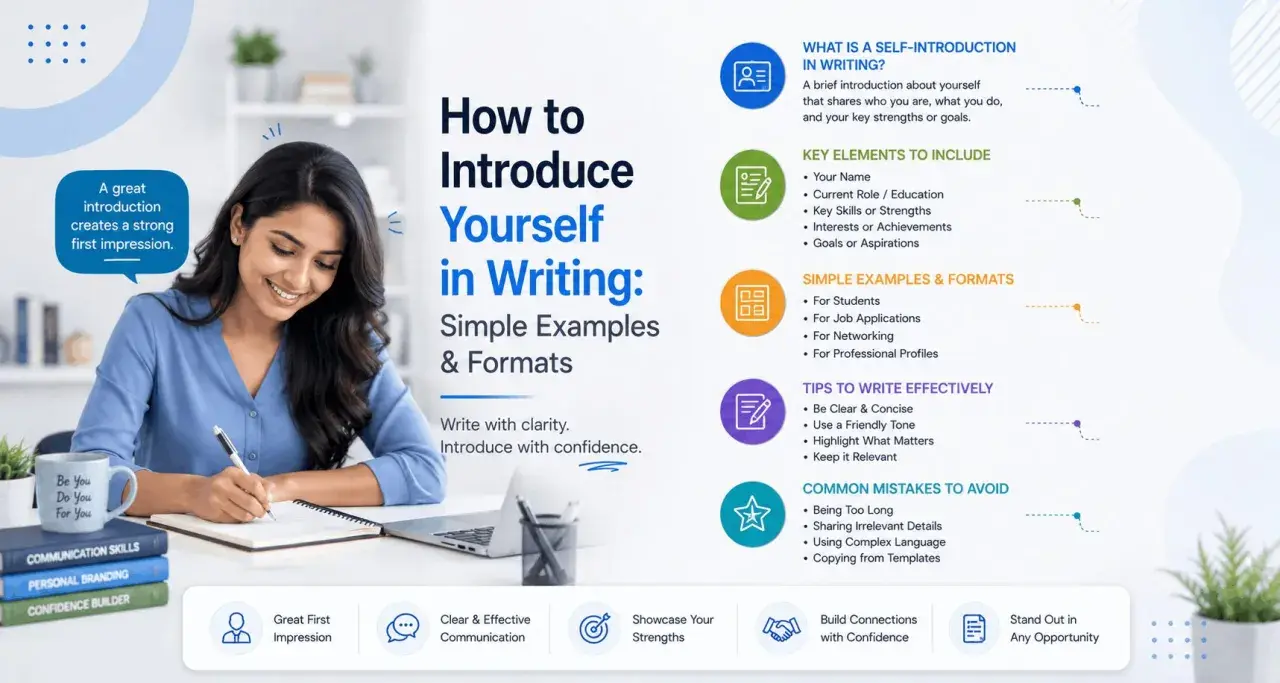
Knowing how to present yourself clearly is one of the fastest ways to build trust at work, in interviews, and in networking conversations. A strong self-introduction is not a speech; it is a compact communication tool that tells people who you are, why you are there, and how they can connect with you. I focus here on practical ways to make that first moment sound natural, confident, and inclusive without turning it into a memorized script.
The fastest way to make a first introduction work
- Keep the focus on clarity, not on impressing people with every detail of your background.
- Match the length to the setting: a hallway hello, a team meeting, and an interview all need different versions.
- Lead with your name, role, and relevant context, then add one useful detail that opens conversation.
- In inclusive settings, make room for names, pronouns, and different communication styles without forcing awkwardness.
- For most workplace situations, a 15 to 30 second version is enough; longer only when the room asks for it.
What people usually want from a self-introduction
When people look for guidance on how to introduce themselves, they usually do not need theory. They need a version that works in a new team, an interview, a networking event, or a first email. The real question is not “What is the perfect script?” It is “What should I say so the other person immediately understands my place in the conversation?”That is why I treat a self-introduction as a tiny decision tree. First, show who you are. Second, explain why you are relevant in this setting. Third, leave the door open for the other person to respond. If you do those three things well, the introduction feels calm rather than rehearsed.
| Situation | Best length | Main goal | What to include |
|---|---|---|---|
| New team meeting | 15 to 25 seconds | Help people place you quickly | Name, role, immediate focus |
| Networking event | 20 to 40 seconds | Start a real conversation | Name, function, interest, reason for being there |
| Interview | 45 to 90 seconds | Show relevance and confidence | Career thread, strengths, one proof point |
| Email introduction | 50 to 100 words | Make the next step obvious | Reason for writing, context, request |
I like this range-based approach because it keeps people from overthinking every word. Once the setting is clear, the next step is building a version you can actually say out loud.
A simple structure that works in most situations
The easiest structure I use is: name, role, relevance, next step. It works because it moves from identity to purpose without sounding stiff. You do not need to say everything about yourself. You need to say enough that the other person knows how to engage.
- Name - Say it early and clearly. In real conversations, that matters more than people admit.
- Role or context - Explain why you are in the room, on the call, or at the event.
- Relevance - Add one useful detail about your work, background, or focus area.
- Next step - End with a question, a reason for connecting, or a small invitation to continue.
A simple example sounds like this: “I’m Jordan, and I lead onboarding for a SaaS team. I spend most of my time helping new customers get value quickly, and I’m especially interested in how communication shapes that first experience.” That is enough to be memorable without becoming self-important. It gives the listener a clean opening for their reply, which is exactly what a good introduction should do.
In practice, the best version is the one you can say without rushing. Once you have the structure, you can tailor the tone to the room.

Examples you can adapt instead of copying
I prefer examples that feel real rather than polished to the point of being useless. The goal is not to memorize lines word for word. The goal is to hear the rhythm of a good introduction and then make it your own.
- New coworker: “I’m Priya, and I joined the operations team this week. I’m focused on vendor coordination and process cleanup, so if your work touches onboarding timelines, I’d love to compare notes.” This works because it is brief, specific, and collaborative.
- Networking event: “I’m Daniel. I work in workplace culture and leadership development, and I’m here because I want to meet people who are thinking seriously about employee experience.” This works because it says who he is, what he cares about, and why he showed up.
- Interview: “I’m Sofia, a customer success manager with six years in B2B software. My work has centered on retention, adoption, and cross-functional communication, and I’m now looking for a role where those skills shape the customer journey more directly.” This works because it connects the past to the opportunity in front of her.
- Email introduction: “I’m Marcus, and I manage people analytics for a regional sales team. I’m reaching out because I saw your work on manager training, and I think our priorities may overlap.” This works because it is concise, respectful, and clear about the reason for contact.
What I notice in all four examples is what they leave out: unnecessary biography, filler language, and the impulse to prove too much too quickly. That restraint is what makes the introduction sound confident.
From here, the question becomes less about wording and more about whether the introduction fits the people in front of you.
How to stay inclusive when you introduce yourself
In inclusive workplaces, self-introduction is not just about personal branding. It is also about reducing friction for other people. I have found that the most effective introductions make space for names, roles, and differences without turning the moment into a performance.
- Say your name slowly enough to be heard. If your name is often unfamiliar to others, clarity is more helpful than speed.
- Share pronouns if that is normal in your environment. Keep the tone matter-of-fact so the practice feels ordinary, not forced.
- Avoid insider language. Acronyms, local jokes, and company shorthand can make a new person feel like an outsider in seconds.
- Invite others in. If you are leading the meeting, a round of brief introductions can help quieter voices be heard instead of skipped.
- Respect different communication styles. Some people are direct, some are reflective, and some need a few seconds before they speak. Leave room for that.
- Do not make assumptions about background or role. A title never tells the whole story, and good communication leaves space for context.
In the U.S. workplace, this matters because first impressions often set the tone for collaboration. A thoughtful introduction tells people, “You can speak to me without guessing who I am or how I want to work.” That is a small signal, but it carries real weight. Once the introduction feels inclusive, the next challenge is avoiding the habits that make it sound thin or performative.
Common mistakes that make an introduction weaker
Most weak introductions fail for the same few reasons. They either try too hard or not hard enough. They overload the listener, hide the useful information, or end without giving the other person a way to continue the conversation.
| Mistake | Why it hurts | Better move |
|---|---|---|
| Trying to sound impressive | It often becomes vague or inflated | Focus on relevance and one concrete detail |
| Reading a script word for word | It sounds stiff and disconnected | Know the key points, not every line |
| Starting with your entire resume | People stop listening before you reach the point | Choose one current thread and build from there |
| Using humor that depends on shared context | It can confuse or exclude people | Keep humor light and optional |
| Talking only about yourself | It closes the conversation | End with a question or a reason to connect |
There is also a quieter mistake I see a lot: people shrink themselves too much. They think modesty means making their role sound smaller than it is. In reality, a clear introduction is not bragging. It is basic professional courtesy. When someone understands what you do, they can collaborate with you more easily. That is the whole point.
Once those traps are out of the way, the final step is polishing the delivery so the message actually lands.
The details that make your first line easier to remember
I pay attention to a few practical details every time I introduce myself, because they matter more than people expect. The words are important, but delivery changes how those words are received.
- Pace: Slow down after your name. Most people rush that moment and lose clarity.
- Pause: A short pause between name and role helps the listener process both.
- Volume: Speak at a level that reaches the back of the room without sounding like you are performing.
- Eye contact: In person, look at the person or group you are speaking to; in virtual settings, look at the camera long enough to feel present.
- Recovery: If you stumble, reset once and continue. A small mistake is less noticeable than visible panic.
- Follow-up: End with a question or invitation if the situation allows it, because that turns a monologue into a conversation.
If I had to reduce the whole topic to one line, I would say this: introduce yourself in a way that makes the other person’s next reply easy. That is what turns a name into a conversation, and a conversation into trust.
