
Professional communication works best when people can quickly understand the point, the tone, and the next step. In practice, that is what business language is for: not sounding impressive, but making decisions easier, reducing confusion, and keeping people aligned. In this article, I break down what that style looks like, how it changes across emails and meetings, and how to keep it clear, inclusive, and credible in a U.S. workplace.
The essentials for clearer workplace communication
- Professional language should help readers or listeners act faster, not decode your wording.
- Jargon is useful only when everyone already shares the same context.
- Plain, inclusive wording lowers friction for new hires, non-native speakers, and cross-functional teams.
- Email, meetings, and feedback each need a different level of directness and detail.
- The biggest improvements usually come from removing ambiguity, not adding more words.
What this language is supposed to do at work
I think of workplace language as a tool with a very specific job: it should move work forward. That means it has to do more than sound polished. It needs to reduce uncertainty, signal priorities, and help other people respond without guessing what you meant.
When language does that well, you see it everywhere: a manager gets a budget approved faster, a project team understands who owns the next step, and a client can tell whether you are making a recommendation or asking for input. When it does not, people spend time decoding tone, chasing context, or repairing misunderstandings that should never have happened in the first place.
The useful test is simple: does this wording help the reader act? If the answer is no, the message probably needs to be shorter, cleaner, or more specific. Once that goal is clear, it becomes much easier to strip away the clutter that makes professional communication feel heavier than it should.
The rules I use to keep it clear
Clear professional language is rarely clever. It is usually disciplined. The strongest drafts I see are built around a few habits that sound basic but make a real difference in daily work.
Start with the audience, not with your draft
I always ask who needs this message and what they already know. A finance partner, a new hire, a client, and an executive do not need the same level of explanation. If I write for my own convenience instead of the reader’s context, I usually end up with language that feels complete to me and vague to everyone else.
Choose words that name the thing itself
“Support the initiative” is weaker than “approve the pilot.” “Take action” is weaker than “send the revised file by Thursday.” Specific verbs and nouns lower the mental load on the reader. They also make accountability easier, which matters more than sounding diplomatic in a sentence that is supposed to produce a decision.
Keep sentences short enough to scan
Long sentences are not automatically bad, but they become a problem when they carry too many ideas at once. I prefer one main point per sentence when the message is important. That is especially true in internal communication, where readers are often distracted and need to understand the message quickly on the first pass.
Use jargon only when it saves time for the right audience
Jargon is not always the enemy. Inside a specialized team, some shorthand is efficient because everyone knows exactly what it means. Outside that team, the same term can turn into friction. The difference is context: if the phrase reduces explanation for one group but creates confusion for another, it is not really efficient anymore.
| Jargon-heavy version | Clearer version | Why the second one works |
|---|---|---|
| Let’s leverage synergies. | Let’s work together to improve results. | It says what the collaboration is meant to do. |
| Can you circle back on this? | Can you reply with your decision by Friday? | It gives a concrete action and deadline. |
| We need to align offline. | Let’s schedule a separate conversation. | It avoids insider shorthand and sounds plain. |
| This is a robust solution. | This is a reliable solution that covers the main use cases. | It explains what “robust” actually means. |
These edits are small, but they change how the reader feels while reading: less decoding, more confidence. That matters even more when the message moves across channels, because the same sentence does not behave the same way everywhere.

How it changes in email, meetings, and feedback
Good professional communication is not one-size-fits-all. Email, live conversation, and performance feedback each have a different job, so the language should shift with the setting instead of staying flat and formal by default.
Email needs speed and structure
Email works best when the reader can scan it in seconds and still know what to do. I like to put the purpose in the first line, keep the request visible, and use bullets when there are multiple moving parts. A long wall of text makes people work harder than necessary, which is a bad trade in a channel that already gets too much attention.
A useful pattern is: context, request, deadline, then any supporting detail. If the email is about approval, say what needs approval. If it is about a change, say what changed and why. If it is about a decision, state the decision that is needed and who owns it.
Meetings need clarity about direction
Meetings often fail because people talk around the issue instead of naming the point of the conversation. I prefer to open with the goal, not the background. That can be as simple as: “We need to decide whether to launch next week” or “We need to leave with one owner for each follow-up.”
The best meeting language also includes closure. A good recap names the decision, the owner, and the date. Without that, a meeting can feel productive while quietly producing nothing. In practical terms, the language that matters most in meetings is the language of commitment.
Read Also: Effective Feedback Training - Master Workplace Communication
Feedback needs precision without drama
Feedback is where many people become vague, overly soft, or accidentally harsh. I try to keep it grounded in observable behavior, its impact, and the next expectation. “You were careless” is not useful. “The report was missing the final numbers, which delayed the review, so I need the next version checked against the source file before you send it” is much more useful.
This is also where tone matters. A direct sentence is not the same as an aggressive one. In fact, the more important the feedback, the more carefully I choose exact wording so the person can hear the message without having to defend against the style.
Once the channel is right, the next question is whether the wording leaves room for everyone in the room to participate, which is where inclusive language becomes part of the job rather than an optional extra.
Why inclusive wording matters more than polished jargon
I treat inclusive language as a quality issue, not a cosmetic one. If your message assumes that everyone shares the same background, same references, same comfort with acronyms, and same cultural norms, you will lose people even when the content is technically correct.
That shows up in obvious ways, like using idioms that do not travel well across cultures, but it also shows up in smaller habits. Unexplained abbreviations can make new employees feel behind. Gendered assumptions can make people feel invisible. Humor that depends on local office culture can make a message feel closed instead of welcoming.
- Use names and roles carefully. If a person has given a preferred name or pronouns, follow that consistently.
- Avoid idioms when the stakes are high. Phrases like “let’s get our ducks in a row” may sound casual to one person and confusing to another.
- Spell out acronyms on first use. It is a small move, but it lowers the burden for anyone outside the immediate team.
- Make accessibility part of the draft. Clear headings, plain wording, and readable structure help more people use the message.
- Watch the hidden default. If your wording assumes one type of employee, one type of client, or one type of family structure, it is narrower than you think.
In my experience, the best inclusive language does not sound engineered. It sounds considerate and direct at the same time. That balance is important, because the goal is not to flatten personality; it is to remove unnecessary barriers so more people can contribute without extra effort.
With that in place, the remaining risk is a different one: a message can still be respectful and inclusive and yet fail because it is vague, bloated, or half-committed.
Common mistakes that make messages harder to trust
Most weak workplace writing does not fail because the writer lacks vocabulary. It fails because the writer hides the real point. I see the same mistakes again and again, especially in organizations where people feel pressure to sound strategic.
- Buzzword stacking. Too many fashionable terms can make a message sound empty, even when the intent is solid.
- Excessive hedging. Phrases like “maybe,” “sort of,” and “possibly” can be useful in moderation, but too much uncertainty makes the reader unsure what actually matters.
- Passive voice used as a shield. “Mistakes were made” hides responsibility when the reader needs accountability.
- Tone mismatch. A friendly opener followed by a cold demand, or a formal message followed by a casual aside, can feel inconsistent and hard to read.
- No owner, no date, no next step. A message without those details may sound thoughtful but still fails operationally.
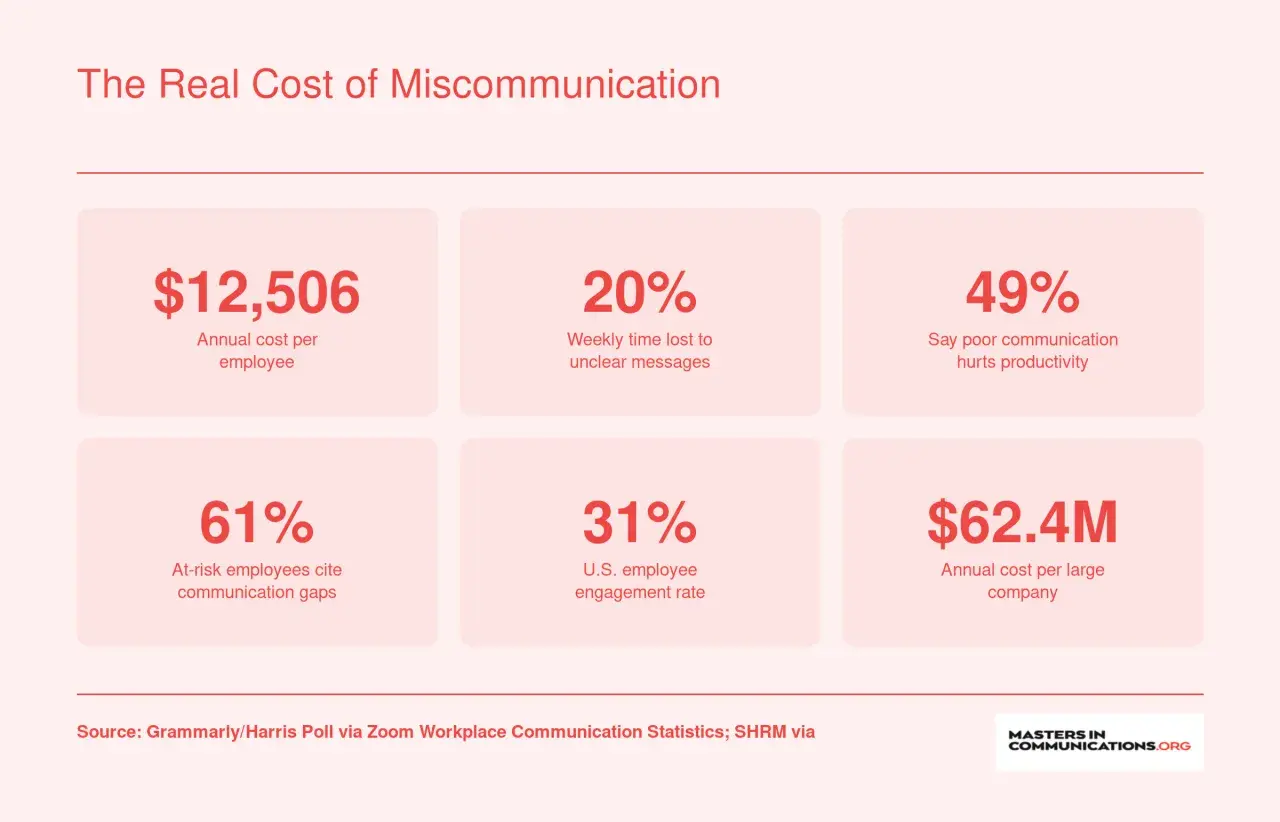
The real cost is not stylistic. It is operational. Confusing language slows response time, creates unnecessary follow-up, and sometimes shifts the burden of interpretation onto the least powerful person in the conversation. That is why I prefer to treat clarity as part of leadership, not just part of writing.
The good news is that better language does not require a complete rewrite of your communication culture. It usually starts with a repeatable editing process, which is easier to adopt than most teams assume.
A simple framework I use before sending anything
When I need a message to land cleanly, I run it through a short check before I send it. It takes less time than repairing a confused response later.
- State the point in one sentence. If you cannot do that, the message is not ready.
- Name the audience. Write for the person who has to act on it, not for the person who already understands it.
- Remove words that do not help the reader. Extra adjectives and soft filler often disappear without damaging the meaning.
- Add the action. Include the owner, the deadline, and the expected response whenever they matter.
- Read it aloud once. If it sounds stiff, vague, or oddly formal, the reader will probably feel that too.
This framework is especially useful in modern teams that rely on templates, AI drafts, and fast turnaround. Those tools can produce perfectly acceptable text, but they can also flatten voice and bury the actual ask. The human edit is where you restore judgment, specificity, and tone.
Once that habit is in place, the standard can rise from “clear enough” to “easy for anyone to use,” which is the level I would want in any inclusive workplace.
The standard I would set for a modern workplace
If I were shaping communication norms for a team, I would set a few non-negotiables. Use a shared glossary for recurring terms. Keep internal acronyms under control. Write templates that a new hire can understand without a private briefing. Make feedback specific enough to act on. And check that important messages still make sense when read by someone outside the core group.
That standard becomes even more important as more teams use AI to draft emails, updates, and policy language. Faster drafting is useful, but speed only helps when the final message still sounds like a human made choices about audience, fairness, and clarity. Otherwise, the organization ends up with polished text that does not actually communicate.
The version of workplace language that performs best is usually the least flashy one: precise enough to move work forward, inclusive enough to keep people in the conversation, and direct enough that nobody has to guess what happens next.