
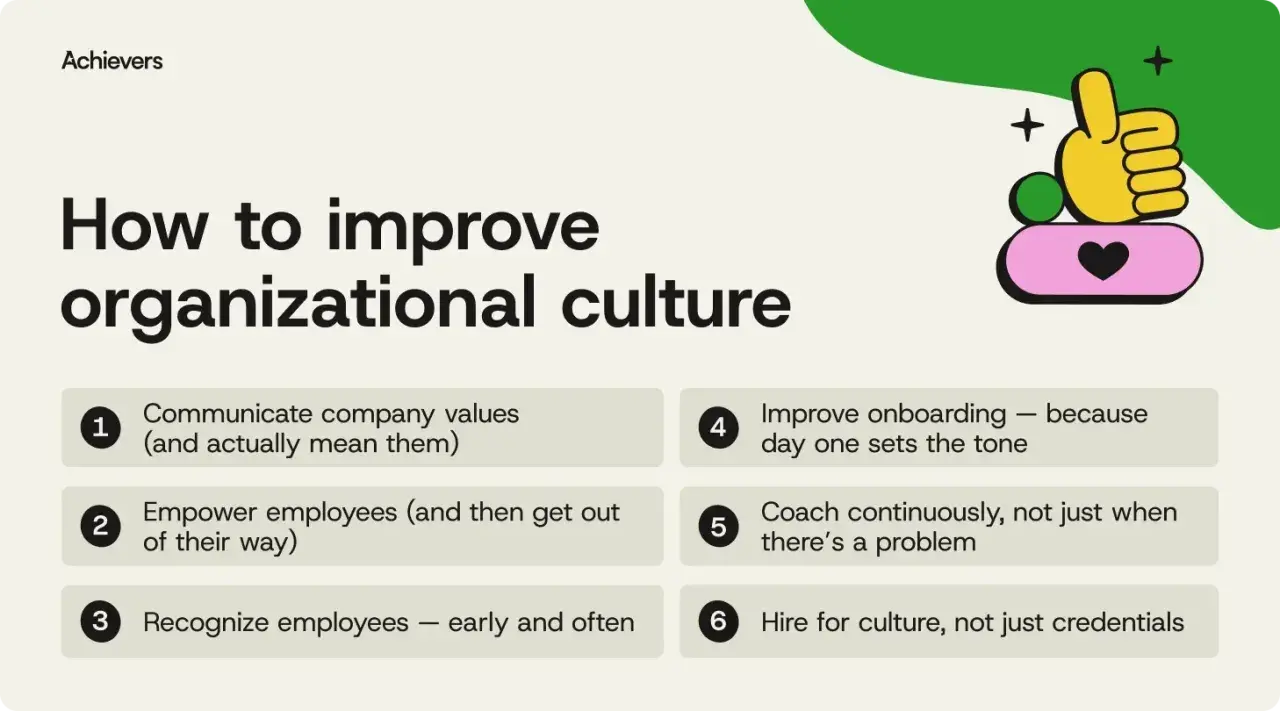
Company culture changes when everyday behavior changes. In practice, that means the way meetings run, how managers give feedback, what leaders reward, and whether people feel safe enough to speak honestly. This guide on how to improve company culture focuses on the moves that actually shift the day-to-day experience, especially in U.S. teams where hybrid work, turnover risk, and inclusion expectations can expose weak norms fast.
The fastest levers are leadership, routines, inclusion, and measurement
- Culture is the pattern of behaviors people repeat when no one is watching, not the wording on a values page.
- Leaders change culture faster through visible choices, promotions, and accountability than through slogans or one-off workshops.
- Psychological safety and inclusion are not side projects; they are core conditions for honest feedback, collaboration, and retention.
- Monthly pulse checks and quarterly reviews work better than vague annual sentiment surveys because they show what is actually changing.
- Small routines, such as structured 1:1s and decision memos, create a bigger culture shift than most expensive offsites.
What strong company culture looks like in practice
Culture is not what the company says about itself. It is what people learn to expect: how quickly decisions are made, whether disagreement is welcome, whether good work is recognized, and whether similar behavior is treated differently depending on status. If those signals are inconsistent, employees trust the informal rules, not the formal ones.
I usually look for culture in the places where pressure shows up first. A healthy culture does not mean everyone is always upbeat. It means people can raise a problem, ask for help, or challenge a decision without worrying that the room will punish them for it.
| Signal | Healthy pattern | Risk pattern |
|---|---|---|
| Decision making | Leaders explain the why, even when people disagree | Decisions appear suddenly and feel arbitrary |
| Meetings | More than a few voices are heard, and quieter people are invited in | The same senior voices dominate every discussion |
| Feedback | Feedback is specific, timely, and tied to growth | Feedback is delayed, vague, or only used during reviews |
| Recognition | People are praised for behaviors that reflect company values | Only revenue or visibility gets rewarded |
| Conflict | Tension is addressed directly and respectfully | Problems are avoided until they become performance issues |
Leadership behavior sets the tone faster than any policy
Culture change usually starts in the executive team and then either spreads or stalls. If leaders say collaboration matters but reward solo heroics, the organization will learn that collaboration is optional. If they say inclusion matters but allow senior people to interrupt, dominate, or dismiss others, the real culture becomes obvious very quickly.
One of the clearest lessons from the last few years is that managers matter more than many organizations admit. When manager behavior is weak, the whole system feels weaker. If a manager is unclear, inconsistent, or defensive, the team often experiences that as the company’s culture, even if the broader brand story says something else.
These are the leadership behaviors I would prioritize first:
- Say what matters and why it matters, especially when the answer is not popular.
- Model the behavior you want under pressure, not just in calm moments.
- Reward collaboration, not only individual output.
- Explain trade-offs behind decisions instead of hiding behind authority.
- Act quickly when a senior person violates the standard, because exceptions teach the organization what really counts.
Culture work gets much harder when leaders make one rule for everyone else and another for themselves. That is why I prefer to start with visible leadership habits before I touch training decks or engagement slogans. Once those habits are clear, the next layer is the set of routines people repeat every week.
Turn daily routines into cultural signals
Culture lives in repetition. If you want a calmer, more accountable, more inclusive workplace, I would start with the routines everyone touches rather than the rare events that look impressive on a slide.
In most companies, a few simple routines do more work than a long list of initiatives:
- Hold 1:1s every two weeks so managers can remove blockers, not just review task status.
- Share meeting agendas in advance so people can prepare and quieter voices have a fair chance to contribute.
- Use a round-robin in important meetings, where each person speaks in turn before open discussion starts.
- Adopt a short decision memo, which is a written note that explains the choice, the trade-offs, and the owner.
- Run a quarterly retro to decide what the team should stop, start, and continue.
- Recognize specific behaviors publicly, not just outcomes, so people see what the organization actually values.
These routines matter because they turn abstract values into visible habits. They also make culture less dependent on charisma, which is useful because charisma is not a management system. After that, the next step is to make sure the same routines work for everyone, not just the people who are naturally heard first.

Make inclusion and psychological safety part of the operating system
Inclusive leadership is not a separate topic from workplace culture. It is the test of whether your culture actually works for the full range of people in the organization. McKinsey’s 2025 Women in the Workplace report found that 84% of companies rank fostering an inclusive culture as a high priority, but a priority on paper is not the same thing as a lived experience. The practical question is simple: can people speak up, disagree, and ask for help without worrying that it will cost them status? That is psychological safety, and it matters because people rarely contribute their best thinking in environments where they expect embarrassment, punishment, or quiet retaliation.Here is where I would focus first:
- Share agendas early and invite dissent before the meeting starts, not after the decision is already made.
- Track who gets airtime in leadership meetings and who gets interrupted.
- Make sure stretch assignments and high-visibility projects are distributed fairly, not handed to the same inner circle.
- Train managers to respond to bad news without defensiveness, because the reaction to a mistake often matters more than the mistake itself.
- Review promotion and pay decisions for patterns that suggest some teams are applying different standards.
Inclusion fails when it is treated like messaging. It works when the organization changes who gets heard, who gets developed, and who gets trusted. If you want to know whether that is happening, you need evidence, not just a vibe check.
Measure culture with evidence, not just sentiment
I do not trust culture programs that cannot be observed. The right metrics are a mix of perception and behavior, because a team can sound positive in an all-hands and still be losing people, skipping feedback, or avoiding hard conversations.
A practical measurement stack usually looks like this:
| Indicator | What it shows | How often to review |
|---|---|---|
| Pulse survey results | Whether people trust leadership and feel connected to the work | Every 4 to 6 weeks |
| Retention by manager or team | Where the employee experience is breaking down | Monthly or quarterly |
| Internal mobility and promotion rates | Whether growth is accessible and fair | Quarterly |
| Meeting participation | Whether people feel safe enough to contribute | Monthly |
| Absenteeism and employee relations cases | Whether stress and friction are building beneath the surface | Monthly |
Keep the survey short. Five questions is often enough if you run it consistently and close the loop within two weeks. If you ask people for input and then disappear, the process damages trust instead of building it. Gallup notes that deeper culture change typically takes three to five years, even though some engagement improvements can appear within a year, so I always treat measurement as an ongoing discipline rather than a one-time audit. That leads naturally to the mistakes that quietly undo good intentions.
Common mistakes that drain trust and momentum
Most culture efforts fail for predictable reasons. The program looks thoughtful at launch, but the systems underneath stay unchanged. Employees notice the gap immediately, and once they do, the initiative starts to feel performative.
| Mistake | Why it fails | Better move |
|---|---|---|
| Launching a values campaign without changing behavior | People hear the message but see no proof | Attach each value to a visible behavior and a manager habit |
| Tolerating senior exceptions | One exempt leader can erase months of good work | Apply standards consistently, even when it is uncomfortable |
| Measuring happiness instead of trust and behavior | People may be polite while still disengaged or silent | Track participation, retention, and team-level patterns |
| Overloading managers with too many initiatives | Nothing gets embedded deeply enough to stick | Pick a few routines and reinforce them until they become normal |
| Ignoring hybrid and frontline realities | Different groups experience the culture in different ways | Design practices that work across locations, schedules, and job types |
I also see organizations overestimate the impact of one-off retreats. A good offsite can reset energy, but it cannot replace accountability, fair decisions, and consistent manager behavior. If the company’s daily systems still reward the wrong things, the retreat will fade fast. The better answer is a focused rollout that changes habits in a controlled sequence.
A 90-day culture reset that can actually stick
If I were rebuilding culture from a weak starting point, I would not try to change everything at once. I would choose a small number of visible moves, make them consistent, and then reinforce them until the organization can feel the difference.
- Days 1 to 30: Listen hard. Run a handful of manager and employee interviews, review retention and promotion patterns, and identify the two or three behaviors that are doing the most damage.
- Days 31 to 60: Change the routines. Update meeting norms, refresh the 1:1 template, define one decision process in writing, and show managers exactly what good looks like.
- Days 61 to 90: Reinforce and measure. Share what changed, what did not, and which leaders are modeling the new standard. Keep one or two metrics visible so progress does not become a vague feeling.
The real test is whether people can point to concrete differences after 90 days: clearer expectations, more balanced airtime, faster follow-through, and less fear in meetings. If those shifts appear, the culture is moving in the right direction. If they do not, I would go back to the routines and incentives before adding another initiative.
