
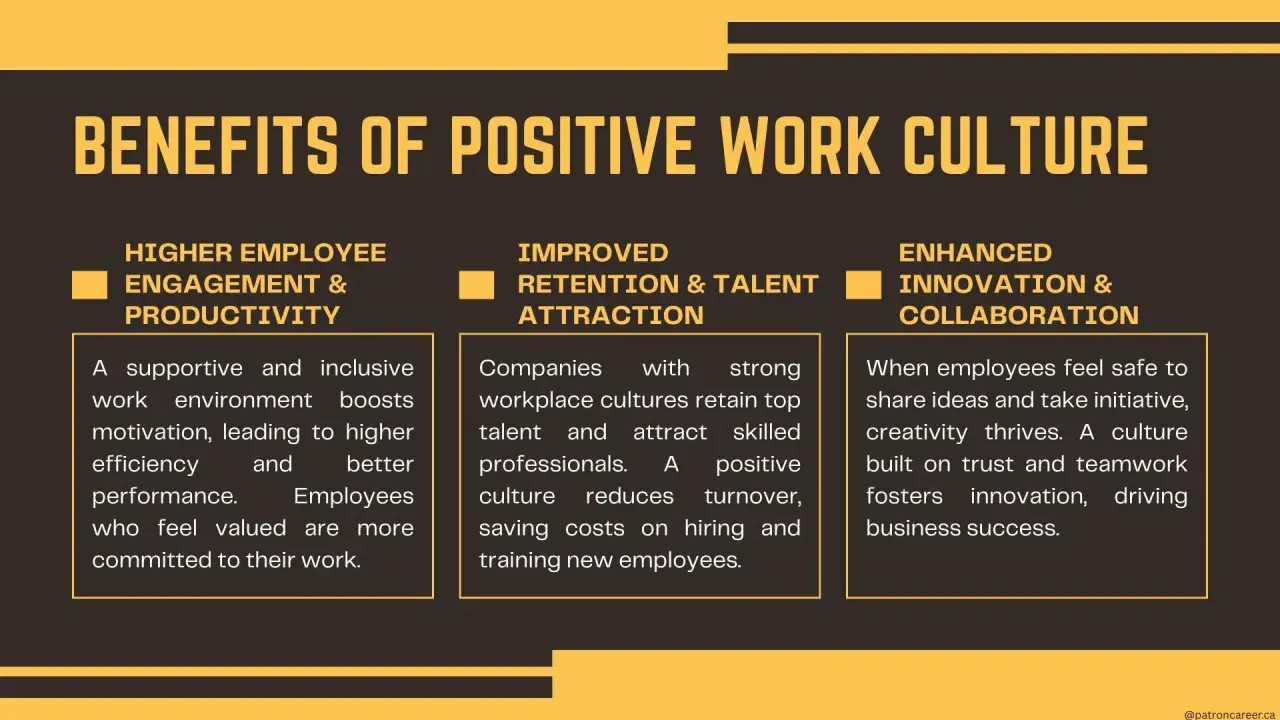
A positive work environment is less about perks and more about whether people can do useful work without fear, confusion, or constant friction. In practice, it shows up in clear expectations, respectful conflict, fair feedback, manageable workloads, and leaders who notice people as humans, not just output. In my experience, the teams that get this right make support ordinary rather than occasional, and that changes both performance and retention.
The healthiest teams make work feel clear, fair, and safe enough to speak up
- People need clarity, respectful communication, and realistic workload before any perk feels meaningful.
- The strongest lever is manager behavior because it shapes trust, feedback, and day-to-day fairness.
- Culture improves when employees can raise concerns without guessing how leaders will react.
- Inclusion is not separate from culture; it is part of how decisions, recognition, and growth work.
- The most useful metrics are engagement, regretted turnover, absenteeism, and internal mobility.

What a positive work environment actually looks like
When I audit workplace culture, I look for the daily signals first. A healthy atmosphere feels predictable, respectful, and human: people know what matters, how decisions get made, and where to go when something is off. It is not silent harmony. It is a place where disagreement stays useful, feedback is specific, and support does not depend on who you know.
| Signal | Healthy version | Warning sign |
|---|---|---|
| Clarity | Priorities are written down and stable enough to plan around. | Goals shift without explanation and people are forced to guess. |
| Conflict | Disagreement stays focused on the work, not the person. | Meetings turn political, sarcastic, or quietly hostile. |
| Inclusion | Different voices are invited in and actually shape decisions. | Only the loudest or most familiar voices get airtime. |
| Workload | Deadlines match capacity and trade-offs are explicit. | Overtime becomes normal and exhaustion is treated as commitment. |
| Feedback | Comments are timely, specific, and tied to growth. | People hear about problems only after they have escalated. |
If several warning signs show up together, the issue is usually not one bad week or one difficult manager. It is the operating system of the team. Once you can see that pattern, the business impact becomes much easier to understand.
Why this culture pays off for people and business
Recent U.S. engagement data shows only 31% of employees engaged and 17% actively disengaged. That matters because low engagement is rarely a personality issue; it is usually a symptom of missing basics like clarity, care, and development. When people do not feel anchored in the work, they spend more energy managing frustration than creating value.
The same pattern shows up in culture research. SHRM found that workers in positive organizational cultures are almost four times more likely to stay with their current employer, and that 83% of employees in good or excellent cultures are motivated to produce high-quality work, compared with 45% in poor or terrible cultures. Those are not soft outcomes. They are the difference between a team that compounds trust and one that quietly bleeds talent.
That is why I do not treat culture as a side topic. It influences turnover, collaboration, and whether people will speak up when something is broken. If the atmosphere is strained, every process becomes harder than it needs to be.
The five building blocks I would prioritize first
I usually think about culture through five lenses: protection from harm, connection and community, work-life harmony, mattering at work, and opportunity for growth. Worker voice and equity sit underneath all of them. Without those two, the whole framework becomes a slogan that works beautifully on slides and unevenly in real life.
Protection from harm
This is more than accident prevention. People need to know that bullying, discrimination, harassment, and retaliation will be taken seriously and handled quickly. Psychological safety matters here too: employees should be able to ask questions, raise risks, or disagree without being punished for honesty.
Connection and community
People stay where they feel seen. That comes from simple habits: managers following through, teammates helping each other, and meetings that leave room for quieter voices instead of rewarding only the fastest speakers. In inclusive teams, belonging becomes visible in everyday interactions, not just in company values.
Work-life harmony
Flexibility helps only when the workload is realistic. A strong culture does not shame people for taking leave, setting boundaries, or working in a way that fits their role. It also does not confuse availability with dedication. If everyone is always “on,” the team is probably running on strain, not commitment.
Mattering at work
Recognition has to be specific and credible. A generic “good job” does little; a precise note about the impact of someone’s work builds trust. People also need transparent decisions so they understand why priorities changed, why one idea moved forward, and how their contribution fits the bigger picture.
Read Also: Build a Coaching Culture - Your Guide to Workplace Impact
Opportunity for growth
Growth is not just training budgets. It is coaching, stretch assignments, access to meaningful projects, and a real path to advancement without having to leave the company. If a workplace keeps hiring ambitious people but offers no room to move, the culture will eventually feel stale, even if the benefits package looks strong.
If I had to choose one test for the whole framework, it would be this: can the least senior person and the least extroverted person still feel safe, useful, and able to grow? That answer reveals a lot more than a mission statement ever will. The manager layer is usually where that answer becomes real.
What managers need to do differently every week
Managers turn values into habits. I would rather see a manager do five ordinary things consistently than launch one big culture initiative and disappear. The useful habits are simple, but they are not casual.
- Set expectations in writing. People work better when they know what matters this week, what can wait, and what success looks like.
- Hold a short weekly check-in. Fifteen minutes is enough if the conversation covers priorities, blockers, and support needs instead of drifting into status theater.
- Invite a voice that has not spoken yet. In hybrid meetings especially, the people who are quiet are often the ones with the clearest view of risk.
- Give feedback within 48 hours when possible. Timely feedback is easier to use and less likely to feel punitive.
- Close the loop on every concern. If someone raises an issue and never hears back, silence becomes the lesson.
One question I like is, “What would make this week easier for you to do excellent work?” It is practical, not sentimental, and it surfaces problems before they harden into resentment. Small manager habits do not fix a broken system on their own, but they are the fastest way to make trust visible.
Mistakes that quietly undo good intentions
A lot of organizations say the right things and still damage trust every day. The most common mistake is confusing visible perks with real support. Snacks, swag, and themed events may be harmless, but they do almost nothing if the actual experience is chaotic or unfair.
- Perks without predictability. Free coffee does not offset shifting deadlines, vague priorities, or weekend work that nobody wants to name.
- Tolerating one high performer who creates fear. A single brilliant jerk can poison team norms faster than almost any process failure.
- Asking for feedback and doing nothing with it. When employees speak up and nothing changes, they stop trying.
- Making inclusion optional. If only certain people get heard, inclusion is just branding.
- Letting workload grow while recognition stays generic. Burnout feels inevitable when effort rises and support stays abstract.
- Applying rules inconsistently. People notice when flexibility, praise, and consequences depend more on the manager than on the policy.
The pattern is straightforward: whatever leaders tolerate becomes part of the culture. That is why values work only when leaders are willing to make them inconvenient in the short term. The next step is to measure whether those choices are actually changing anything.
How to know the culture is improving
I would measure culture with a small dashboard, not a long survey that nobody reads. The right metrics do not need to be complicated, but they do need to be reviewed regularly and taken seriously. Monthly or quarterly, I would track trust, retention, and load instead of only asking whether people “feel fine.”
| Metric | What it tells you | How often I would check it |
|---|---|---|
| Engagement pulse | Energy, clarity, and trust in the work environment | Monthly or quarterly |
| Regretted turnover | Whether valued people are leaving for avoidable reasons | Quarterly |
| Absenteeism and sick time | Workload strain and burnout risk | Monthly |
| Internal mobility | Whether growth is real or only promised | Quarterly |
| Complaint resolution time | Whether speak-up systems work in practice | Monthly |
One caution: a single better score does not prove the culture is fixed. I look for direction over two or three review cycles, and I pay attention when survey scores rise but exit interviews still sound defensive. That usually means the story is improving faster than the experience.
The signals I would watch over the next 90 days
If I were giving a leader a 90-day assignment, I would keep it small and visible: clarify expectations, train managers on feedback, check workload honestly, and make one speak-up channel easier to use. Then I would watch the daily signals, not the slogans.
- Do meetings have clearer agendas and fewer surprises?
- Are quieter voices being invited in, not just tolerated?
- Are managers closing the loop on issues within a week or two?
- Are recognition and promotion decisions explained well enough for people to trust them?
- Is overtime exceptional, or is it the hidden norm?
If those signals improve together, the culture is moving in the right direction. If they do not, the answer is usually not another perk or slogan; it is leadership discipline, workload realism, and fair treatment repeated until they become ordinary.
