
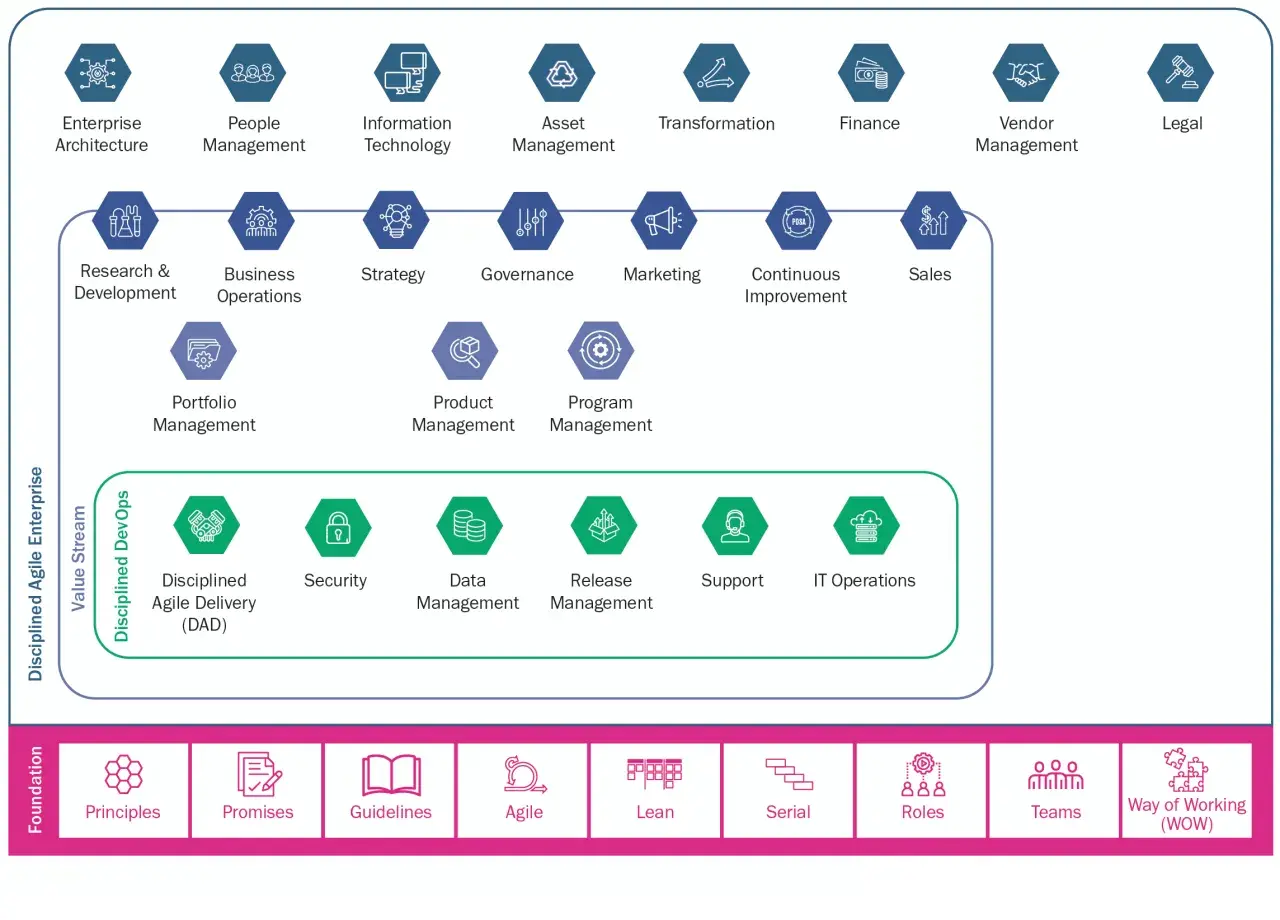
Scaling agile is less about copying team rituals and more about redesigning how strategy, funding, and decision-making flow across a large organization. What people call agile at scale only works when leadership changes the system around the teams, not just the ceremonies inside them. In 2026, the organizations that handle this well treat change as a permanent capability, not a one-time rollout.
What matters most before the first rollout
- Agile only scales when strategy, governance, and team design change together.
- Leadership has to move from command-and-control to clear priorities, fast decisions, and visible sponsorship.
- Psychological safety matters because scale amplifies silence, confusion, and bias.
- The best metrics track flow and outcomes, not just activity or velocity.
- Frameworks help, but only if they fit the organization’s operating model and change capacity.
What changes when agile moves beyond one team
In a small team, the mechanics are visible: one backlog, a few dependencies, and a direct line between effort and output. In a larger enterprise, the hidden system matters more than the ceremonies. The shift I watch for is from task coordination to value-flow coordination, where the organization cares less about who is busy and more about how quickly meaningful work reaches customers, employees, or other users.
| Area | Small-team agile | Scaled agile | Why it matters |
|---|---|---|---|
| Decision-making | Team members decide quickly inside clear boundaries | Decision rights are pushed closer to the work, with clear escalation paths | Slow approvals turn every dependency into a queue |
| Planning | One team plans around its own sprint or iteration | Multiple teams need a shared cadence and a common view of priorities | Without alignment, one plan collides with five others |
| Dependencies | A few handoffs are manageable | Dependencies become a design problem, not just a coordination problem | Too many handoffs create delay, rework, and frustration |
| Leadership | Managers mostly support one team’s execution | Leaders shape funding, governance, and the conditions for learning | Executive behavior determines whether the change sticks |
| Metrics | Velocity and task completion can be useful locally | Flow, predictability, customer impact, and employee health matter more | Output can rise while value stays flat |
Why strategy has to lead the transformation
I never start with training materials. I start with the strategic outcomes the organization actually needs, because a large-scale agile effort should improve how strategy turns into action. A value stream is the path work follows from idea to delivered value, and if that path is unclear, teams can be busy for months without creating much that matters.
Before I would call a scaling effort ready, I want clean answers to a few questions:
- Which business outcomes matter most in the next two to three quarters?
- Which decisions need to move closer to the teams, and which must stay centralized?
- Which work can be organized around products or services, and which is better handled as shared support or governance?
- Where are the slowest approvals, the costliest handoffs, and the biggest hidden dependencies?
- What funding model will support smaller bets instead of locking everything into one annual plan?
Once those answers are visible, the organization can choose structure instead of improvising around confusion. That clarity is what makes the human side of change easier to manage.
The human side of change is where most transformations stall
The pattern is familiar: leaders announce the shift, teams nod along, and then old habits reappear the moment pressure rises. The thing that changes that pattern is not a prettier slide deck. It is repeated sponsorship, manager involvement, and a culture where people can say what is broken without fear.
Inclusive leadership matters here more than most transformation plans admit. If only the loudest voices shape planning or retrospectives, the organization loses signal before it loses speed. I pay close attention to whether the environment supports psychological safety, meaning people can speak up, challenge ideas, and admit mistakes without being punished or embarrassed.
- Explain the reason for change every time the cadence repeats, not just at launch.
- Give middle managers a real role as coaches, blockers-removers, and translators of priorities.
- Use short feedback loops, often two to four weeks, so teams can learn without waiting for a huge release.
- Collect input in more than one format, because not everyone contributes best in a live meeting.
- Make dissent visible and safe, especially when teams are diverse in background, role, or communication style.
When teams are diverse, scale can either widen the range of useful perspectives or flatten them into silence. The difference comes down to whether leaders design for participation, not just attendance. That is where the choice of scaling approach starts to matter.

Pick a scaling approach that fits the organization, not the other way around
I would not choose a framework because it is fashionable. I choose it based on the constraints in front of me: how many teams are involved, how much governance the business needs, how complex the dependencies are, and how much change capacity the leadership team really has.
| Framework | Best fit | Strength | Trade-off |
|---|---|---|---|
| SAFe | Large portfolios, heavy coordination, strong governance requirements | Creates alignment, shared cadence, and portfolio visibility | Can become heavy if people treat it like compliance instead of a way of working |
| Scrum@Scale | Organizations with strong Scrum teams that need lighter cross-team coordination | Extends existing Scrum practice without adding too much structure | Less prescriptive when you need tighter funding or governance changes |
| LeSS | Groups willing to simplify around one product focus and fewer layers | Minimal rules, strong product orientation, fewer artifacts | Requires deeper structural change, not just training |
| Disciplined Agile | Enterprises that need tailoring across functions and contexts | Flexible and practical across development, finance, HR, and governance | Easy to over-customize unless leaders keep discipline around outcomes |
None of these frameworks removes the need for leadership. The right one simply gives you a better starting point for the organization you already have. After that, the real test is whether the metrics show that the change is helping.
Metrics that show whether the change is real
Velocity can be useful inside a single team, but it is a weak enterprise metric. I prefer measures that show whether work is flowing, whether decisions are getting faster, and whether users or employees are actually feeling the difference. If output goes up while lead time, quality, and outcomes stay flat, the organization is optimizing activity instead of value.
| Metric | What it tells you | Healthy signal | Warning sign |
|---|---|---|---|
| Lead time | How long it takes for work to move from request to value | Shorter, more predictable cycles | Work waits in queues even when teams are busy |
| Decision latency | How fast blockers are resolved | Decisions happen close to the work | Approvals pile up at the top |
| Flow efficiency | How much time is spent moving value versus waiting | Less waiting, fewer handoffs, cleaner flow | Teams spend more time coordinating than delivering |
| Rework or escaped defects | Whether quality survives integration and release | Fewer late surprises and less blame | Fixes appear late and keep repeating |
| Employee pulse or retention | Whether people can sustain the pace of change | Stable or improving engagement | Burnout, cynicism, or quiet withdrawal |
| Outcome movement | Whether the change is actually helping users or the business | Adoption, satisfaction, or service results improve | Lots of delivery activity, little real impact |
Those signals tell me more than a dashboard full of tasks ever will. They also expose the common failure modes early enough to fix them.
The mistakes I see most often
- Agile theater - ceremonies change, but funding, hierarchy, and decision rights stay exactly the same.
- Centralized bottlenecks - every important decision still waits for the same few executives.
- Dependency sprawl - teams are called cross-functional, but they still need three other departments to finish basic work.
- Manager exclusion - people managers are told to step aside instead of being retooled as coaches and problem-solvers.
- Inclusion blind spots - the same voices dominate every discussion, and quieter people stop contributing.
- Tool-first change - the organization buys dashboards and boards before it changes how work actually moves.
I watch for these patterns because they tell me whether the organization is changing its operating system or just its vocabulary. If you want the change to stick, the first 90 days matter more than the launch announcement.
A 90-day start that keeps the change honest
- Pick one value stream and one business outcome to improve first.
- Map the main handoffs, approval points, and decision bottlenecks before you touch the framework.
- Define who owns priorities, who removes blockers, and who provides governance.
- Set a small set of metrics up front so the pilot is judged on flow and outcomes, not slogans.
- Run the pilot long enough to learn from two to four iterations, then adjust structure before you spread it wider.
If I had to reduce the whole approach to one rule, it would be this: scale only the parts of the organization that can absorb change, and remove the blockers that slow learning. That is how agile becomes an operating model instead of a one-time transformation.
