
Will AI take over project management? My view is that it will take over a meaningful slice of the routine work, but not the leadership, judgment, or trust that make projects succeed. This article breaks down what AI can already do, what still needs a human project manager, and how teams can adopt the technology without weakening culture or inclusion.
AI will change project management more than it will replace it
- AI is strongest at repetitive, data-heavy work like notes, drafts, scheduling, and first-pass risk detection.
- Human project managers still own accountability, stakeholder alignment, conflict resolution, and trade-offs.
- The role is shifting from coordination toward strategy, change leadership, and decision design.
- Most organizations are still early in GenAI adoption, so guardrails matter more than hype.
- Inclusive rollout matters because AI can widen capability gaps if training and review are uneven.
The short answer is no, but the role will change fast
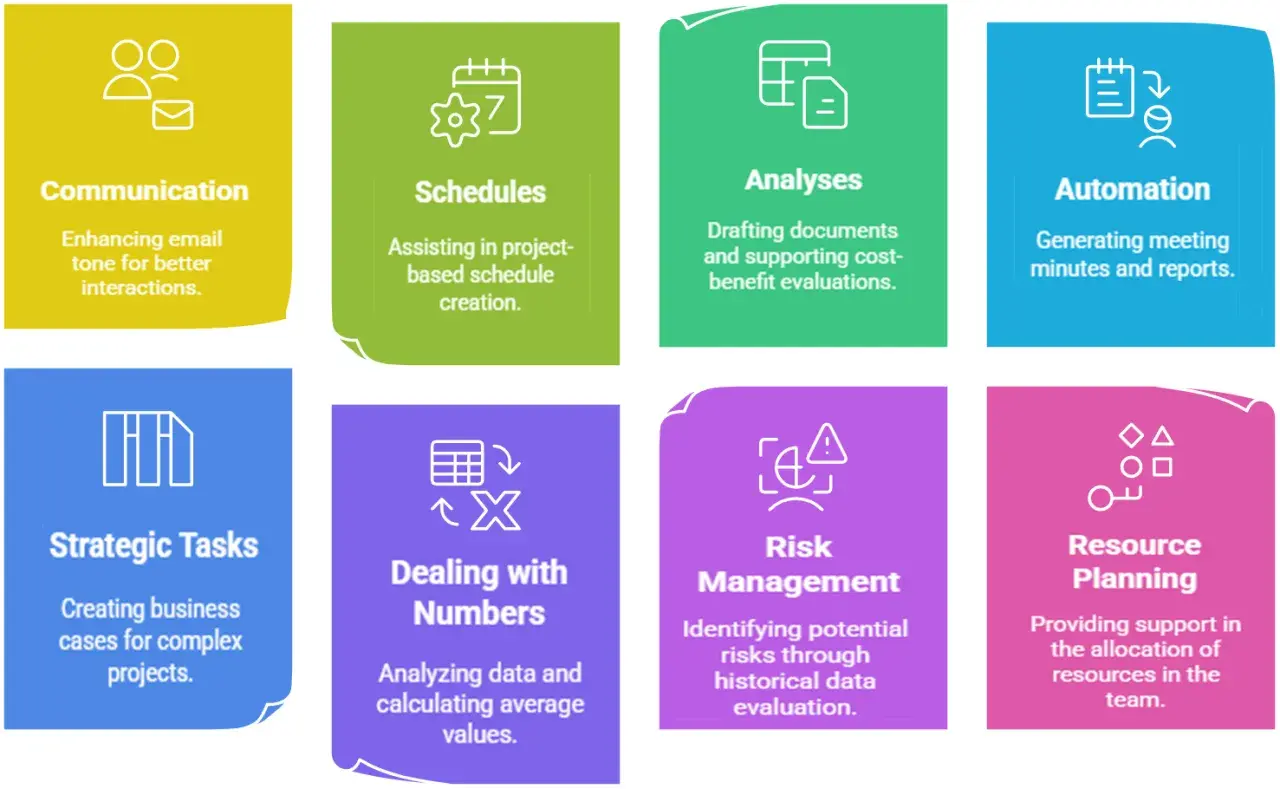
AI is already absorbing the low-friction layer of project work: meeting notes, status drafts, task summaries, schedule suggestions, and early risk flags. That does not add up to a full replacement, because project management is not just moving information around. It is making decisions when priorities conflict, people disagree, or the data is incomplete.
PMI cites a forecast that 80% of project management tasks could be run by AI by 2030, but tasks and roles are not the same thing. BCG also expects 50% to 55% of U.S. jobs to be reshaped by AI over the next two to three years, which is a better lens for this shift: the work gets redesigned first, and only then do job boundaries move. That is why the useful question is not whether AI wins outright, but which parts of the job it can safely absorb.
Once you look at the work through that lens, the real picture becomes much clearer.

Where AI is already useful in project management
AI is strongest where the work is repetitive, pattern-based, and easy to verify. In those situations, it can save time without taking away accountability. I would break the current use cases into a few practical buckets.
| Task area | What AI does well | What still needs a human |
|---|---|---|
| Status reporting | Drafts weekly updates from project data, meeting notes, and tool activity | Checks accuracy, explains context, and chooses what to escalate |
| Meetings | Transcribes, summarizes, and extracts action items | Drives alignment, resolves disagreements, and confirms commitments |
| Risk tracking | Flags anomalies, delays, and missing dependencies | Judges severity and decides when a risk needs action now |
| Scheduling and resourcing | Suggests scenarios and highlights overloads | Balances priorities, politics, and people constraints |
| Documentation | Drafts charters, plans, and meeting follow-ups | Validates the final version and ensures it matches reality |
| Knowledge retrieval | Finds similar past projects and patterns in historical work | Decides whether the old pattern still applies now |
One term that comes up a lot here is human-in-the-loop, which simply means a person reviews, edits, or approves the output before it affects a real decision. That pattern is especially useful for project work because it keeps speed without surrendering judgment. The value is not only time saved. It is also fewer context switches, less manual copy-paste work, and faster visibility for everyone involved.
The harder question is what happens when the work stops being routine.
What AI still cannot replace
Project management gets difficult when the work becomes political, ambiguous, or emotionally charged. AI can summarize a disagreement, but it cannot read the room, decide which compromise protects the business, or rebuild trust after a missed deadline. Those are human responsibilities, and they stay human because they depend on context that is only partly written down.
- Stakeholder negotiation and conflict resolution
- Priority trade-offs when budget, scope, and time all collide
- Sense-making when the data is incomplete or contradictory
- Accountability for decisions with real business impact
- Change adoption, especially when teams are resistant or anxious
There is also a culture issue. If AI is allowed to write the story of a project without human review, it can flatten nuance and quietly amplify bias in resource allocation, performance narratives, or whose concerns get amplified. In practice, that means weak AI governance is not just a technical problem. It is a leadership problem, and often an inclusion problem too. That is where the role starts to shift from coordination into strategy.
The real shift is from coordinator to strategist
In 2026, the strongest project managers are not competing with AI on clerical speed. They are using AI to protect attention for higher-value work: sequencing decisions, aligning sponsors, choosing what not to do, and translating strategy into execution. That is a different job shape, and it rewards people who can move comfortably between delivery detail and business outcomes.
From status chasing to decision design
Old-school project coordination often meant collecting updates, reconciling spreadsheets, and keeping everyone on the same page by hand. AI takes a lot of that burden away. What remains is more strategic: deciding which signal matters, which exception deserves escalation, and which trade-off best supports the business goal. In other words, the project manager becomes less of a messenger and more of an operating rhythm owner.
Read Also: Improve Organizational Performance - 6 Levers for Real Growth
When the project itself is about AI
The job gets even more demanding when the project is an AI initiative. Then the PM has to think about data quality, privacy, model risk, review cycles, user trust, and adoption across the business. That is a very different exercise from using AI to draft a status report. It requires stronger cross-functional leadership because the project is not only delivering software or process change. It is also changing how decisions get made.
That makes the implementation question just as important as the technology question.
How to introduce AI without damaging trust or inclusion
If I were rolling this out on a real team, I would start small and be explicit about guardrails. Teams usually lose trust when AI appears as a silent productivity mandate instead of a documented change in workflow. The rollout needs to feel controlled, useful, and fair.
- Pick low-risk use cases first, such as meeting notes, status drafts, action tracking, and simple risk summaries.
- Define what must always be reviewed by a human, including external communication, budget changes, scope commitments, and people decisions.
- Standardize inputs so the model works from the same source of truth: project brief, milestones, decision log, and risk register.
- Train for verification, not just prompting. A good PM needs to know when AI is probably right and when it is confidently wrong.
- Measure outcomes that matter: cycle time, rework, predictability, stakeholder satisfaction, and team load.
That last point matters for workplace culture. If only the loudest or most technically confident people benefit, AI becomes a capability gap instead of a productivity gain. Inclusive leadership means the tools, training, and review process are accessible to the whole team, not just early adopters. It also means making sure AI does not become a shortcut for ignoring quieter voices or edge cases that do not fit the pattern.
Once that foundation is in place, the operating model becomes much easier to define.
What the best teams will do next
The strongest teams will not argue about whether AI is a threat. They will redesign project work so software handles the repetitive layer and people keep the judgment layer. That means setting clear boundaries, documenting approvals, and treating AI as part of the delivery system rather than a novelty tool.
- AI drafts first passes; humans own the final call.
- AI flags patterns; PMs decide what the patterns mean.
- PMOs set rules for data, approval, and recordkeeping.
- Leaders watch for bias in prioritization, staffing, and reporting.
- Teams keep a decision log for major scope, cost, or timing changes.
In practice, that model is boring in the best possible way: clear, auditable, and easy to improve. It also scales better than heroic manual coordination, which is still how many teams operate before they formalize AI use.
The most realistic answer is that AI will not take over project management as a profession, but it will reshape the job enough that old habits stop working. The winners will be the people and organizations that use AI to remove friction, protect human judgment, and build a more inclusive way of delivering work. That is less dramatic than replacement, but far more useful.
