
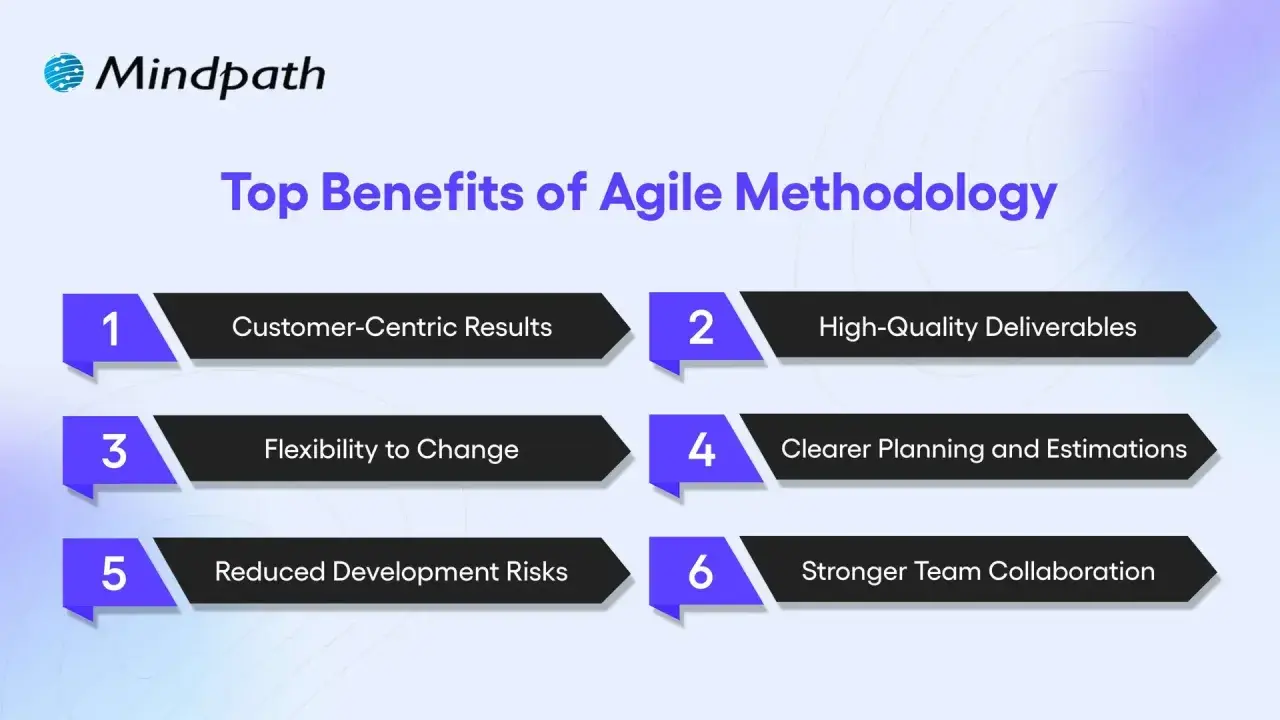
Agile is less about ceremonies and more about how teams make decisions when the work is uncertain. The benefits of agile become clearest when priorities shift, feedback arrives early, and people need a way to keep shipping without pretending the plan will survive unchanged. In this article I break down the practical advantages, where agile helps most in project management and development, and where it only works if the team culture supports it.
Key points at a glance
- Agile works best when the goal is to adapt quickly without losing control of scope, quality, or stakeholder trust.
- The biggest gains usually come from shorter feedback loops, clearer priorities, and lower risk of late-stage surprises.
- In change-heavy projects, agile is strongest when leaders protect focus, remove blockers, and keep outcomes visible.
- Agile is not a shortcut for vague planning; it still needs disciplined ownership and real decision-making authority.
- The method pays off most when the team can learn from feedback and when different voices can shape the work early.
Why agile fits strategy and change better than rigid plans
Strategy work rarely fails because people lack ambition. It fails because the plan assumes too much certainty. I see agile as a way to treat a roadmap as a living hypothesis: define the outcome, ship a small slice, learn from what actually happens, then adjust before the cost of being wrong grows.
That matters in change-heavy environments because priorities shift for real reasons, not because anyone is being indecisive. A market moves, a policy changes, a customer behavior changes, or a leadership team sees new evidence. In that setting, the value of agile is not speed for its own sake; it is controlled adaptability. Once you see it that way, the conversation moves from “Can we follow the plan?” to “Can we keep making good decisions as the plan evolves?”
That shift in mindset is why the first wins usually show up inside the team itself before they show up in a dashboard.
The team-level gains that show up first
The earliest gains are usually practical rather than dramatic. I see them in three places more than anywhere else: clearer priorities, shorter feedback loops, and fewer late surprises.
- Better prioritization - a visible backlog forces tradeoffs and reduces the illusion that everything matters equally.
- Faster feedback - reviews expose weak assumptions while the work is still cheap to change.
- More ownership - cross-functional teams finish outcomes together instead of passing work through silos.
- Lower rework - smaller increments make defects and missing requirements easier to catch.
- Less status chasing - transparency lets leaders spend more time removing blockers and less time asking for updates.
There is also a cultural effect that leaders sometimes miss: people are more willing to surface a problem early when the process expects adjustment instead of perfection. In inclusive teams, that matters a lot. When the format rewards participation rather than hierarchy, quieter voices have a real chance to shape the outcome, and the work tends to improve because of it.
Those gains are easier to explain when you compare agile with a more predictive approach side by side.

Where agile changes project management and development work
For project managers, agile changes the job from enforcing a fixed plan to managing flow, decisions, and risk. For developers, it changes the pace of feedback and makes quality a shared responsibility instead of a late-stage inspection.
| Project challenge | What agile changes | Why it matters |
|---|---|---|
| Shifting requirements | Work moves through a backlog instead of a one-time plan | The team can respond before a change becomes expensive |
| Slow feedback | Teams review increments every cycle | Bad assumptions are corrected early |
| Long handoffs | Product, design, engineering, and operations plan together | Misunderstandings surface sooner |
| Late quality checks | Testing and review happen continuously | Defects do not pile up until the end |
| Stakeholder drift | Regular demos keep decision-makers involved | The team builds the right thing, not just a finished thing |
This is why agile works so well in environments where the answer is not known up front. It lets a team learn without freezing the work, which is exactly what most strategy and change initiatives need. The same structure also creates a better place for different voices to be heard, which brings me to the workplace culture side of the story.
What agile looks like in an inclusive workplace
Agile only delivers its full value when the team can speak honestly. That is where inclusive leadership matters. A retrospective should not be the loudest person repeating what everyone already said. It should be a structured conversation where quieter contributors, remote colleagues, and people with different communication styles can shape how the team works next. If the goal is a more diverse and equitable work environment, agile rituals only help when every participant can influence the work, not just observe it. When that happens, the team gets psychological safety, which simply means people can raise a risk or admit a mistake without fear of being punished for it.
- Make information visible - keep the backlog, decisions, and success criteria in plain view so nobody has to guess.
- Rotate facilitation - it reduces hierarchy and gives more people a chance to influence the process.
- Use written prep - a short pre-read helps people think before they speak, which improves participation.
- Focus on behavior, not personalities - the point of a retro is to improve the system, not to turn feedback into a blame session.
- Measure outcomes, not presence - hours in meetings are not the same thing as progress.
When teams are diverse, this structure matters even more. A good agile process gives people room to disagree early, which is usually cheaper and healthier than forcing false alignment. The catch is that agility only helps when the surrounding system can actually support it.
Where agile pays off less than people expect
I would be cautious about promising agile everywhere. If requirements are fixed by regulation, if dependencies run through many external teams, or if leaders want the benefits without granting any decision-making authority, the model can become frustrating fast. In that situation the problem is often not the method; it is the mismatch between the method and the operating model.
- Highly regulated work often needs more documentation and signoff than a pure agile team would prefer.
- Hardware-heavy or dependency-heavy programs can move slower than software teams, so iterations need tighter coordination.
- Weak governance can turn “flexible” into “uncontrolled,” which is not agility.
- Unclear ownership makes backlogs noisy and priorities political.
In those cases I usually recommend a hybrid approach: keep the iterative learning loop, but add the planning, audit trail, or milestone discipline the context really needs. That is more honest than pretending a single method solves every kind of change. Once the boundaries are clear, implementation becomes a matter of discipline rather than slogans.
How I would roll it out in a real change initiative
If I were leading a strategy or transformation effort, I would not start by adding more ceremonies. I would start by shrinking uncertainty.
- Define one business outcome - for example, reduce onboarding time, improve adoption, or shorten release cycles.
- Break the work into small releases - short cycles make learning visible and keep the team from betting everything on one launch.
- Keep the backlog tied to value - every item should connect to the outcome, not just to activity.
- Review with real stakeholders - demos are more useful when decision-makers see the actual increment, not a status report.
- Use one small metric set - I prefer one outcome metric, one delivery metric, and one quality metric so the team does not drown in dashboards.
- Retrospect every cycle - the point is to change how the team works, not just to note what happened.
The pattern is simple: define, deliver, inspect, adapt. What makes it powerful is not the ceremony itself, but the discipline to keep learning public and actionable. That is the real test of whether a team is becoming agile or merely using agile language.
What I check before I call a team truly agile
Before I say a team is getting the full value of iterative work, I look for three signs: priorities that can change for a reason, a team that can act on feedback quickly, and leaders who remove blockers instead of collecting updates. If those are missing, the process may look agile but the organization is still behaving like a rigid hierarchy.
The most practical question is not whether the team uses sprints, standups, or boards. It is whether people can learn fast enough to avoid expensive mistakes and whether different voices can influence the work before decisions harden. When that is true, agile does more than speed up delivery; it gives strategy a way to stay connected to reality as change unfolds.
