
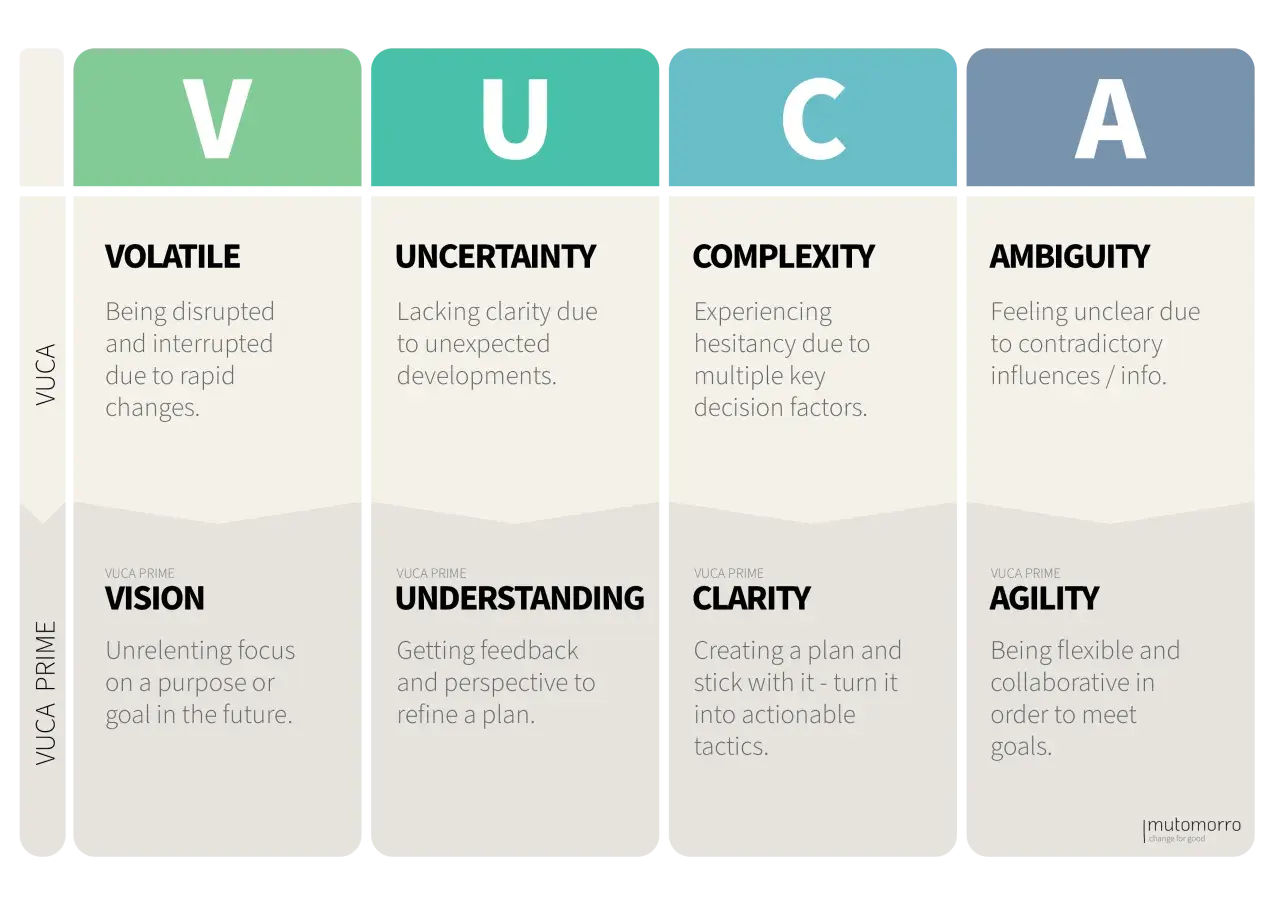
The practical answer to what does VUCA stand for is volatility, uncertainty, complexity, and ambiguity, but the useful answer goes a step further. VUCA is a way to describe why plans, decisions, and communication break down when the environment shifts faster than people can adapt. I use it as a strategy and change lens because it explains both the business problem and the human one.
Here is the practical meaning behind the VUCA framework
- VUCA stands for volatility, uncertainty, complexity, and ambiguity.
- It is most useful as a leadership framework, not as a buzzword.
- Each letter points to a different challenge, so each one needs a different response.
- In change work, clear communication and decision rights matter as much as the plan itself.
- Inclusive teams usually handle VUCA better because they surface weak signals earlier.
What each part of VUCA means in plain English
When I break the framework down, I do not treat the four letters as synonyms. They describe different kinds of pressure, and confusing them leads to bad strategy. Volatility is about speed and size of change, uncertainty is about not knowing what will happen next, complexity is about too many connected moving parts, and ambiguity is about mixed signals that can be read in more than one way.
| Letter | Meaning | What it looks like at work | What leaders need to do |
|---|---|---|---|
| V | Volatility | Sudden swings in demand, staffing, policy, or technology | Shorten planning cycles and build faster review points |
| U | Uncertainty | Limited information about timing, impact, or direction | Separate what is known from what is still an assumption |
| C | Complexity | Many interdependent systems affecting one another | Map dependencies and avoid oversimplified fixes |
| A | Ambiguity | The same situation can be interpreted in different ways | Test interpretations before locking in a response |
The U.S. Army War College helped popularize the term in strategic thinking, and that origin still matters because it reminds us that VUCA was never meant to be decorative language. It was a response to environments where old patterns stopped working reliably. Once you see the four parts separately, it becomes much easier to decide which one you are actually dealing with, and that leads directly to better strategy.

Why the framework matters for strategy and change
VUCA is useful because it exposes the limits of rigid planning. A traditional annual plan assumes the environment will stay stable long enough for the plan to hold. In a VUCA setting, that assumption is weak. The answer is not to stop planning; it is to plan differently, with more iteration, more feedback, and more room to adjust.
I think of VUCA as a warning against fake certainty. If leaders pretend they know more than they do, they usually end up with slow decisions, brittle communication, and frustrated teams. If they admit the level of uncertainty early, they can make better tradeoffs, set clearer priorities, and move faster on the things that actually matter.
This is also where change management becomes real. People do not resist change only because they are stubborn. They resist it when the change is unclear, the stakes are hidden, or the reasoning is not shared. In other words, VUCA is not just about markets or technology. It is about how people experience change inside the organization, especially when communication is vague or uneven. That is why the next question is not whether leaders should respond, but how.
How I would respond inside a team or organization
My default response to VUCA is to make the system more legible. That means reducing avoidable confusion, tightening decision loops, and giving people enough context to act without waiting for top-down approval. In a healthy workplace culture, this also includes inclusive leadership practices, because diverse teams notice blind spots earlier and challenge weak assumptions before they become expensive mistakes.
| Traditional response | VUCA-friendly response | Why it works better |
|---|---|---|
| One big plan for the entire year | Rolling plans reviewed at regular intervals | Lets the team adjust to new information without starting from zero |
| Everything escalates to senior leaders | Clear decision rights at the lowest sensible level | Speeds action and reduces bottlenecks |
| General updates with little context | Specific communication about what is known, unknown, and next | Reduces rumor, anxiety, and second-guessing |
| Top-down certainty even when facts are incomplete | Transparent acknowledgment of risk and assumptions | Builds credibility and trust |
| Uniform messages for every group | Tailored communication for different teams and roles | Respects that people are affected differently by the same change |
Three practical tools help here. First, scenario planning, which means mapping several plausible futures instead of betting everything on one prediction. Second, feedback loops, which are regular checkpoints that tell you whether the change is working. Third, psychological safety, which is the level of trust people need to speak honestly without fear of punishment. When those three are in place, teams usually cope with volatility and ambiguity much better. That leads straight into the mistakes I see most often.
Common mistakes that make VUCA harder than it needs to be
The biggest mistake is treating VUCA like a slogan instead of a decision-making tool. If a leader names the problem but does not change how the team works, the acronym becomes wallpaper. I also see organizations use VUCA as an excuse for chaos, as if complexity means anything goes. It does not. It means the rules for making decisions need to be sharper.
- Confusing speed with progress and making rushed decisions that are hard to reverse.
- Trying to remove all uncertainty before acting, which usually causes delay.
- Centralizing every decision, which slows response time and demotivates local experts.
- Using jargon to sound strategic while avoiding practical change.
- Ignoring the human side of change, especially anxiety, fatigue, and loss of control.
- Assuming one communication style works for everyone, which often leaves parts of the workforce underinformed.
There is a cultural angle here too. In my experience, teams with low trust turn uncertainty into silence, and silence turns small problems into large ones. Teams with better inclusion habits usually handle ambiguity more cleanly because people are more willing to ask hard questions early. Once those mistakes are visible, the next step is to use the framework in a simpler, more disciplined way.
The simplest way to use VUCA without hiding behind jargon
If I were advising a leadership team, I would keep the response plain and operational. Start by naming the kind of pressure you are under. Then separate facts from assumptions. After that, decide which actions need central approval and which ones can move locally. The goal is not to control the whole environment. The goal is to make the organization more adaptive.
- Define the change in one sentence.
- List what is known, what is unknown, and what is likely.
- Assign decision rights so people know who can act.
- Set a review cadence instead of waiting for a perfect plan.
- Explain the change in language different teams can use.
- Ask for dissent early, especially from people closest to the work.
I still prefer VUCA over newer acronyms when I need a clean, practical way to talk about strategy and change. It is broad enough to be useful, but specific enough to guide action. If you remember only one thing, make it this: VUCA does not tell you to predict the future better; it tells you to build an organization that can respond better. That is where strategy becomes real, and where a strong workplace culture starts to matter most.
