
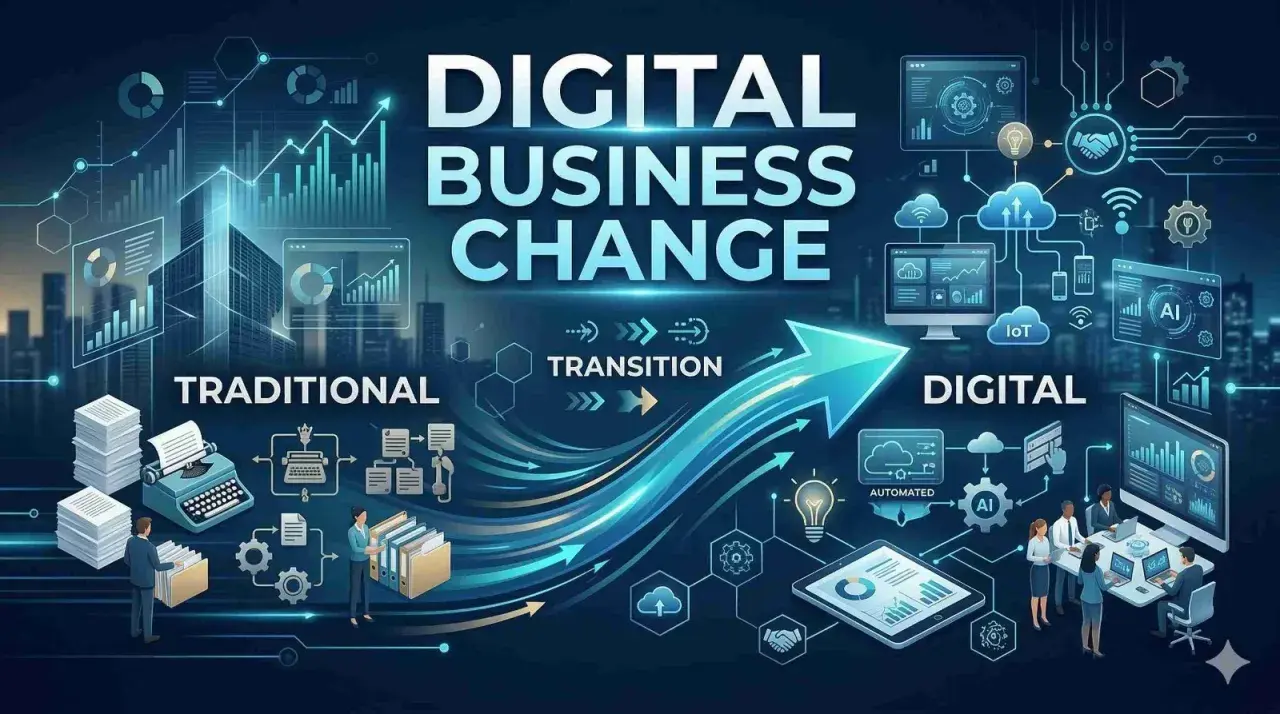
Corporate digital training works best when it is tied to a real business shift: a new system, a leadership reset, a process redesign, or a culture change that people must live out in their daily work. I usually treat it as a change tool, not a content library, because the goal is not course completion but faster adoption and better decisions. In this article, I break down how to design the program, choose the right formats, build manager support, and measure whether learning is actually changing behavior.
What matters most when learning has to support change
- Start with the business change and the behaviors it requires, not with the platform.
- Use different learning paths for different roles, because managers, frontline employees, and specialists rarely need the same depth.
- Blend self-paced learning, live practice, and manager reinforcement so the new behavior survives launch week.
- Measure adoption and application, not only completion rates.
- Design for accessibility and different work patterns if you want the rollout to reach the whole workforce.
Start with the change, not the platform
The first question I ask is simple: what should people do differently after the training? If the answer is vague, the program will be vague too. LinkedIn’s 2025 Workplace Learning Report found that 68% of employees said learning helps them adapt during times of change, and 91% of L&D professionals said human skills are increasingly important, which tells me the best programs are both practical and human.
- What behavior has to change? For example, using a new approval flow, leading different conversations, or following a new service standard.
- Who needs to change first? Managers often need to move before everyone else because they translate the change for their teams.
- Where will resistance appear? Resistance usually shows up where the change slows work, adds uncertainty, or removes familiar shortcuts.
Once I can answer those questions, I can design learning that supports the change instead of distracting from it. That clarity makes it much easier to match the learning design to the kind of shift the company is facing.
Map the learning design to the type of change
Not every change deserves the same learning treatment. A software rollout can often be handled with guided practice and short refreshers, while a shift in leadership behavior usually needs discussion, coaching, and repetition. The mistake I see most often is using one generic module for everything.
| Type of change | What people need | What usually works | Common failure |
|---|---|---|---|
| New software or workflow | Task-level steps and error recovery | Short modules, sandbox practice, job aids | Too much theory, not enough practice |
| Process redesign | Decision rules and handoffs | Scenario walkthroughs, team sessions | Employees know the steps but not the exceptions |
| Leadership or culture change | Behavior examples and conversation skills | Manager coaching, role play, peer discussion | One-off training with no follow-up |
| Compliance or risk update | Clear rules and consequences | Mandatory e-learning with check-for-understanding | People click through without absorbing the nuance |
| Restructuring or integration | Role clarity and shared language | Phased communication, FAQ hubs, live Q&A | Rumors fill the gap left by silence |
This is where strategy matters. Once the learning format matches the change type, the program feels more relevant and less like extra homework. From there, I move to the delivery mix, because format drives how much of the message actually sticks.

Choose formats that fit how adults actually learn at work
Deloitte’s 2026 Global Human Capital Trends notes that traditional change management and training can be too slow when the pace of change keeps accelerating. I agree with the practical point behind that: if people cannot learn in the flow of work, they usually learn too late to change behavior.
| Format | Best for | Strength | Watch out for |
|---|---|---|---|
| Self-paced microlearning | Basic concepts, policy refreshers, tool navigation | Easy to scale and revisit | Weak when the job requires judgment or practice |
| Live virtual workshop | Discussion-heavy topics and alignment | Creates energy and shared understanding | Can become passive if the facilitator talks too much |
| Simulation or sandbox | Software, workflows, customer interactions | Lets people practice safely | Takes more setup and maintenance |
| Manager-led team huddles | Reinforcement and local translation | Connects learning to daily work | Fails when managers are not prepared |
| Peer learning or community sessions | Complex change and cross-functional learning | Surfaces real objections and local solutions | Needs structure or it drifts |
In practice, the best mix is usually less glamorous than a single polished course, but it is far more durable. The next challenge is making sure the rollout does not lose momentum after the first launch email.
Build the rollout so managers reinforce the change
Managers are the multiplier. If they are confused, skeptical, or simply uninformed, they will quietly drain the energy out of the program. I would rather launch later with prepared managers than launch early and hope they improvise well.
- Brief managers first. Give them the why, the expected behavior change, and the answers to likely objections.
- Give them usable tools. A one-page talk track, a few coaching questions, and a simple checklist are often enough.
- Pilot with a small group. This exposes confusion before the rollout becomes expensive.
- Launch in waves. Different teams adopt at different speeds, especially in larger U.S. organizations with office, remote, and frontline roles.
- Reinforce in the workflow. Put reminders, job aids, and short check-ins where the work actually happens.
The point is not to over-script every manager. It is to make reinforcement easy enough that the new habit has a chance to survive busy weeks. Once the rollout is in motion, I want evidence that people are using what they learned, not just opening it.
Measure adoption, application, and business impact
Completion rates tell me almost nothing on their own. They show exposure, not adoption. A stronger measurement stack looks at whether people started the training, applied it in real work, and improved the business outcome the change was meant to affect.
| Metric layer | Example signal | What it answers |
|---|---|---|
| Adoption | Enrollment, completion, repeat visits, time spent in practice | Did people engage? |
| Application | Manager observations, workflow checks, scenario responses | Did behavior change? |
| Business result | Fewer errors, shorter cycle times, faster tool adoption, better service scores | Did the change improve performance? |
| Culture signal | Pulse feedback, trust, speaking-up behavior, role confidence | Did people feel able to use the change? |
For inclusion or leadership programs, I would add a qualitative layer: what employees say in listening sessions, not just what they click in a survey. That matters because culture shifts are often visible first in conversations, and that takes us to the part many programs still underweight: accessibility and inclusion.
Keep the experience inclusive enough for the whole workforce
If the program works only for people with stable schedules, strong internet, and long stretches of uninterrupted time, it is not really a company-wide solution. In a real U.S. workforce, the audience is mixed: office staff, remote employees, managers, field teams, shift workers, and people learning in a second language. The more varied the audience, the more intentional the design has to be.
- Use captions and transcripts. They help hearing-impaired employees and anyone learning in a noisy or distracting environment.
- Make the learning mobile-friendly. Frontline employees do not always have desk access.
- Keep the language plain. Clear writing reduces friction for non-native speakers and busy managers.
- Offer flexible pacing. Not everyone can sit through a 60-minute session at the same time.
- Use examples from different roles. Culture and change feel more credible when people can see themselves in the scenario.
- Protect time to practice. Access without practice is just exposure, not capability.
This is one place where inclusive leadership and learning strategy meet. If people can access the material but cannot safely discuss it, question it, or try it, the rollout will look neat on paper and uneven in reality. The final question is how to turn all of this into a first move that a team can actually execute.
The first 90 days are where the program proves itself
If I were starting from zero, I would keep the first quarter simple: define the change outcome, map the audiences, build one blended learning path, and pilot it with managers who are willing to test and refine the message. I would not try to solve every future need in version one.
- Days 1-30: define the business change, the target behaviors, and the success metrics.
- Days 31-60: build the core learning assets, manager toolkit, and feedback loop.
- Days 61-90: run the pilot, measure application, and cut what is not helping.
That pace keeps the program grounded in reality and prevents the common trap of building a beautiful course that does not change work. If I had to reduce the whole approach to one principle, it would be this: design the learning around the change, the managers around the learning, and the metrics around the behavior. That is what turns corporate digital training from a content library into part of the operating model.
