
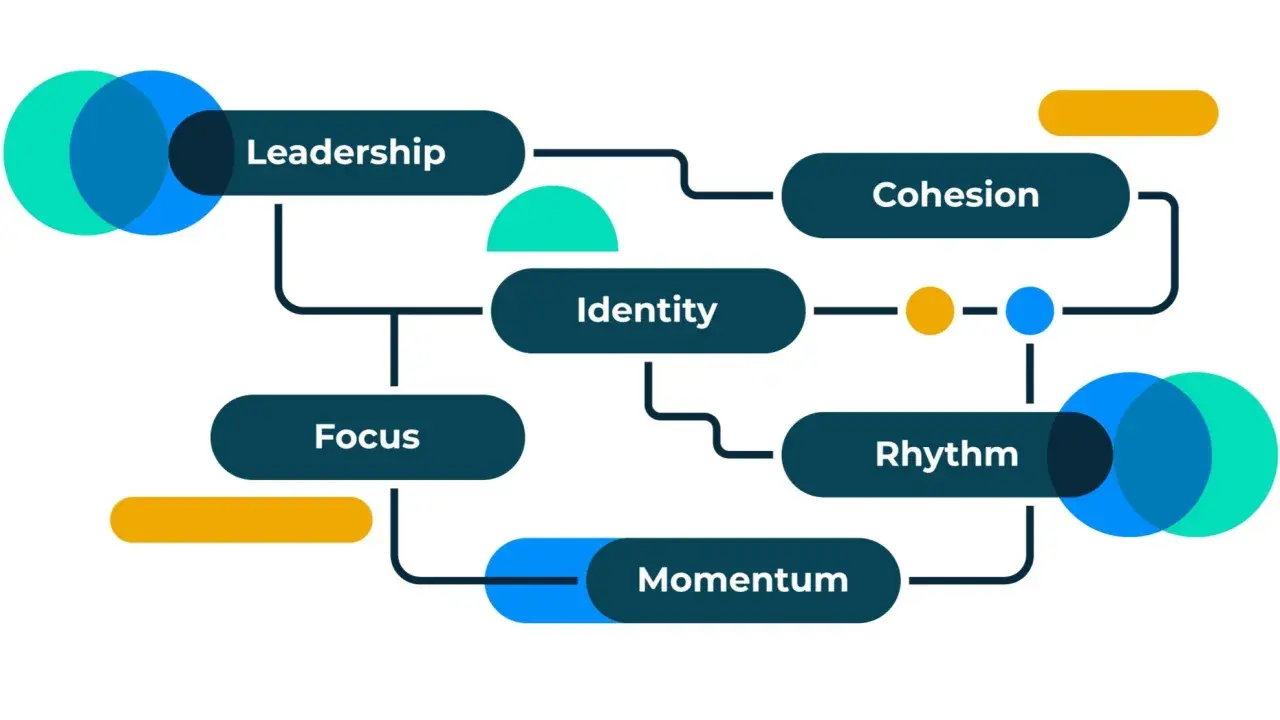
What matters most when you improve organizational performance
- Start with a diagnosis of where work slows down, not with a generic engagement campaign.
- Limit strategic priorities so teams can make fast decisions without constant escalation.
- Turn managers into coaches with weekly check-ins, clear goals, and real feedback.
- Build inclusion into meetings, decisions, and recognition so more people contribute better ideas.
- Treat change as a managed process with pilots, communication, training, and reinforcement.
- Track a small scorecard of leading and lagging metrics so improvement is visible and actionable.
Start with a diagnosis, not a slogan
When performance slips, leaders often reach for a broad initiative too quickly. I get better results by asking three questions first: where is the value leaking, what work is being delayed, and which behaviors are making improvement harder than it should be? That diagnosis should look at outcomes, operating flow, and employee experience at the same time.
A useful baseline usually includes three layers of data. First, business results such as revenue per employee, customer retention, win rate, quality defects, or project delivery time. Second, operating signals such as cycle time, handoff volume, rework, and decision latency. Third, human signals such as turnover, absenteeism, internal mobility, and manager effectiveness. If all three layers are moving in the wrong direction, the problem is almost never one isolated team.
I usually keep the diagnostic window tight: 10 to 15 interviews across levels, one process mapped end to end, and a short list of the three most repeated blockers. That is enough to see patterns without turning the exercise into a research project. If the same delay shows up in onboarding, approvals, and customer follow-up, the issue is structural. Fixing it requires changing the system, not blaming the people inside it.
Once you know where the leaks are, the next step is deciding what the organization should stop doing so the strategy can actually land.
Translate strategy into fewer, clearer priorities
Strategy improves performance only when it helps people make everyday choices. I usually push leadership teams to narrow the agenda to three to five enterprise priorities and then give each function one to three measurable outcomes. Anything more creates noise; anything less usually leaves teams guessing. The point is not to make the plan smaller for its own sake. The point is to make it usable.
- Define what must improve in the next two quarters.
- Spell out tradeoffs, such as speed versus customization or growth versus cost.
- Translate priorities into objectives and key results, or a similarly simple goal system.
- Remove work that no longer supports the plan.
Clarity also means saying what will not be prioritized right now. That part is uncomfortable, but it matters. When teams know what matters and what does not, they spend less time asking for permission and more time moving work forward. Fewer priorities also make it easier to see where change is needed next, because you can compare results against a stable target instead of a moving one.
Turn managers into coaches, not just approvers
Managers sit closest to performance, which means they can accelerate it or quietly block it. The strongest organizations I see do not treat managers as reporting layers; they treat them as coaches who clarify expectations, remove obstacles, and give feedback before a problem becomes a pattern. A manager’s job is not to have every answer. It is to make good work easier to do.
That starts with simple, repeatable habits: weekly one-to-ones, crisp goal setting, feedback within days instead of months, and regular conversations about growth. SHRM’s recent work reports 14.9% lower turnover rates with continuous feedback and says 85% of staff members take more initiative when feedback is frequent and ongoing. I would not treat those numbers as a magic formula, but they do reinforce a basic truth: performance rises when people know where they stand and what to do next.
Good managers also pay attention to inclusion. If only the loudest voice in the room gets airtime, the organization loses information. I prefer managers who ask quiet people to weigh in, who explain decisions instead of hiding behind hierarchy, and who recognize contribution in a way that does not reward self-promotion over substance. That combination builds trust, and trust makes performance conversations far more useful.
Once manager behavior is steady, the organization is better prepared to make inclusion feel practical rather than symbolic.
Build inclusion into the way work gets done
Inclusion is not a side topic here. It affects whether people share concerns early, whether teams challenge weak ideas, and whether talent actually stays. Gallup’s employee-experience model is useful because it reminds leaders that onboarding, daily interactions, performance conversations, and exit all shape how work feels long before anyone leaves. In other words, culture is not an abstract value statement. It is a repeated experience.
In practice, inclusive performance improvement usually shows up in ordinary operating habits, not in a slogan on the wall. I would focus on a few simple moves:
- Rotate meeting facilitation and note-taking so influence is not concentrated in one person.
- Use clear decision criteria and write them down before the discussion starts.
- Standardize interviews, promotions, and stretch assignments so opportunity is not informal or inconsistent.
- Ask for dissent explicitly, then respond to it seriously when it appears.
- Recognize team contribution, not just the people who speak the most or stay visible the longest.
The practical test is simple: do different people have a real chance to influence outcomes, or do the same few voices dominate every important decision? If inclusion is real, it shows up in who speaks, who gets developed, and who gets trusted with meaningful work. That matters because culture is where strategy either becomes everyday behavior or quietly stalls.
Take change management seriously enough to plan for adoption
Performance improvements almost always involve change, and change fails when it is treated like a memo instead of a transition. Whether the organization is implementing new software, restructuring a team, or shifting how decisions are made, people need to understand the reason, the impact on their work, and the support they will get while they adapt. If the change is real, the people side matters as much as the technical side.
I like to keep the change plan practical and visible:
- Build the case for change in plain language.
- Map which roles, processes, and teams are affected first.
- Pilot with one or two teams for six to eight weeks.
- Train managers before launching broadly.
- Reinforce new behavior with scorecards, coaching, and visible executive sponsorship.

Track a small set of metrics that people can act on
I prefer a compact scorecard with five to seven core metrics. That is enough to see movement without drowning leaders in dashboards. The best mix usually combines leading indicators, lagging results, and a few culture signals, so you can tell not only whether the business is improving but also whether the improvement is likely to last.
| Metric type | What to measure | Why it matters | Typical cadence |
|---|---|---|---|
| Leading indicators | Process adoption, training completion, cycle time, decision speed | Shows whether new behaviors are taking hold before results fully change | Weekly or biweekly |
| Lagging indicators | Revenue growth, retention, quality defects, customer churn | Shows the business outcome of the work already done | Monthly or quarterly |
| Culture signals | Pulse survey scores, speaking-up rate, internal mobility, manager trust | Shows whether the improvement is sustainable or just temporary | Monthly or quarterly |
| Change adoption | System usage, time-to-proficiency, exception rate, support tickets | Shows whether a rollout is actually being used the way it should be | Weekly during launch |
The rule I use is simple: every metric should point to an action. If a number goes sideways, someone should know what to do next week, not just what to report next month. Otherwise the dashboard becomes theater, and theater does not improve performance.
Avoid the habits that make improvement feel productive but do nothing
Most stalled improvement efforts share the same pattern: executives announce a goal, middle managers get overloaded, employees hear new language but see old incentives, and the organization slowly reverts. That is why I pay close attention to the traps that make a company look active while the underlying performance barely changes.
- Launching too many initiatives at once.
- Measuring only lagging results and ignoring early signals.
- Leaving managers without coaching skills or decision authority.
- Rewarding heroic overwork instead of better process design.
- Treating inclusion as messaging rather than behavior change.
- Failing to stop low-value work that steals attention from the real priorities.
The fix is not glamorous. Cut work that does not matter, simplify decisions, and reinforce one or two behaviors until they become normal. Improvement becomes durable when leaders are willing to be selective, not when they try to solve everything at once. That discipline sets up a much cleaner 90-day reset.
What a realistic 90-day reset looks like
If I were helping a leadership team reset performance in 90 days, I would keep the plan deliberately narrow. The goal is not to fix every problem. It is to create enough momentum, evidence, and trust that the organization keeps improving after the first push ends.
- Days 1 to 30: Diagnose the biggest friction points, pick three priorities, define the scorecard, and name the manager behaviors that need to change first.
- Days 31 to 60: Run one pilot, tighten meeting norms, start weekly one-to-ones, and remove one bottleneck process that slows execution.
- Days 61 to 90: Compare the baseline to current results, scale what worked, stop what did not, and publish a short learning memo so the organization can see the progress clearly.
The fastest way to improve organizational performance is to make strategy concrete, management consistent, inclusion visible, and change manageable. When those pieces move together, people stop fighting the system and start improving it.
