
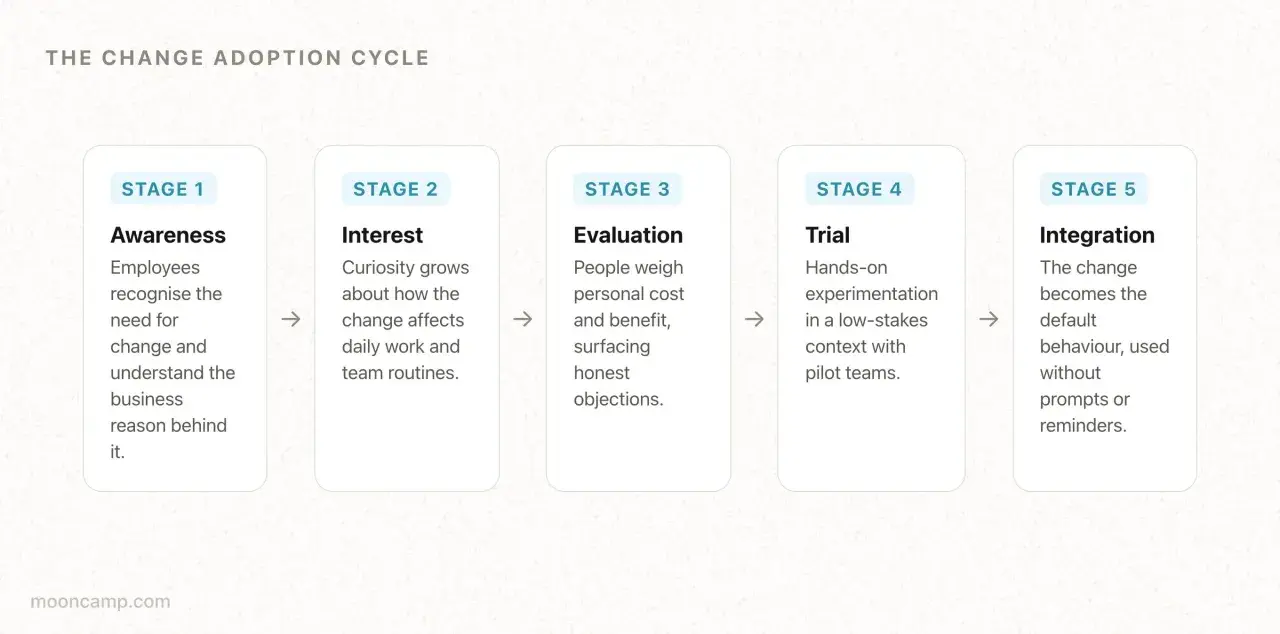
Adoption, not announcements, decides whether change succeeds
- Change management is the discipline of preparing, equipping, and supporting people so they can adopt a new way of working.
- The technical plan and the people plan are different, and both are required if the change is going to stick.
- Communication works best when it is repeated, specific, and tailored to each audience.
- Resistance often points to confusion, overload, or low trust, not simple stubbornness.
- Inclusive leadership improves change quality because it surfaces blind spots before rollout.
- Good change work is measured over 30, 60, and 90 days, not judged only on launch day.
What change management really covers
I separate change management from project management because they answer different questions. Project management asks whether the work gets done; change management asks whether people can and will use the result. That distinction matters, because a system can launch on time and still fail if employees do not trust it, understand it, or feel ready to use it.| Focus | What it answers | What happens if it is missing |
|---|---|---|
| Project management | What gets built, when it gets built, and who owns each task | The work slips, or the technical delivery is incomplete |
| Change management | How people move from the current state to the future state | The launch happens, but adoption stalls |
| Organizational capability | How well the company handles future change | Every new initiative starts from zero |
One useful benchmark is that structured change management has been linked to much stronger project outcomes. In Prosci research, effective change management has been associated with being 7x more likely to meet project objectives, 4.6x more likely to stay on schedule, and 1.4x more likely to stay on budget. I take that as a reminder that the people side is not soft work; it is what turns a decision into a result. Once that distinction is clear, the next question is sequence, because the order of actions shapes whether people trust the change or resist it.
The change process I rely on when strategy needs adoption
My preferred sequence is simple enough to remember and disciplined enough to survive reality. I do not treat it as a rigid template, but I do treat it as a reliable order of operations when the goal is real behavior change.
- Define the outcome and the non-negotiables. Decide what success looks like in business terms, not just in activity terms.
- Map who is affected and how. Different groups will face different risks, workloads, and learning curves.
- Build the change story. Explain why this change is happening now, what problem it solves, and what will be different.
- Equip leaders and managers first. People trust their direct manager more than a polished launch deck.
- Launch with support, not just instructions. Training, job aids, office hours, and feedback channels reduce friction.
- Reinforce through routines and measurement. The new behavior has to show up in meetings, metrics, and expectations.
You do not need to wait for perfect clarity before moving, but you do need enough clarity that people understand the direction and their role in it. In practice, the first three steps create legitimacy; the last three create adoption. Once the sequence is clear, communication determines whether the organization moves together or simply hears the announcement.
Communication that creates momentum instead of noise
A town hall is not a communication plan. I want each audience to hear three answers, and I want those answers to stay consistent across channels: why this change now, what changes for me, and how support will show up. If people have to guess at any of those, they will fill the gap with rumors or their own worst-case scenario.
The strongest communication is usually not the most polished one. It is the most useful one. That means short messages, repeated often, translated into local context, and delivered by the people closest to the work. Senior leaders should set direction, but managers have to make the change concrete. They are the ones who can explain how the shift affects workloads, handoffs, priorities, and success measures.
- Repeat the core message in more than one format, because people absorb change at different speeds.
- Use examples from the actual workflow, not abstract slogans that could apply to any organization.
- Make room for questions before and after launch, because unanswered concerns do not disappear just because the announcement is complete.
- Give managers talking points they can adapt, so the message stays consistent without sounding scripted.
I also like to ask whether the message is credible to the people most affected by it. If the answer is no, the problem is usually not wording; it is trust. That leads straight into resistance, because what looks like pushback is often a practical response to confusion or bad history.
Resistance and change fatigue are signals, not personality flaws
When people push back, I do not assume they are being difficult. More often, they are responding to ambiguity, overload, or a poor track record with previous initiatives. Resistance can mean, “I do not understand the reason,” “I do not trust the follow-through,” or “I do not have the capacity to absorb one more shift.” Those are very different problems, and each one needs a different response.
- Confusion usually means the rationale is too vague. Fix it with a clearer case for change and a more concrete future state.
- Loss of competence means people feel exposed. Fix it with practice, coaching, and enough time to learn the new process.
- Loss of control means people were not involved early enough. Fix it by bringing them into design conversations sooner.
- Trust problems mean the organization has promised more than it delivered. Fix it by acknowledging tradeoffs and keeping commitments small enough to prove.
- Change fatigue means the portfolio is too crowded. Fix it by sequencing better and stopping lower-value work that is draining attention.
Inclusive leadership makes change more durable
Inclusive change is not a softer version of change management; it is usually a better one. When diverse voices are included early, you catch workflow gaps, language problems, access issues, and fairness concerns before they become resistance. I have seen too many rollouts fail because the only people shaping the plan were the ones least affected by the day-to-day friction.
For workplace culture work, this matters even more. A change that ignores how different teams experience it will not feel fair, and a change that does not feel fair rarely feels worth supporting. If people do not believe the process is respectful, transparent, and usable, they may comply on paper while quietly working around it in practice.
- Invite frontline employees and middle managers into design sessions, not just into the launch meeting.
- Use plain language and multiple formats so remote workers, shift workers, and employees with different learning preferences can all engage.
- Build feedback channels that feel safe, because people share real concerns only when they believe disagreement will not be punished.
- Ask which groups may be left out by default, then adjust the process before it becomes a problem.
I think of inclusive leadership as a force multiplier for change adoption. It broadens the quality of the input, reduces blind spots, and makes the change story easier to trust. Once that foundation is in place, the next challenge is avoiding the common mistakes that quietly undermine good intentions.
The mistakes that quietly derail the work
Most change efforts do not fail because the idea was bad. They fail because leaders underestimate the amount of reinforcement required after the announcement. These are the patterns I watch for most closely.| Mistake | What it causes | Better move |
|---|---|---|
| Treating launch day as the finish line | Initial excitement fades before new behavior becomes normal | Plan reinforcement before launch, not after it |
| Using one message for every audience | People miss the parts that matter most to their role | Tailor the message by impact, function, and level of responsibility |
| Training without workflow support | People understand the theory but cannot perform in real conditions | Pair training with job aids, coaching, and practice time |
| Ignoring managers | Questions pile up at the point of execution | Equip managers first and make them part of the rollout |
| Launching too many changes at once | Attention fragments and change fatigue rises | Sequence initiatives and pause lower-value work where possible |
| Measuring activity instead of adoption | Attendance looks good while usage stays low | Track behavior, usage, and business outcomes together |
These are avoidable mistakes, but only if leaders are willing to slow down long enough to inspect the rollout instead of celebrating the announcement. That is where measurement becomes essential, because adoption needs evidence, not optimism.
How I know a change is actually sticking
I like a 30, 60, 90-day rhythm because it forces leaders to distinguish between activity and adoption. At 30 days, I look for friction. At 60 days, I look for usage patterns. At 90 days, I look for whether the change is starting to affect business results, team behavior, or customer experience.
A simple pulse survey of 3 to 5 questions every 2 to 4 weeks is usually enough to show whether people understand the change, feel supported, and know what to do next. I would rather see a small, consistent feedback loop than a large survey that nobody acts on. The point is not to collect data for its own sake; it is to spot where the change is getting stuck while there is still time to fix it.
| Indicator type | Examples | What it tells you |
|---|---|---|
| Leading indicators | Manager cascade completion, training completion, usage in pilot teams, support ticket volume, pulse survey results | Whether the change is getting traction |
| Lagging indicators | Process cycle time, quality errors, customer complaints, turnover, budget variance | Whether the change is producing real value |
If the leading indicators improve but the lagging ones do not, I know the organization has launched something, but not yet embedded it. That gap is where most transformations live or die. The most useful change management articles and playbooks help leaders close that gap before it turns into another missed initiative.
What I keep ready before the next transformation starts
That is the standard I use when I read change management articles: they should leave me with a clearer story, a cleaner sequence, and a way to measure adoption. If they do not help with those three things, they are probably interesting but not operationally useful.
- A one-paragraph change story that explains why the shift matters now.
- A stakeholder map that shows who is affected, who influences adoption, and who needs extra support.
- A manager toolkit with talking points, FAQs, and examples tied to real workflows.
- A reinforcement plan that covers training, practice, feedback, and follow-up.
- An adoption dashboard that tracks both people signals and business outcomes.
If you prepare those pieces before the launch, you give the change a much better chance of surviving the first wave of confusion. That is usually where strategy either becomes normal work or becomes another initiative people remember for the wrong reasons.
