What matters most before a change launch
- The goal is adoption, not announcement.
- Sponsorship, manager readiness, and repeated communication do more work than a single launch memo.
- A phased rollout with pilots, feedback loops, and reinforcement is more reliable than a one-and-done rollout.
- Inclusive design helps change land fairly across different teams, schedules, and roles.
- Measure behavior change and usage, not just attendance or training completion.
What effective change work is really solving
I usually start by separating three layers: the technical change, the behavior change, and the cultural change. The software can go live, the policy can be approved, and the org chart can be updated, but if people do not know what to do differently on Tuesday morning, the initiative is not done.
McKinsey’s recent work on reinvention is a useful reminder that many organizations are not handling a single neat project anymore; they are managing overlapping shifts in structure, technology, and expectations. That is why change planning has to be more than messaging. It has to answer who is affected, what new habits are required, and how the organization will support those habits until they stick.
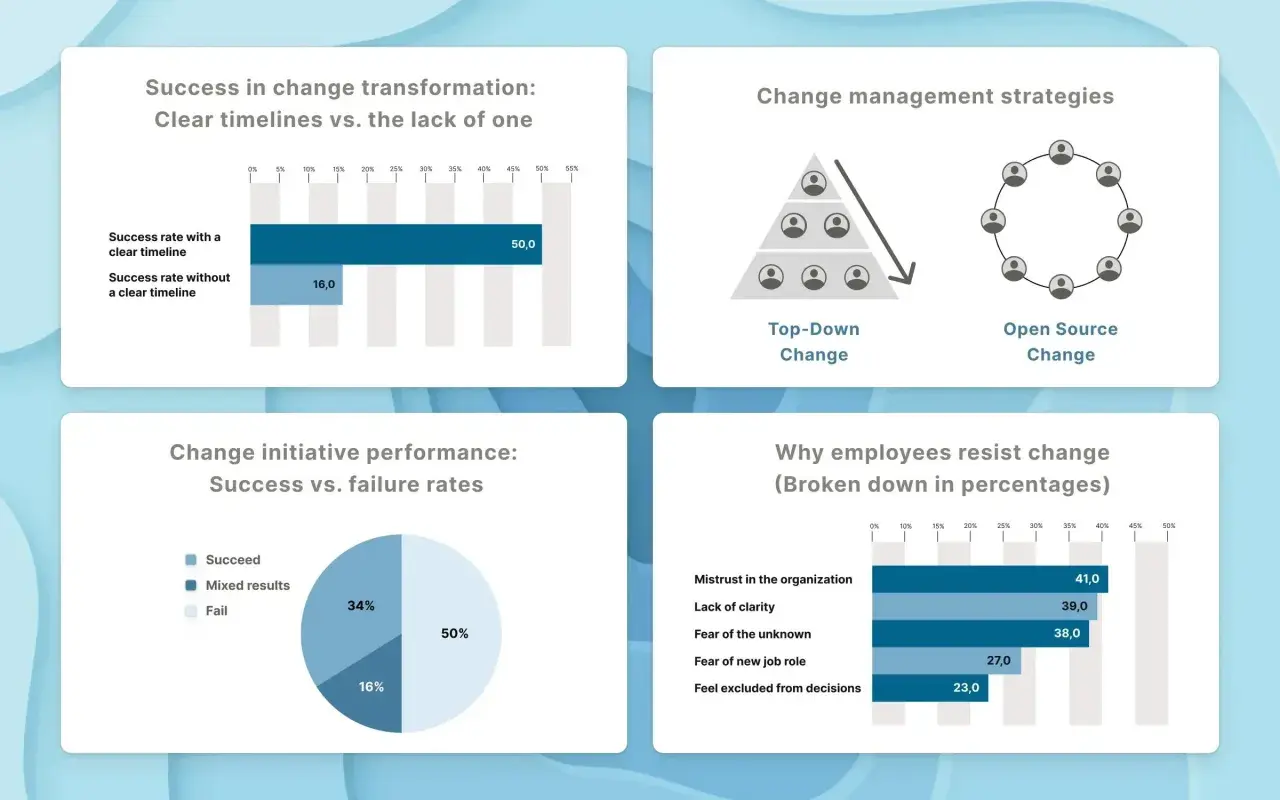
I also think it helps to be blunt about resistance. Most of the time, resistance is not rebellion. It is uncertainty, workload, loss of competence, or plain old distrust of the process. If you treat that reaction as a people problem instead of a design problem, you miss the real fix. Once you accept that adoption is the real target, the next step is choosing the methods that make adoption possible.
The methods that consistently improve adoption
The strongest approaches are boring in the best possible way: they create clarity, reduce friction, and make the new behavior easier than the old one. I like to think of them as a toolkit rather than a doctrine, because no single tactic solves every change.
| Strategy | What it does | Works best when | Common failure mode |
|---|---|---|---|
| Executive sponsorship | Makes the change visible, legitimate, and worth prioritizing | The change cuts across departments, budgets, or power structures | The sponsor shows up once and disappears after the announcement |
| Manager enablement | Turns strategy into daily behavior and local answers | Frontline managers need to explain the change to their teams | Managers learn about the change after employees do |
| Two-way communication | Surfaces concerns, rumors, and practical blockers early | The change is sensitive, high stakes, or emotionally loaded | Communication is treated as a broadcast instead of a conversation |
| Pilots and quick wins | Proves value and reduces fear before full rollout | The new process, tool, or policy needs testing in real work | The pilot is too small or too unusual to be trusted by everyone else |
| Training in the workflow | Builds ability, not just awareness | People must use a new tool or process immediately | Training is detached from real tasks and forgotten fast |
| Reinforcement and metrics | Keeps the new behavior from sliding back | The change needs to stick after go-live | Leaders measure activity, not actual adoption |
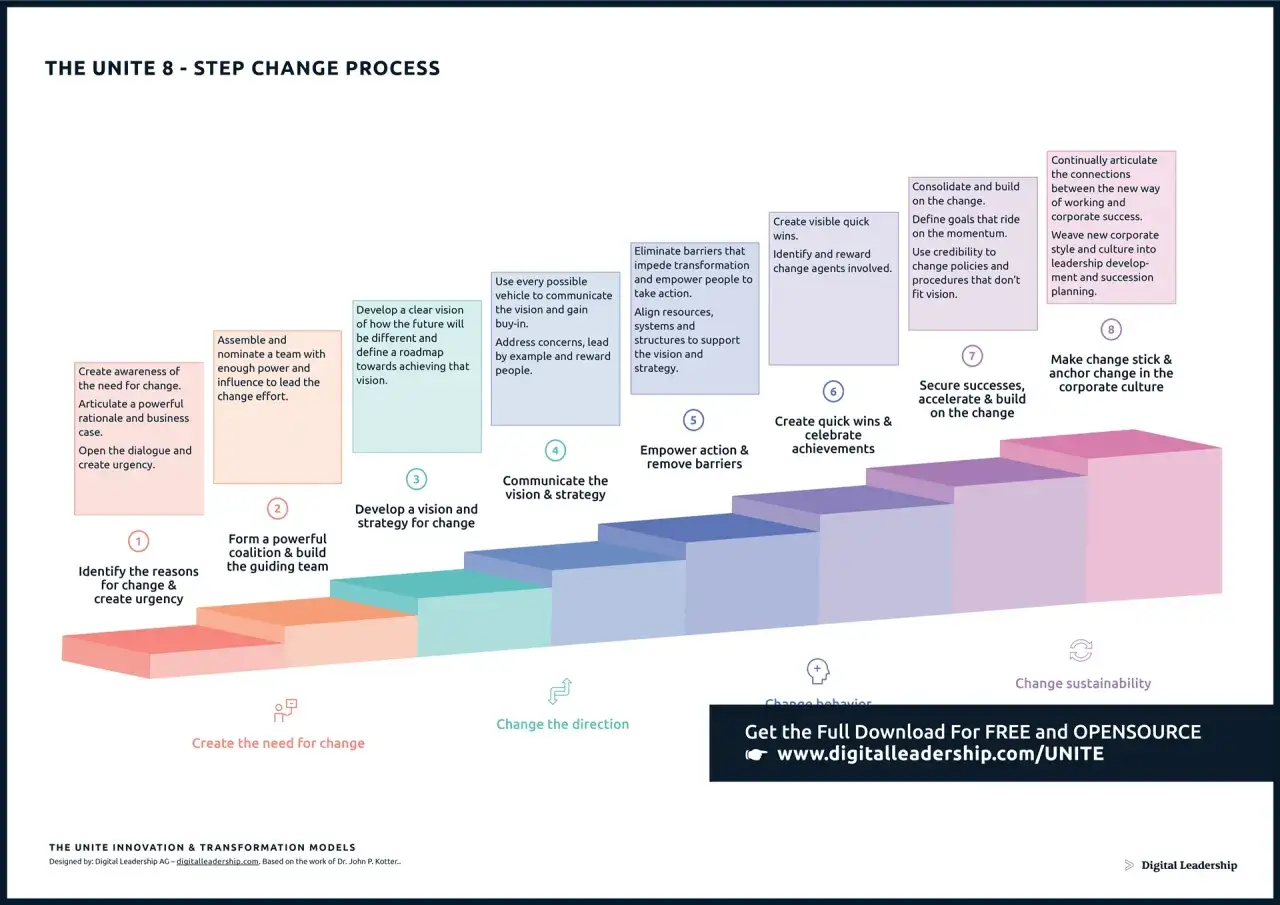
When I need a diagnostic lens, I lean on ADKAR to check whether people lack awareness, desire, knowledge, ability, or reinforcement. For broader transformations, the right framework depends on the problem: Kotter helps build momentum, Lewin is enough for simpler staged transitions, and 7-S is useful when strategy, structure, systems, and culture all need to move together. The point is not to collect frameworks; it is to use the one that fits the real blockage. A good set of methods still needs a rollout plan, because people rarely change in a straight line.
How I would structure a rollout that people can follow
I prefer a 30/60/90-day arc for most changes because it forces the team to distinguish between launch activity and real adoption. A longer transformation can and often should extend beyond 90 days, but the first quarter should still have a clean rhythm.
- Days 1 to 30: define the business outcome, map the impacted roles, brief sponsors, and identify what will change in the daily workflow. This is also where I build the risk list and decide who needs extra support.
- Days 31 to 60: train managers first, pilot with one or two representative teams, collect questions, and remove the obvious friction. This is the stage where support channels should already be live, not promised later.
- Days 61 to 90: scale to more teams, monitor usage and help-desk trends, and adjust policy, training, or tools based on what the pilot revealed. The goal here is not speed for its own sake; it is stable adoption.
- After day 90: reinforce the change through metrics, performance conversations, onboarding, and quarterly review. If the initiative still needs constant rescue, the rollout is not finished.
That timeline only works if the message is clear enough for people to repeat it in their own words, which is where communication design matters.
Communication that reduces resistance
The best communication plans answer the questions people ask privately: Why now? Why this version? What happens to my workload? Who do I talk to when the new process breaks? If leaders skip those questions, people fill in the blanks themselves, and the rumor mill becomes the loudest voice in the room.
- Why the change is happening now. Give the business reason in plain English, not in consultant language.
- What is changing and what is not. People need boundaries as much as they need vision.
- What each audience is expected to do. A manager, a team lead, and a frontline employee often need different instructions.
- What support exists. Training, office hours, FAQs, and escalation paths should be visible from day one.
- How feedback will be handled. People will speak up more when they know someone is listening and acting.
I also avoid one giant announcement. I would rather brief managers first, then launch with a clear FAQ, live office hours, and short updates every week during the rollout. After that, 2 to 4 week pulse checks are enough to tell you whether the story is landing or getting distorted. Once communication is in motion, the next question is whether the change is fair enough for people to trust it.
Inclusive change that protects trust and culture
Inclusive change is not a separate initiative; it is how you keep the process fair enough for people to trust it. If employees think the rules were written for a small group in a conference room, they will cooperate on paper and hesitate in practice.
- Invite people closest to the work into discovery and testing. Frontline managers and employees from different locations or shifts often spot problems that leadership misses.
- Make materials accessible. Use plain English, captions, screen-reader-friendly files, and multiple channels for questions.
- Check timing and workload. Caregivers, hybrid teams, and people already carrying heavy change load need realistic pacing.
- Protect psychological safety. That means people can raise problems without being punished or labeled resistant.
- Explain how decisions are made. Process fairness matters almost as much as the final decision.
Common mistakes that quietly sink good plans
Most failed rollouts do not collapse because the idea was bad. They fail because the organization underestimated friction.
- Launching before managers are ready. Employees hear mixed messages and lose confidence fast.
- Measuring attendance instead of adoption. Completion is not the same thing as behavior change.
- Treating resistance as a personality flaw. Resistance is often a signal that the design, timing, or support is off.
- Ignoring workload and change fatigue. People cannot absorb major change on top of an overloaded quarter without something breaking.
- Leaving incentives untouched. If performance metrics reward the old behavior, the new one will lose.
- Stopping support too soon. Most backsliding happens after leaders assume the job is done.
If two or three of these show up at once, I stop blaming communication and look at governance, incentives, and sponsorship instead. That question of ownership is what makes change capability either repeatable or fragile.
What leaders should keep after the project ends
The healthiest organizations do not just finish change; they store the learning. I want three things to survive every major initiative: a sponsor checklist, a manager toolkit, and an adoption dashboard that tracks usage, friction, and feedback over time.
- A clear support playbook. People should know who owns the first 30 days after launch.
- A definition of success. Success should describe the behavior that proves adoption, not just the launch event.
- Behavior metrics. Usage, error rates, cycle time, ticket volume, and manager feedback usually tell a better story than attendance logs.
- A lessons-learned review. Capture what worked, what stalled, and what needs to change before the next initiative starts.
That is the real goal: not a perfect launch, but an organization that can change again without starting from zero.