
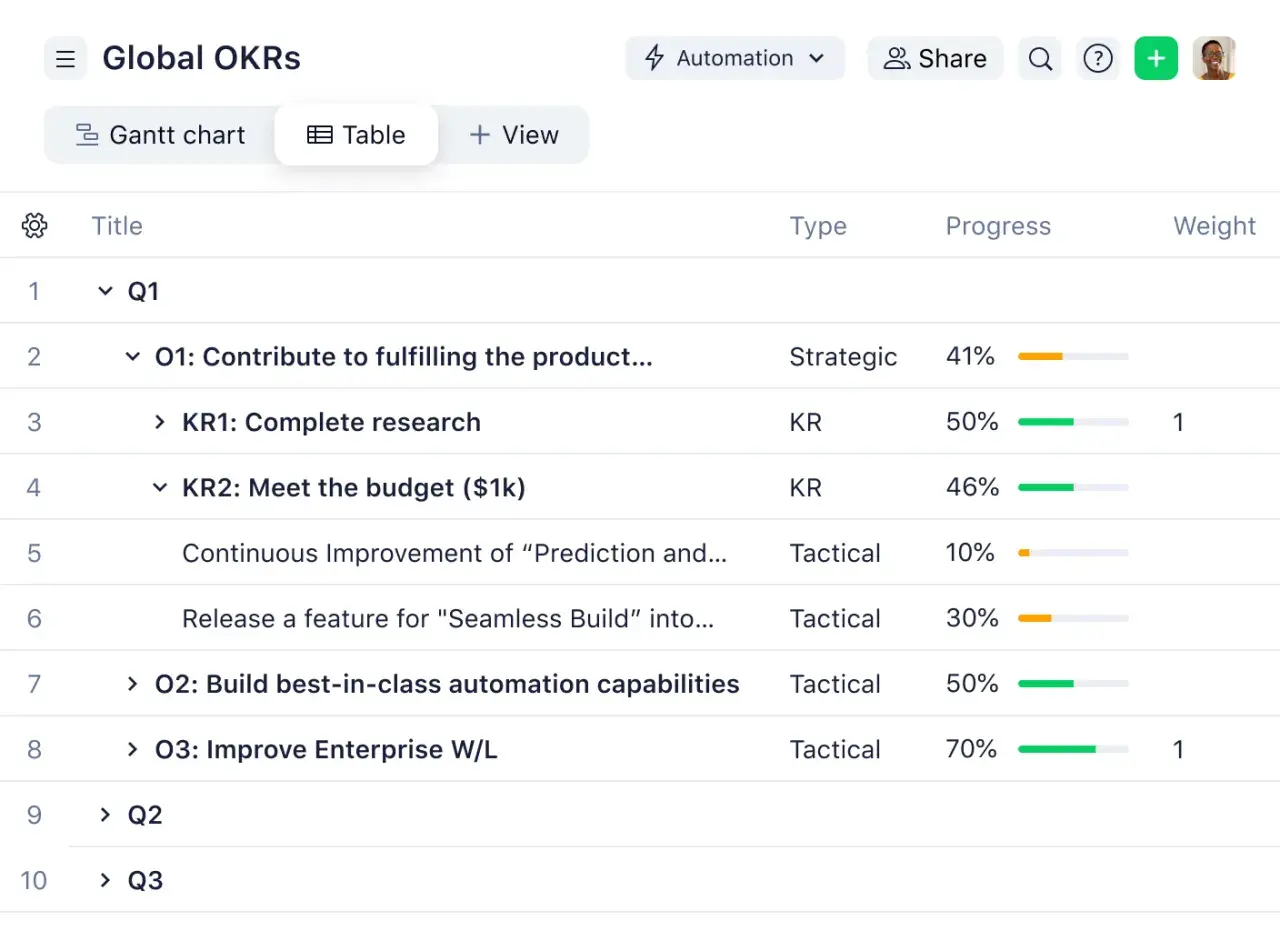
What matters most before you use OKRs for performance
- OKRs are strongest as a strategy and alignment tool, not as a direct pay formula.
- Individual performance still needs separate inputs such as quality, collaboration, judgment, and learning.
- A quarterly rhythm with weekly check-ins gives enough structure to adapt when strategy changes.
- Fewer goals usually work better: I prefer 3 to 5 objectives with a small number of measurable key results.
- Fairness improves when expectations are written early, applied consistently, and calibrated with evidence.
What OKRs really add to performance management
At the simplest level, OKRs turn strategy into a shared operating plan. They help people see what matters now, what success looks like, and how their work contributes to a larger shift. I do not treat them as a replacement for good management; I treat them as the layer that makes priorities visible enough for managers and employees to have honest conversations about progress.
The easiest way to keep that distinction clear is to separate the different layers of measurement.
| Layer | Main question | Typical cadence | Use it for | Do not use it for |
|---|---|---|---|---|
| OKRs | What strategic outcome are we trying to move? | Quarterly, with weekly progress updates | Alignment, focus, and change execution | Direct compensation decisions |
| Individual performance goals | What is this person accountable for in their role? | Set and reviewed across the year | Expectation setting and role clarity | Replacing the broader view of contribution |
| Manager feedback and coaching | How is the work being done? | Ongoing | Development, behavior, and course correction | Scoring people on one data point |
| Compensation and rewards | How should pay reflect impact and market factors? | Usually annual or periodic | Rewarding contribution fairly | Forcing stretch goals to become safe goals |
That separation matters because a goal system becomes fragile the moment it tries to do everything at once. Once OKRs, evaluation, and compensation are tangled together, people start writing cautious goals, hiding uncertainty, and optimizing for the rating instead of the result. When those layers are distinct, the conversation gets sharper and the culture gets more honest. That leads straight into why OKRs are so useful when strategy is changing.
Why they work better when strategy is changing
Strategy and change create friction. Teams have to learn new priorities, stop work that used to matter, and make decisions with incomplete information. OKRs help because they force a short list of bets. They are a useful answer to complexity precisely because they do not try to describe every task; they describe the outcome that matters most.
I also like that OKRs create a healthier relationship with ambition. Google’s guidance describes the 60% to 70% range as the sweet spot for attainment, which is a reminder that the system is supposed to stretch people without punishing them for not hitting a perfect score. In practice, that means a lower grade can be data, not failure. If a team keeps landing at 100%, the goals were probably too safe.
That is especially useful during change initiatives. A company rolling out a new product model, a new operating structure, or a new customer journey cannot afford a quarterly process that only confirms what already happened. OKRs give leaders a way to say, “This is the shift we are making, this is how we will know it is working, and this is what we are willing to stop doing to make room for it.”
When that message is clear, the next question becomes practical: how do you build the system so it supports change instead of turning into bureaucracy?

How I would design the system so it stays useful
I prefer to design OKR systems from the strategy down, not from a template up. The best version is simple enough to remember and disciplined enough to guide real decisions.
- Start with 3 to 5 strategic priorities. If everything is important, nothing is. A small list forces trade-offs and keeps the organization honest about focus.
- Write objectives as outcomes, not activities. “Launch a training program” is a task. “Increase the share of managers who can coach effectively” is an outcome. The second version tells you whether the work changed anything.
- Attach 2 to 4 measurable key results to each objective. I prefer a tight range because too many key results dilute accountability. If one team has 12 or 15 results, the system is probably too noisy to steer behavior well.
- Define one owner for each key result. Ownership should be clear, even when delivery is collaborative. Shared work still needs a named person who watches the metric and surfaces risks early.
- Set a data source before the quarter starts. If the team has to argue about where the number came from after the fact, the KR was not ready. Good OKRs are measurable because the metric is agreed upfront.
- Use weekly check-ins and a quarterly reset. Weekly reviews are for course correction. Quarterly reviews are for learning, pruning, and refreshing priorities. Formal review cycles do not need to be constant to be effective.
I also keep one rule in mind: separate the ambition conversation from the compensation conversation. That gives managers room to set bold goals without forcing everyone into defensive behavior. It is one of the simplest ways to keep the system useful during growth, restructuring, or a major operating change. From there, the more interesting question is what to measure at each level of the organization.
What to measure at the company, team, and individual levels
Not every metric belongs at every level. A company OKR should describe a strategic change. A team OKR should show how that change gets executed. Individual performance should capture contribution, quality, collaboration, and judgment, not just goal attainment. I see a lot of systems fail because they ask one measure to do all three jobs.
| Level | What good looks like | Example focus | Common mistake |
|---|---|---|---|
| Company | Clear directional shift with visible business impact | Improve retention, enter a new segment, shorten time to market | Turning the company OKR list into a bucket of department wishes |
| Team | Measurable execution against a shared outcome | Reduce onboarding friction, increase cross-team handoff speed, improve product adoption | Loading one team with problems they cannot actually control |
| Individual | Role clarity plus evidence of how the person contributed | Delivery quality, collaboration, decision-making, learning, and reliability | Reducing a person to a single OKR score |
Here is the practical test I use: if a metric cannot reasonably be influenced by the person or group being assessed, it should not be the main performance measure. That sounds obvious, but it is where many systems become unfair. A manager can evaluate contribution to a team outcome; they should not pretend the outcome was created by one person alone. The same idea matters even more when fairness and inclusion are part of the culture you are trying to build.
How to keep it fair and inclusive
If inclusion is a priority, it has to show up in the performance system. Otherwise, inclusive behavior becomes optional, invisible, or treated like extra credit. I think that is a structural problem, not a motivation problem. People usually pay attention to what the system rewards, not what the company says it values.
The EEOC recommends communicating performance standards early, applying them consistently, and using factual details when explaining evaluations. That is the right baseline for any OKR-driven process, because transparent standards reduce the room for subjective interpretation. In practice, I would add four more guardrails.
- Use behaviorally specific criteria. Do not write “shows leadership” if you can write “runs meetings that surface risks, assign clear owners, and close decisions.”
- Separate evidence from impression. A manager should be able to point to examples, not just a feeling that someone was “strong” or “weak.”
- Calibrate across teams. One manager’s “meets expectations” should not mean something wildly different from another manager’s interpretation.
- Watch for visibility bias. Remote workers, caregivers, quieter contributors, and people in support roles are often undervalued when managers reward loudness or availability instead of impact.
I also think inclusive leadership should be visible inside the goals themselves. That can mean measuring how evenly stretch assignments are distributed, whether decision-making is documented, or whether managers create room for quieter voices in planning sessions. Those are not “soft” signals. They shape who gets noticed, who gets developed, and who gets promoted. Once those signals are in place, the next danger is the set of mistakes that make OKRs look rigorous while quietly hollowing them out.
Common mistakes that turn OKRs into bureaucracy
Most bad OKR systems do not fail because the framework is wrong. They fail because the organization uses the framework to avoid harder management work. I see the same patterns over and over.
- Too many objectives. When everything is a priority, teams lose the ability to focus.
- Task lists disguised as key results. A KR should show a change in outcome, not a completed activity.
- Using the score as the whole story. A person can miss a stretch target and still do excellent work in a volatile environment.
- Tying every result to compensation. That pushes people toward safe goals and weakens ambition.
- Reviewing only at the end of the quarter. If the team waits that long, the system becomes retrospective paperwork instead of management.
- Copying leadership goals into every role. Not every employee should have the same outcomes, even if they support the same strategy.
- Ignoring qualitative context. Numbers matter, but so do trade-offs, constraints, and collaboration quality.
One useful diagnostic question is this: if the outcome moves in the wrong direction, would the team know what to do differently next week? If the answer is no, the OKR is too vague. If the answer is yes, you are at least measuring something that can guide action. That brings me to the part I would protect most carefully when priorities keep shifting.
The guardrails I would keep when priorities keep shifting
In 2026, most organizations are still managing some mix of restructuring, hybrid work, AI adoption, and tighter accountability. That means the goal system has to stay flexible without becoming slippery. My rule set is simple: keep the number of goals small, keep the measures visible, and keep the evaluation process evidence-based.
- Use OKRs to decide where the organization is going next quarter.
- Use manager coaching to explain what good performance looks like today.
- Use documented evidence and calibration to reduce bias.
- Use compensation decisions with a broader lens than a single OKR score.
- Use the quarter-end review to learn, not to stage a surprise.
When those guardrails are in place, OKRs do what they are supposed to do: they help people focus on meaningful outcomes without losing fairness, accountability, or trust. That combination is what makes the framework useful in a real organization, especially when strategy is moving and the culture still has to hold together.
