
Creative thinking training works best when it helps people produce better options under pressure, not when it simply creates a burst of random brainstorming. In strategy and change work, the real value is practical: reframing problems, widening the range of possible moves, and turning promising ideas into tests the business can actually use. I focus here on what a strong program teaches, how it supports inclusive leadership, and how to judge whether it is creating usable ideas rather than just enthusiasm.
The fastest path to better ideas is structure, not more noise
- Strong programs build both idea generation and idea selection; one without the other does not move strategy forward.
- The best format is usually a mix of one shared workshop, short practice cycles, and manager follow-through.
- Inclusive design matters because it surfaces quieter voices, reduces groupthink, and improves the range of options.
- Training should be tied to one real business challenge, not abstract creativity exercises with no deadline.
- Measure pilots, adoption, and decision speed, not only how many ideas people wrote on a whiteboard.
What this kind of training is really solving
Most organizations do not have a creativity problem in the abstract. They have a problem with stale options, narrow framing, and teams that keep reaching for the same answer because it feels safe. That is why I treat idea-generation training as a business capability, not a morale exercise. It should help people think more widely, challenge assumptions earlier, and find better moves when the usual playbook stops working.
The APA has long used divergent thinking as a common marker of creativity, because it captures the ability to generate many possible solutions to a problem. That matters in strategy and change because the first answer is rarely the best answer. If a team can only name one or two options, it is not really exploring the problem; it is settling for familiar ground.
In U.S. workplaces, this shows up most clearly during transformation: restructuring, new technology adoption, hybrid collaboration, customer shifts, or a change in operating model. A good program gives people a method for thinking beyond compliance and into possibility. That is where better ideas begin, and it also sets up the skills the team needs to use those ideas well.
The skills a useful program should build
I usually look for five abilities in any program that claims to improve creative output. If one of them is missing, the training tends to feel inspiring in the room and forgettable a week later.
- Reframing - Participants learn to turn a symptom into a better question. Instead of asking, “How do we get more attendance?” they ask, “What is making people disengage in the first place?”
- Divergent thinking - This is the habit of producing many different ideas before judging them. Quantity comes first; refinement comes later.
- Convergent thinking - Good programs teach people how to narrow options using clear criteria such as strategic fit, feasibility, impact, and equity. Creative work is not complete until the best ideas are chosen and developed.
- Association and analogy - People borrow patterns from other industries, teams, or customer experiences. A retail operations fix may not copy a health care process, but the analogy can still reveal a useful path.
- Participation design - The format itself matters. Brainwriting, round-robin sharing, and silent reflection often produce better ideas than letting the loudest person steer the session from the start.
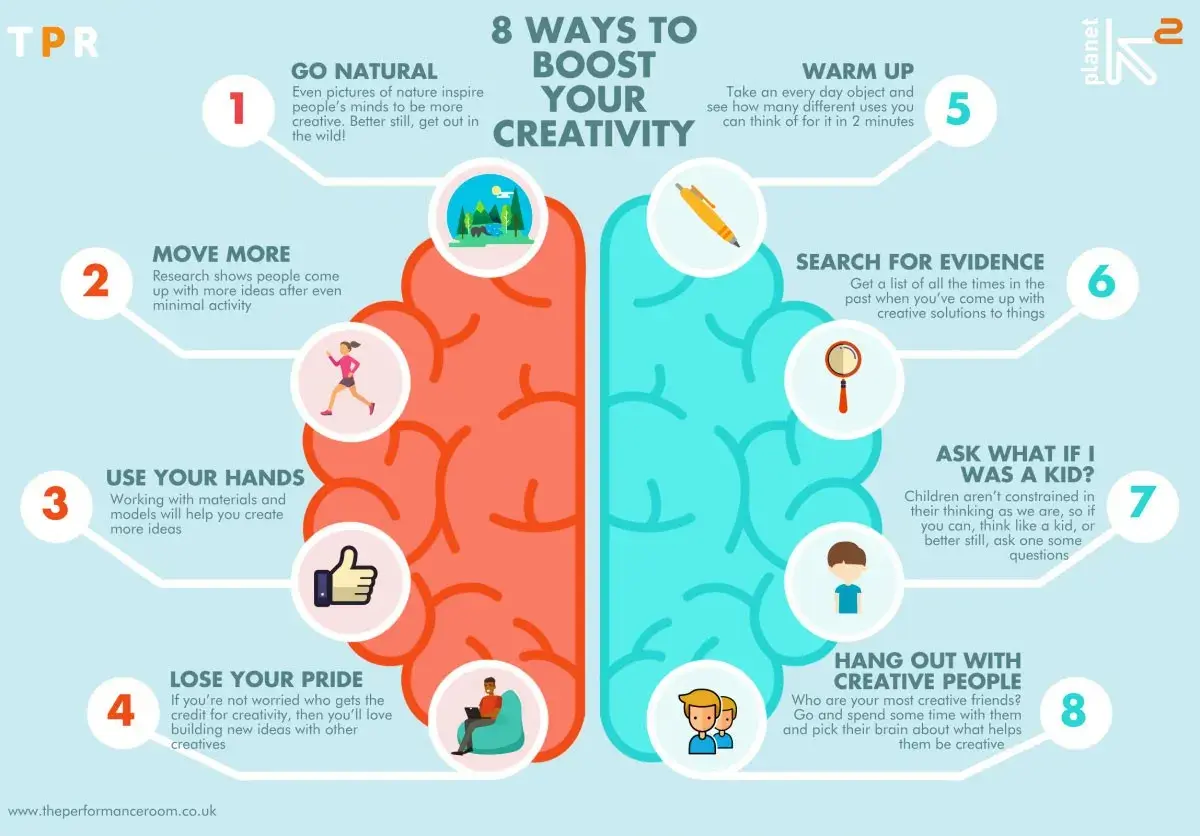
The APA has also summarized research showing that walking can increase creative ideation in the moment, which is a useful reminder that idea generation does not have to be seated, static, or overly formal. I take that seriously when I design training: movement, whiteboards, short timed exercises, and written input often produce better thinking than long lectures. The point is not novelty for its own sake. The point is to make different kinds of thinking possible, then bring them back to the business problem.
Those skills matter even more when teams are diverse, because the best idea is often the one that would have been missed in a narrower room. That leads directly to the question of format, because structure determines who gets heard and how ideas are shaped.

What strong program formats look like
I trust programs that mix a shared vocabulary with repeated practice. A single inspiration session can help, but it rarely changes how people think under pressure. The better option is a format that gives teams a quick win, then keeps them applying the methods to real work.
| Format | Best for | Strength | Limitation |
|---|---|---|---|
| Half-day workshop | Building shared language and quick momentum | Fast to launch, easy to understand, good for broad groups | Often fades if nothing follows it |
| Cohort program | Habit building over several weeks | Creates repetition, feedback, and accountability | Needs manager support and a real business case |
| Challenge lab | Solving one strategic problem | Produces tangible outputs and keeps the work grounded | Requires a well-defined challenge and decision maker |
| Leader coaching | Changing how senior people frame decisions | Influences tone, sponsorship, and follow-through | Scales slowly across a large organization |
For most teams, the sweet spot is a hybrid: one live session to introduce the tools, followed by three to five short practice cycles over the next month. I like that rhythm because it is long enough to build a habit, but short enough to stay tied to a business deadline. If the format becomes too academic, the energy disappears. If it becomes too loose, nothing sticks.
In practice, I also prefer formats that let people contribute in more than one way. Written ideation, breakout discussion, and a visible prioritization step help quieter employees contribute without having to compete for airtime. That is where the training starts to connect with strategy and change.
How idea generation supports strategy and change
Creative thinking becomes valuable only when it helps leaders make better strategic choices. I do not want teams to “be creative” in the abstract; I want them to solve a specific problem more intelligently. That is why the most effective programs begin with a real challenge and end with a testable action.
A simple structure works well:
- Choose one business question - For example, “How might we reduce time-to-productivity for new hires?” or “How might we make a change initiative easier to adopt?”
- Frame it tightly - Use a prompt like “How might we…” or “What would it take to…” so the team is solving a real problem, not wandering through abstract brainstorming.
- Generate ideas in layers - Start with silent writing for five minutes, then move to pair sharing, then group building. This sequence usually produces better ideas than immediate open discussion.
- Use criteria early - Score ideas against strategic fit, impact, feasibility, equity, and time to test. That keeps the work from drifting into personal preference.
- Commit to a pilot - Pick one or two ideas and test them within 30 days. If an idea cannot be named, owned, and tested, it is still a concept, not a change.
That last step matters more than most leaders admit. A strategy conversation that never reaches an experiment is just a conversation. In that sense, creative thinking is not only about novelty; it is about decision quality. And decision quality improves when more perspectives are present. Deloitte’s inclusive leadership research has made a similar point about blind spots: if the same voices dominate every round, the organization will keep missing opportunities that other people can see.
This is also where change management becomes relevant. People rarely resist every change; they resist changes that feel imposed, vague, or disconnected from their day-to-day work. When they help shape the options, the change usually feels less like a mandate and more like a shared solution.
Where programs fail in real organizations
Most weak programs do not fail because the idea is bad. They fail because the organization treats creativity like a side activity instead of part of how decisions get made. I see the same mistakes again and again.
- They are too abstract - People leave with nice language but no way to apply it to a real business challenge.
- They reward speed over depth - Quick answers get praised, while more original ideas are rushed or dismissed.
- They privilege the loudest voices - If the session is all verbal brainstorming, the room gets smaller, not bigger.
- They lack decision rules - Without a shared filter, the team confuses personal taste with strategic value.
- They stop at the workshop - No owner, no deadline, no follow-up means no behavior change.
The warning sign I watch for is the wall of sticky notes that nobody revisits. It looks active, but it is often just performance. Real learning shows up when leaders remove blockers, assign ownership, and protect time for the next step. If that does not happen, the session may still feel good, but it will not change how the organization works.
The good news is that these failures are fixable. The fix starts with measurement, because what you measure is what people take seriously.
How to measure whether it worked
If a program only measures attendance, it is measuring convenience, not impact. I want to see a mix of process and outcome metrics so the organization can tell whether the training changed behavior or just entertained people for an afternoon.| Metric | What it tells you | When to check it |
|---|---|---|
| Participation breadth | Whether different roles and voices are joining the process | During and immediately after each session |
| Idea diversity | Whether the team is producing a wide range of options instead of variations of the same answer | After each ideation round |
| Pilot rate | How many ideas move into a real test | 30 to 60 days after the session |
| Implementation rate | Whether tested ideas become part of the operating model | 60 to 180 days after launch |
| Decision speed | Whether the team is making clearer choices faster | Over the full program cycle |
| Employee confidence | Whether people believe their ideas can shape change | Before and after the program |
I usually want to see at least one experiment per team within a quarter. That is not because every test will succeed, but because testing forces clarity. It tells you whether the idea works in the real environment, with the real constraints, instead of staying trapped in workshop logic. If you cannot get to a pilot, the process is probably too theoretical or the organizational sponsorship is too weak.
One more practical point: measure equity in participation as well. If only managers or extroverts contribute meaningful ideas, the program is leaving value on the table. That is especially important in inclusive leadership work, where the goal is not just more ideas but better access to them.
The part that keeps the ideas alive after the workshop
The best results come from a simple 90-day rhythm, not a grand transformation announcement. I would structure it this way: use the first two weeks to choose one strategic challenge and define success; spend the next two to three weeks running the training and narrowing the strongest ideas; then use the rest of the quarter to test, refine, and decide what should scale.
- Days 1 to 15 - Pick one real challenge, name the decision owner, and define what success looks like in plain language.
- Days 16 to 30 - Run the main session, use silent ideation before discussion, and select three ideas worth testing.
- Days 31 to 60 - Assign owners, remove blockers, and launch one small pilot with a clear review date.
- Days 61 to 90 - Review what changed, keep what worked, and document what the team learned for the next cycle.
If I had to reduce the whole approach to one rule, it would be this: do not let creative work stop at inspiration. The point is to create a repeatable path from idea to experiment to decision. When that path is visible, inclusive, and tied to strategy, the training stops being a workshop and starts becoming part of how the organization changes.
