
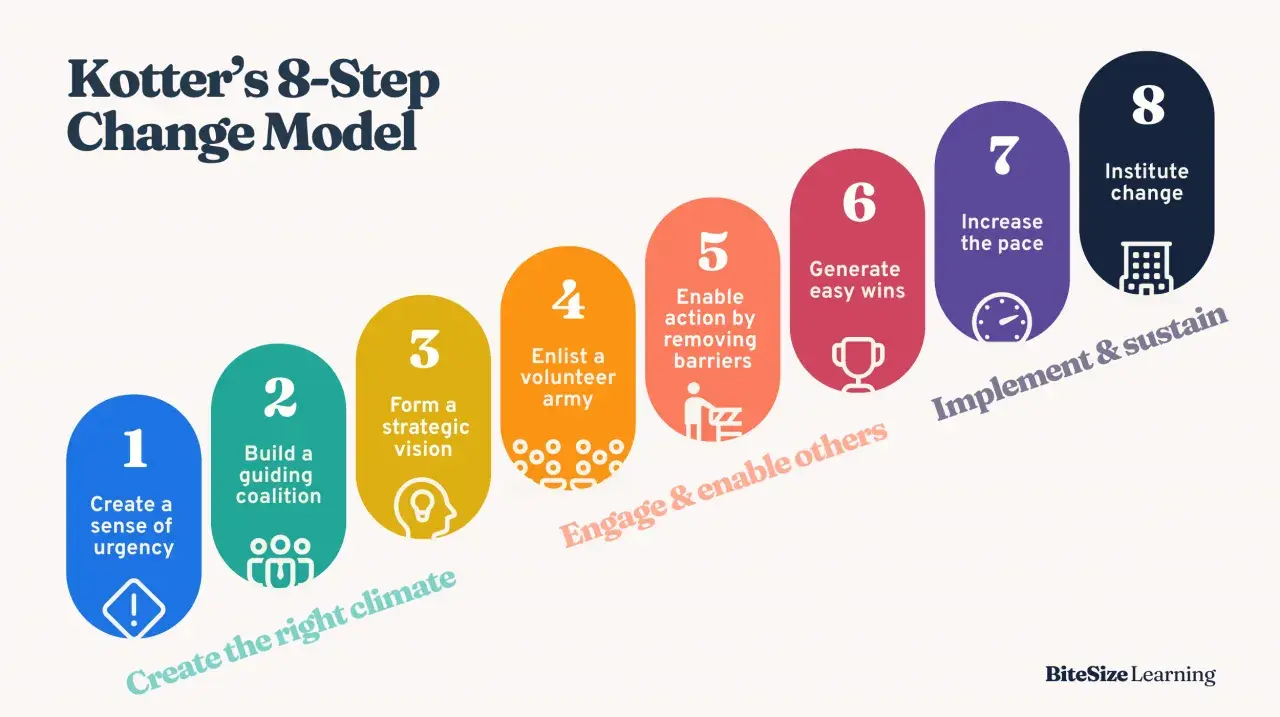
Workplace change rarely breaks because people dislike progress. It breaks when the future is vague, the workload is underestimated, and the people expected to carry the shift were never given a real hand in shaping it. I use the idea of embracing change in a practical sense here: building the habits, communication, and leadership discipline that help teams adapt without losing trust, clarity, or performance.
The strongest change plans are concrete, inclusive, and measured
- People usually resist uncertainty, not improvement itself.
- A credible change strategy explains the reason, the expected behavior, the timeline, and the support.
- Inclusive leadership improves adoption because it surfaces problems early and reduces blind spots.
- Small pilots, clear owners, and a 30-60-90 day rollout are more reliable than a big-bang launch.
- The most common failures are vague communication, weak training, and no follow-through after launch.
What change really asks of people
When a company changes a process, tool, structure, or priority, it is not only changing a workflow. It is asking people to relearn habits, rebuild confidence, and accept a period where they are less efficient than usual. That is why change feels personal even when the decision is strategic.
In my experience, the real burden of change usually falls into four areas: attention, competence, identity, and energy. People have to pay close attention to new instructions, learn new skills, let go of old expertise, and do all of that while still meeting existing targets. If leaders ignore those pressures, they mistake a normal human reaction for stubbornness.
- Attention gets split between old work and new expectations.
- Competence drops temporarily while people learn.
- Identity shifts when someone is no longer the person others rely on for the old way of doing things.
- Energy gets drained when change is added on top of a full workload.
Once you see those pressures clearly, resistance stops looking irrational and starts looking predictable. That leads directly to the more useful question: what is the resistance trying to tell you?
Why resistance is usually a signal, not sabotage
Gallup has noted that change often feels like a loss of control before it feels like an improvement, and that is exactly why employees push back. Most people are not objecting to the idea of progress. They are reacting to weak communication, unclear roles, poor timing, or a history of being asked to adapt without enough support.
I treat resistance as a diagnostic tool. It tells me where the strategy is thin, where the communication is too abstract, and where leaders have underestimated the cost of transition.
| What people say | What is often underneath | What to check | What to do next |
|---|---|---|---|
| “This is moving too fast.” | People do not have enough time to learn the new way. | Training hours, workload, and transition dates. | Slow the rollout, cut nonessential work, and stage the change. |
| “I do not see why this is necessary.” | The business case has not been translated into daily impact. | Whether the explanation links to customer, cost, or quality outcomes. | Explain the problem in plain language and show the cost of doing nothing. |
| “This will not work here.” | The plan may ignore local reality. | Team size, workflow differences, compliance constraints, and tool access. | Adapt the rollout to each team instead of forcing one template everywhere. |
| “We have tried this before.” | Trust has been damaged by earlier failed change efforts. | What happened last time, who was affected, and what support was missing. | Acknowledge the history honestly and show what is different this time. |
That distinction matters because it changes the leader’s job. The goal is not to silence resistance. The goal is to remove the conditions that make resistance reasonable. From there, the work becomes much more practical: build a strategy people can actually follow.

How to build a change strategy people can actually follow
The strongest change plans are not complicated. They are specific. They name the problem, define the new behavior, assign ownership, and create a path for feedback before frustration turns into drift.
I use a simple 30-60-90 day structure because it keeps change from becoming vague. It also forces leaders to decide what should happen immediately, what should be tested, and what should only be scaled after the pilot proves itself.
| Stage | What I focus on | What good looks like |
|---|---|---|
| Days 1-30 | Define the outcome, explain the business reason, identify who is affected, and choose the sponsor. | People can explain the change in one sentence and know who owns the rollout. |
| Days 31-60 | Pilot the change with a small group, collect feedback, and remove friction. | The process works in real conditions, not just in a slide deck. |
| Days 61-90 | Scale what works, retire the old workflow, and track adoption and quality. | The new behavior starts to look normal, not experimental. |
Three metrics are usually enough at the start: adoption, quality, and time to proficiency. If adoption is high but quality is poor, the training is weak. If quality is fine but adoption is low, the process is probably too hard or too disruptive. If both are fine but people still complain, the communication layer may be the problem. That kind of reading is far more useful than relying on a vague sense that “the rollout is going well.”
The point of the structure is not to slow change down for its own sake. It is to make the next step visible before the first one is forgotten.
Why inclusive leadership improves adoption
Change is easier to adopt when people believe the process was designed with them, not merely delivered to them. That is where inclusive leadership matters. It does not mean everyone decides everything. It means the people closest to the work, including remote staff, frontline teams, and employees from underrepresented groups, have a real way to shape the rollout before decisions become irreversible.
Inclusive change is often stronger because it catches practical failures early. A policy may look elegant to senior leaders and still fail for shift workers, caregivers, people with accessibility needs, or teams in different locations. If only the loudest voices shape the plan, the final version usually fits the people already closest to power.
- Ask earlier than you think you need to, especially with the people who will live with the new process every day.
- Explain tradeoffs clearly, not just the upside. People trust leaders who are honest about what will get harder before it gets easier.
- Train managers first so they can answer questions consistently instead of improvising under pressure.
- Use multiple channels because not everyone absorbs change through the same format. A live meeting, a written guide, and a short Q&A can each serve different needs.
- Protect psychological safety by making it safe to ask basic questions, report problems, and admit confusion without penalty.
When these habits are in place, change becomes less like a mandate and more like a shared operating decision. That also makes it easier to see the mistakes that still undermine good intentions.
Common mistakes that quietly break good change programs
Most failed change efforts do not collapse in one dramatic moment. They erode slowly through avoidable mistakes. I see the same patterns over and over.- Announcing before aligning creates mixed messages. If managers are not briefed first, employees hear inconsistent explanations and assume the plan is weaker than it is.
- Overloading the same teams makes the change compete with core work. Even a strong strategy loses momentum when people are asked to do more without dropping anything else.
- Training once and stopping assumes learning is complete after a workshop. It is not. People need follow-up, examples, and time to practice.
- Measuring activity instead of adoption gives a false sense of success. Attendance, clicks, and completed forms do not prove that behavior changed.
- Ignoring local context creates avoidable friction. Different teams often need different rollout pacing, job aids, or approvals.
- Ending communication too early leaves a vacuum. If leaders stop talking after launch day, rumors and workarounds fill the space.
If I had to choose the most damaging mistake, it would be assuming that launch equals adoption. In reality, launch is only the start of the behavior shift. The organization still has to help people through the awkward middle, where habits are unstable and confidence is low.
How to make the next shift feel less disruptive than the last one
The best organizations do not treat change as a rare event. They build routines that make the next shift easier than the previous one. That usually means shortening feedback loops, documenting decisions more clearly, and keeping managers involved after the first announcement is over.
- Run a short retrospective after every significant rollout.
- Keep one owner accountable for adoption, not just implementation.
- Review training materials every time the process changes.
- Ask teams what they would need to adapt faster next time.
- Track one or two leading indicators, such as time to proficiency or process errors, before problems spread.
If I reduce the whole topic to one idea, it is this: change becomes manageable when it is designed for real people, not ideal conditions. Clear direction, inclusive input, and disciplined follow-through turn uncertainty into something teams can actually work with. That is what makes organizational change sustainable instead of exhausting.
