
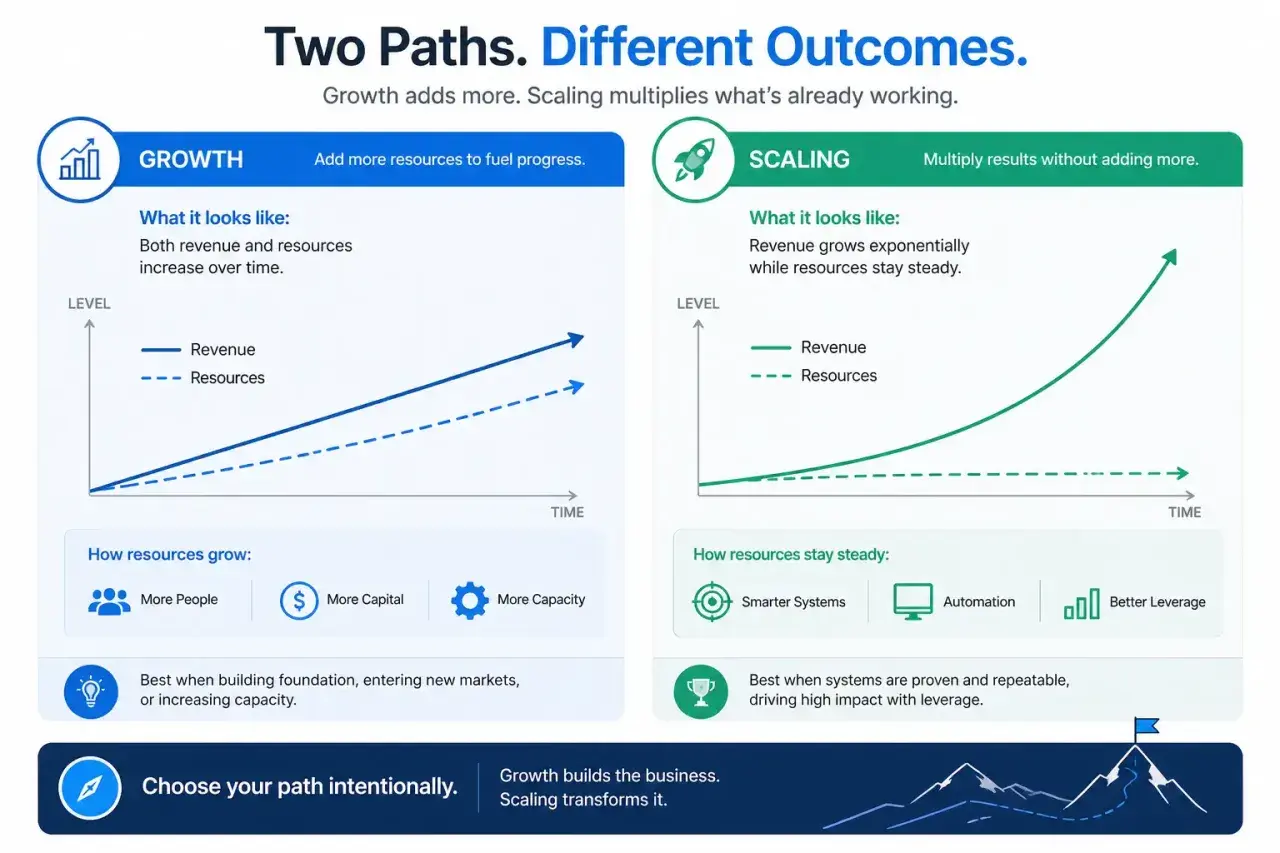
Growth breaks down when expansion becomes a pile of disconnected initiatives. A business growth framework is only useful when it turns ambition into repeatable decisions about where to grow, what to change, and how to keep people aligned while the company scales. In this article I break down the parts that matter most: strategy, operating rhythm, culture, metrics, and the leadership habits that make change stick. I also show where these plans usually fail in U.S. organizations that are trying to grow without losing trust or consistency.
What you need to make growth repeatable instead of reactive
- A strong growth model connects market choice, operating design, and talent development instead of treating them as separate workstreams.
- Inclusive leadership is part of execution, because it helps leaders hear risks earlier and make better decisions under pressure.
- A 90-day pilot is usually enough to test whether the approach is working before you commit to a wider rollout.
- The most common failure is measuring revenue while ignoring adoption, manager capability, and the workload created by change.
- If the culture cannot absorb change, the strategy will stall even when the numbers look good on paper.
Why strategy and culture need to move together
One of the clearest lessons I keep seeing is that growth is not just a commercial problem. It is also a coordination problem. Duke Fuqua describes a change-ready culture as one that can anticipate, respond to, and capitalize on change, and that framing is useful because it puts culture in the same category as strategy, not beside it as an afterthought.
That matters because a company can have a strong market opportunity and still fail to capture it if teams are not aligned on how to behave, who decides, and how to learn from mistakes. I would never start with a revenue target alone. I would start by asking whether the organization can actually absorb the next level of complexity.
- Which customer segment or problem deserves the next investment?
- What capability has to improve before the company can scale safely?
- Which decisions need to stay centralized, and which should move closer to the work?
- What behavior must change if the plan is going to survive real pressure?
When those answers are vague, growth becomes expensive fast. Once they are clear, the next step is to translate them into a structure the business can actually run on.

The five building blocks I would use to design one
If I were building the system from scratch, I would keep it simple and strict. Not simple in the sense of shallow, but simple enough that a manager could explain it without a deck. The point is to build a model that helps the organization make better choices, not a document that looks impressive and then gets ignored.
| Building block | What it answers | What breaks when it is weak | My rule of thumb |
|---|---|---|---|
| Strategy choice | Where are we growing, and why there? | Too many priorities, too little focus | Pick one primary growth bet for each cycle |
| Operating model | Who owns decisions, handoffs, and execution? | Confusion, delays, and duplicated work | Define owners and cadence before you scale |
| Talent and capability | Do we have the skills and manager readiness to deliver? | Strong strategy, weak adoption | Build manager capability early, not after launch |
| Data and metrics | What shows progress before the quarter closes? | Late surprises and too much guesswork | Track a small set of leading indicators monthly |
| Culture and inclusion | Can people speak up, adapt, and grow fairly? | Silence, turnover, and uneven access to opportunity | Make voice and development visible in daily routines |
The businesses that scale well usually do not have one magic lever. They have a coherent stack. Strategy says where to go, operations say how to move, talent says who can carry the load, and culture decides whether people will actually commit. That leads directly to the part many leaders treat too lightly: who gets to shape the change while it is happening.
How inclusive leadership changes the growth equation
Inclusive leadership is not a nice-to-have here. It changes the quality of the information leaders receive, the speed at which problems surface, and the willingness of teams to carry a change through friction. When people believe their input matters, they tell the truth earlier. That is not soft value. That is operational advantage.
Voice catches problems early
In fast-growing teams, the first warning sign is often silence. People see the process break, the customer friction, or the handoff that will not scale, but they do not speak up because they assume someone else will handle it. I want the opposite. I want meetings, retrospectives, and one-to-ones that make it normal to raise the uncomfortable version early, while the fix is still cheap.
Fair access keeps growth from bottlenecking
Growth often stalls when the same small group owns the high-visibility work, the stretch assignments, and the promotion paths. That is a cultural issue, not just a talent issue. If opportunity is narrow, scaling simply moves the bottleneck from revenue to people. The fix is practical: make criteria visible, widen project ownership, and check whether development opportunities are distributed in a way that matches the companys stated values.
Read Also: Decision-Making Frameworks for Strategy & Change
Learning habits make change stick
I think this is where many plans quietly fail. Leaders announce a new way of working, but the organization never builds the routines that help people learn it. Regular manager check-ins, short feedback loops, and after-action reviews matter because they turn change into a habit instead of a one-time announcement. In other words, inclusion becomes operational when more people can contribute and more people can learn.That is why I treat inclusion as part of the growth engine, not a separate HR project. Once that is in place, the framework has a much better chance of surviving contact with real work.
A 90-day build plan that turns the model into action
If you want the system to become real, do not start with a giant transformation. Start with a 90-day build. That window is long enough to expose friction and short enough to correct course before the organization gets tired of the effort.
| Timeframe | Focus | Deliverable |
|---|---|---|
| Days 1-15 | Define the growth thesis and the boundaries | A one-page statement of what you are growing, for whom, and what constraints matter |
| Days 16-30 | Map the current state | A simple view of strategy, capability gaps, decision rights, and cultural risks |
| Days 31-60 | Align managers and metrics | A dashboard with 3 to 5 leading indicators and a manager briefing on how to use them |
| Days 61-90 | Run one pilot and review the results | A scale, stop, or modify decision based on evidence, not hope |
The numbers do not need to be complicated. I would rather track a small set of indicators every month than bury the team in dashboards nobody reviews. For most organizations, that means a mix of adoption, cycle time, employee feedback, and one business outcome tied to the pilot. If the pilot is meant to improve customer retention, measure retention. If it is meant to improve internal mobility, measure internal movement and manager readiness. The point is to connect behavior to outcome before you expand.
This kind of rhythm also makes it easier to spot the failure points before they become expensive. And once you know the common traps, you can avoid wasting time on fixes that look productive but do not move the business.
Where growth plans usually break down
I see the same mistakes over and over, and they are usually avoidable. The problem is not that leaders lack ambition. The problem is that they overestimate how much the organization can absorb at once, and they underestimate how much behavior has to change for the strategy to work.
- They measure only revenue. Revenue matters, but it is a lagging signal. If adoption, capability, or retention are weak, the revenue number will eventually tell the truth too late.
- They launch too many priorities at once. A growth plan loses force when every team is told that everything is urgent. Focus has to be protected.
- They expect managers to cascade the change without support. Middle managers need talking points, decision rules, and time to coach people through the transition.
- They ignore workload during change. If people are already overloaded, even a sensible change feels like another demand instead of a better way of working.
- They confuse training with adoption. A workshop is not the same thing as a changed habit. Adoption shows up in routines, decisions, and behaviors, not attendance sheets.
When I see one of these patterns, I do not usually add more initiative. I simplify. The right response is often to reduce the number of moving parts and make the expected behavior clearer. That is what keeps the framework usable when the business gets busier.
The habits that keep growth from turning into drift
The best version of this approach is the one people can still use after the first wave of excitement fades. I look for four signs that the system is durable: a manager can explain it in under a minute, the team knows what good behavior looks like, the metrics are reviewed on a fixed cadence, and the pilot has a clear decision point attached to it. If those four things are true, the company has a real operating system for growth, not just a strategic ambition.
- Keep the core model to one page so it stays visible.
- Review leading indicators monthly, not only at quarter end.
- Make inclusion part of manager expectations, not a side initiative.
- Use pilot results to decide what gets scaled, revised, or stopped.
That is the version I would trust in 2026: focused enough to move, human enough to last, and disciplined enough to keep change from becoming noise. If strategy, inclusion, and execution stay linked, expansion feels less like a gamble and more like a capability the organization can repeat.
