
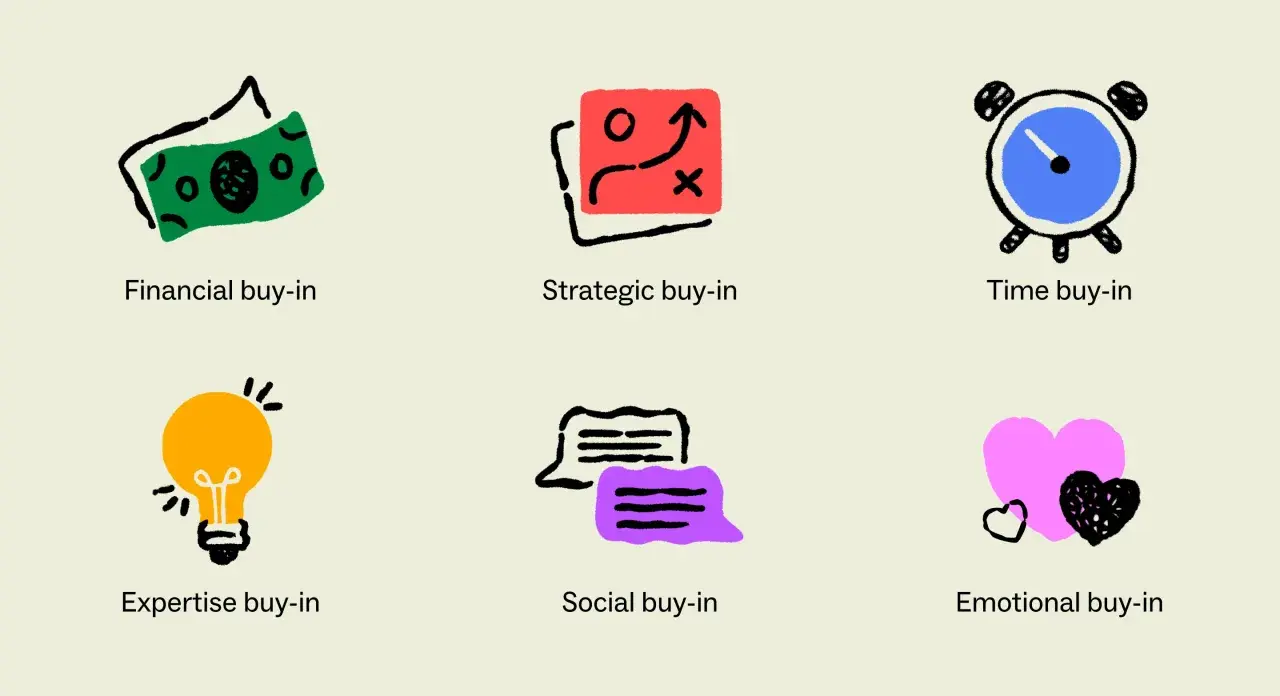
Stakeholder support rarely comes from a polished deck alone. It comes from showing people that the change is worth the effort, that their concerns have been heard, and that the plan has a clear path from idea to execution. This article explains how to get buy in from stakeholders in a way that works for strategy and change work, especially when the change affects leadership habits, team routines, or workplace culture.
The fastest way to win support is to match the message to the audience
- Start with influence, not titles. The people who can slow a change are not always the most senior people in the room.
- Translate the case for change. Executives, managers, and employees usually need different proof to care.
- Involve people early. Input is more persuasive than a fully formed decision announced at the end.
- Treat resistance as information. It often signals fear, workload, unclear roles, or weak trust.
- Plan for follow-through. Buy-in weakens quickly when progress is not visible after the first meeting.

Map influence before you pitch the idea
I start with influence, not titles, because the person who can slow a change is not always the person with the biggest job title. If I want durable support, I need to know who will sponsor the work, who will question it, who will do the work, and who will quietly shape the conversation around it.
A simple stakeholder map usually gives me more clarity than a long slide deck. I sort people by two questions: how much can they affect the outcome, and how much will the change affect them?
| Stakeholder group | What they usually care about | What earns their support |
|---|---|---|
| Executive sponsor | Strategic fit, risk, timing, and return on effort | A concise case, a clear decision ask, and visible progress |
| Middle manager | Team workload, role clarity, and operational disruption | Practical guidance, talking points, and support for leading the change |
| Frontline employee | How the change affects daily work, fairness, and trust | Specific examples, honest tradeoffs, and a way to ask questions |
| HR or People team | Policy alignment, consistency, and culture impact | Measurable outcomes and a plan for reinforcement |
| Informal influencer | Whether the change is realistic and respected | Early involvement and proof that feedback actually changes the plan |
That map keeps me from making two expensive mistakes: over-explaining to people who only need updates, and under-preparing the people who can block adoption. Once I know where the pressure points are, I can frame the case for change in a way that lands.
Build the case for change in the language each group uses
The strongest change case is not one argument repeated five times. It is one idea translated into different priorities. That matters in strategy work, and it matters even more when the change touches inclusive leadership or workplace culture, because the audience will not all define success the same way.
I usually think in four layers: why now, why this, why us, and why this approach. If any one of those is vague, people fill in the blanks themselves, and that is usually where resistance starts.
| Audience | What they need to hear | Example framing |
|---|---|---|
| Executives | Strategic impact and risk | This change supports the business plan, lowers execution risk, and gives us a clearer path to the outcome we want. |
| Managers | Workload and team impact | Here is what will change in practice, what support you will get, and what you will no longer need to carry alone. |
| Employees | Daily relevance and fairness | Here is how this affects your workflow, how your voice will be heard, and what will be different for you next week. |
| People or DEI leaders | Consistency and culture | This change should make the workplace more equitable, more predictable, and easier to sustain across teams. |
| Finance or operations | Cost, capacity, and dependencies | Here is the resource ask, the timeline, the fallback plan, and the operational impact if we do nothing. |
Clarity beats persuasion theater. I would rather give a plain one-page brief with a credible downside analysis than a glossy pitch that hides the tradeoffs. For a culture change, I always translate abstract goals into observable behavior: who speaks in meetings, how feedback is handled, what gets measured, and what leaders will do differently.
When people can see the behavioral change, they are much more likely to believe the strategy is real. That opens the door to involvement, which is where support tends to deepen.
Bring people into the work before the decision is final
Buy-in grows when people can shape the solution, not just react to it. In practice, that means I use a few small mechanisms instead of one giant announcement.
- One-to-one conversations with the most influential stakeholders. A 30-minute interview is often enough to uncover the concern behind the concern.
- Working groups with 6 to 8 people who represent different functions, levels, or lived experiences. That size is small enough to move and large enough to surface blind spots.
- Limited pilots in one team, one office, or one workflow. A pilot gives you real evidence, not just optimistic predictions.
- Feedback loops with a response deadline. I like a simple rule: acknowledge input within 5 business days, even if the final answer takes longer.
A pilot is more persuasive than a promise because it turns opinion into evidence. If a new meeting norm increases participation, or a new manager practice reduces confusion, people stop debating the theory and start seeing the result.
The important part is not collecting every opinion. It is closing the loop so people can see how input changed the plan. That matters in inclusion work, where token consultation without follow-through damages trust fast. Once that trust slips, the next section of the change becomes harder.
Handle resistance without turning it into a power struggle
I do not assume resistance is irrational. More often, it is a sign that people see a cost I have not addressed yet. Sometimes that cost is workload. Sometimes it is status. Sometimes it is a bad memory of the last transformation that never delivered.
Quiet resistance is especially important to notice. In many organizations, people will not say no directly. They will postpone, nod politely, ask for more clarification, or simply stop showing up to the conversation.
| What resistance sounds like | What it may really mean | What to do next |
|---|---|---|
| “We do not have time for this.” | The change feels like extra work without a clear payoff | Remove one burden, show the time saved, and make the first step smaller |
| “We tried this before.” | Trust is low because a past effort failed or was abandoned | Acknowledge the history and explain what is different this time |
| “This will not work for my team.” | Local context has not been considered | Invite the person to adapt the rollout for their environment |
| “Who decided this?” | Decision rights are unclear | Clarify who owns the decision, who advises, and who implements |
| Silence or low participation | People may feel unsafe, unconvinced, or ignored | Use private check-ins and anonymous feedback before the next meeting |
When I am dealing with a sensitive culture change, I separate feedback from consensus. People do not need to agree on everything before the work can move forward, but they do need to understand the decision, the reason behind it, and the boundaries of what can still change. A useful question is, “What would make this workable for you?” It gets me to the practical obstacle faster than asking whether someone supports the idea in the abstract.
That approach keeps the conversation honest without letting it turn into a status contest. Once the emotional temperature is lower, it becomes much easier to keep support alive.
Keep support alive after the first yes
The most common mistake I see is treating buy-in as a one-time win. It is not. Support weakens if people stop hearing what is happening, what is changing, and what progress looks like. If the initiative is about inclusion or culture, that problem is even sharper because people are watching behavior, not just reading updates.
I like to track a small set of metrics so the story stays concrete. You do not need 20 dashboards. You need a few indicators that tell you whether the change is being adopted and whether it is having the effect you expected.
| Metric | What it tells you | How often to review it |
|---|---|---|
| Adoption rate | Whether people are actually using the new process or behavior | Weekly or monthly, depending on the pace of change |
| Participation rate | Whether people are engaging with the rollout, training, or feedback loop | Every 2 weeks during the early phase |
| Sentiment pulse | Whether confidence and trust are rising or falling | Monthly |
| Issue resolution time | Whether blockers are being handled quickly enough | Every sprint or review cycle |
| Outcome metric | Whether the change is improving the result you wanted | 30, 60, and 90 days after launch |
I like a simple 30-60-90 cadence. At 30 days, show what has started and what is blocked. At 60 days, show early wins and the places where the rollout needs adjustment. At 90 days, decide what to scale, what to revise, and what to stop.
Keep reporting the same three or four numbers to every audience, even if the message changes slightly. Consistency makes the initiative feel real. And when people can see progress, they are far more likely to keep backing the work.
The playbook I would use for the next change conversation
If I had to reduce the whole process to one practical sequence, I would use six steps. They are simple, but they work because they force discipline before persuasion.
- List stakeholders by influence and impact, not just by title.
- Write one sentence about what each group cares about most.
- Prepare a tailored version of the case for executives, managers, and employees.
- Run a small set of one-to-one conversations before the big meeting.
- Pilot the change with one team, one workflow, or one location.
- Report back with visible evidence, not just reassurance.
That sequence usually gets further than another round of polished slides. Support is built through alignment, evidence, and follow-through, not through one perfect pitch. If the change is tied to strategy, leadership, or workplace culture, the conversation after the first meeting matters just as much as the meeting itself.
