
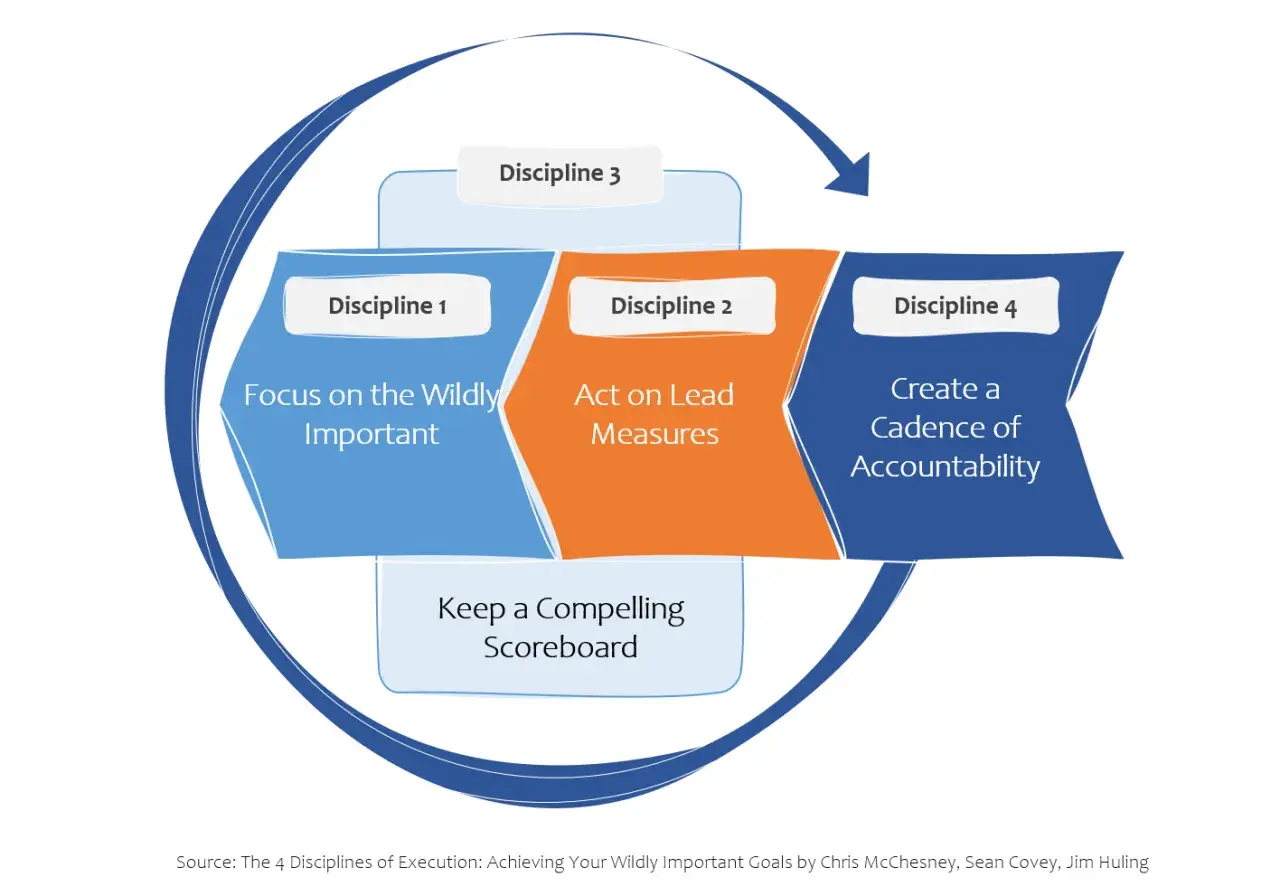
When strategy keeps getting buried under daily work, execution usually fails for a simple reason: too many priorities, not enough visible follow-through. The 4 Disciplines of Execution is a practical way to turn a strategic goal into weekly behavior, so teams can see progress, correct course early, and stay focused long enough to create real change. I’ll break down how the framework works, where it is strongest, where it breaks down, and how I would adapt it for inclusive leadership and workplace culture.
How this framework turns strategy into weekly action
- It works best when one strategic priority truly matters and the team can name it clearly.
- It separates outcome measures from the actions that actually influence those outcomes.
- It uses a visible scoreboard so progress is obvious without a long status meeting.
- It replaces vague accountability with short, regular commitments.
- It is especially useful in change work, where behavior change matters more than a polished plan.
What the framework is really designed to do
At its core, this is not a project management method. It is a focus-and-follow-through system built for moments when the everyday workload, or “whirlwind,” keeps swallowing the work that matters most. I think that distinction matters, because many teams try to solve a strategy problem with better slides, more meetings, or another planning layer. That usually adds noise. This framework helps by narrowing attention, connecting goals to measurable actions, and forcing a regular conversation about whether the team is actually moving.
FranklinCovey popularized the model because it addresses a common execution gap: organizations often know what they want to achieve, but they do not translate that ambition into a small set of behaviors that people can repeat every week. Used well, it gives strategy a rhythm. Used badly, it becomes another reporting ritual. The difference is whether the team treats it as a decision-making tool or just a compliance exercise. Once that is clear, the next step is understanding how each discipline works on the ground.

The four disciplines in practice
The framework is simple on paper, but each discipline solves a different execution problem. I like to explain them together because teams often understand one or two pieces and then miss the system behind them.
| Discipline | What it solves | What it looks like in real work |
|---|---|---|
| Focus on the wildly important | Too many priorities competing for attention | Choose one or two goals that matter enough to displace lesser work |
| Act on the lead measures | Tracking outcomes without influencing the drivers | Identify weekly behaviors that predict success and can be controlled now |
| Keep a compelling scoreboard | Unclear progress and passive ownership | Show the team, at a glance, whether the goal is on track |
| Create a cadence of accountability | Good intentions that fade between meetings | Hold short weekly sessions where people commit to specific actions |
Focus on the wildly important
This discipline is about saying no with discipline. Most teams have five, ten, or fifteen “top priorities,” which is another way of saying they have none. A wildly important goal, or WIG, is the one outcome that deserves disproportionate attention because it creates the biggest strategic impact. In practice, that might be reducing turnover in a key role, improving internal mobility for underrepresented employees, or cutting a critical customer-service bottleneck. The point is not to chase more goals faster; it is to make one important thing impossible to ignore.
Act on the lead measures
Lag measures tell you what happened. Lead measures tell you what people can do this week to influence what happens next. That is why this discipline matters so much in change work. If the lag measure is lower attrition, the lead measures might be manager check-ins, quality feedback conversations, or faster response times to employee concerns. If the lag measure is a more equitable promotion process, the lead measures might be structured calibration reviews or consistent panel completion. The best lead measures are predictive, influenceable, and easy enough to track without turning the process into bureaucracy.
Keep a compelling scoreboard
People execute differently when they can see the game. A good scoreboard makes progress visible in a way that is simple, honest, and hard to ignore. It should tell the team whether it is winning or losing without needing a long explanation. I prefer scoreboards that show only the measures that matter and update often enough to support decisions, not just retrospective reporting. For culture and inclusion work, that matters even more, because hidden progress usually means slow progress. Visibility creates urgency, and urgency helps sustained change stick.
Read Also: Organizational Change - Make It Stick (Finally!)
Create a cadence of accountability
This is where the model becomes real. Weekly commitments force a conversation about ownership, not just aspiration. I think this is one of the most overlooked parts of the framework, because many leaders enjoy setting goals but avoid the small, repeated check-ins that make those goals believable. A short weekly meeting, often around 20 minutes, is enough if it is focused: what did you commit to, what happened, what will you do next. That rhythm is what turns intent into habit, and habit into results. Once the mechanics are clear, the bigger question is where this approach actually helps strategy and change.
Why it works for strategy and change
The framework is strongest when a strategy requires people to behave differently, not just think differently. That is why it shows up so often in change programs. A new operating model, a customer experience redesign, or a culture shift all depend on repeated human behavior. People do not change because a strategy exists on paper; they change when the work around them becomes clearer, smaller, and easier to act on.
In strategy work, the model helps leadership teams avoid the classic trap of trying to move everything at once. In change work, it helps answer the question, “What exactly should people do differently on Tuesday?” That is a more useful question than “Do we support the change?” because support is vague, while behavior is measurable. For example, if a company wants a more inclusive workplace, a strategy deck can say “improve belonging,” but the execution plan needs specific habits: manager check-ins, structured interviews, promotion calibration, and visible follow-up on employee feedback. That shift from ambition to behavior is where the framework earns its keep.
It also works because it acknowledges the reality of competing demands. The daily whirlwind does not disappear during transformation, so the execution system has to survive inside it. That means the strategy must be narrow enough, the measures must be specific enough, and the accountability must be regular enough to hold up under pressure. If any of those pieces are missing, the change effort starts to drift. The next section covers the most common ways that happens.
Where teams get it wrong
Most failures are not conceptual. They are operational. Teams usually know the words; they just do not follow the discipline. Here are the mistakes I see most often:
- Picking too many goals and calling them all “critical.”
- Tracking lag measures only, which tells you too late whether the strategy is working.
- Choosing lead measures that are easy to count but weakly connected to the outcome.
- Making the scoreboard private, complex, or hidden inside a reporting tool no one checks.
- Turning weekly accountability into a status meeting with no real commitments.
- Using the framework to punish people instead of helping them execute.
The biggest limitation is simpler than most leaders want to admit: this method cannot rescue a bad strategy. If the goal is vague, the org is overloaded, or the underlying incentives are broken, better discipline will not magically fix the problem. It can sharpen focus, but it cannot compensate for a lack of capacity or a strategy that has too many dependencies. I also think leaders underestimate the social side of execution. People need clarity, but they also need psychological safety to admit when commitments are slipping. Without that, the weekly rhythm becomes theater. That is especially important in inclusive leadership, where the quality of the process affects who gets heard and who gets protected.
How I would adapt it for inclusive leadership
This is where the framework becomes especially relevant for a site focused on workplace culture. Inclusion goals often fail for the same reason business goals fail: they are too broad to guide daily action. A statement like “build a more equitable culture” is directionally right, but it does not tell teams what to do differently or how to know whether the effort is working.
I would translate inclusion goals into measurable behavior in three layers. First, define the outcome clearly. For example, that could mean reducing promotion gaps, improving belonging scores, or increasing retention in a specific population. Second, choose lead measures that managers and teams can control, such as structured interview completion, consistent feedback cycles, fair calibration meetings, or timely follow-up on employee concerns. Third, make the scoreboard visible at the team or function level, not in a way that exposes sensitive individual data. Aggregated visibility supports accountability without creating unnecessary risk.
This approach is useful because culture changes through repeated habits, not slogans. If leaders say they value inclusion but skip the behaviors that make inclusion real, employees notice quickly. If managers commit to a small set of repeatable actions and track them honestly, people can feel the difference. That is why this framework is so effective for culture work: it turns abstract values into observable practice. The final step is to start in a way that is small enough to survive the first month.
The smallest useful version to start with
If I were introducing this in a real team, I would keep the first version deliberately small. One goal. Two or three lead measures. One visible scoreboard. One weekly meeting. That is enough to test whether the team can actually execute or whether the process is being buried under its own weight.
In the first 30 days, I would do four things: define the single outcome that matters most, identify the behaviors that most strongly drive it, make progress visible in one place, and schedule a short weekly accountability check. After that, I would look for evidence, not enthusiasm. Is the team clearer? Are the commitments sharper? Is the scoreboard changing behavior? If the answer is yes, the framework is doing its job. If not, I would simplify again before adding anything new. In my view, that restraint is what makes execution sustainable rather than performative.
