
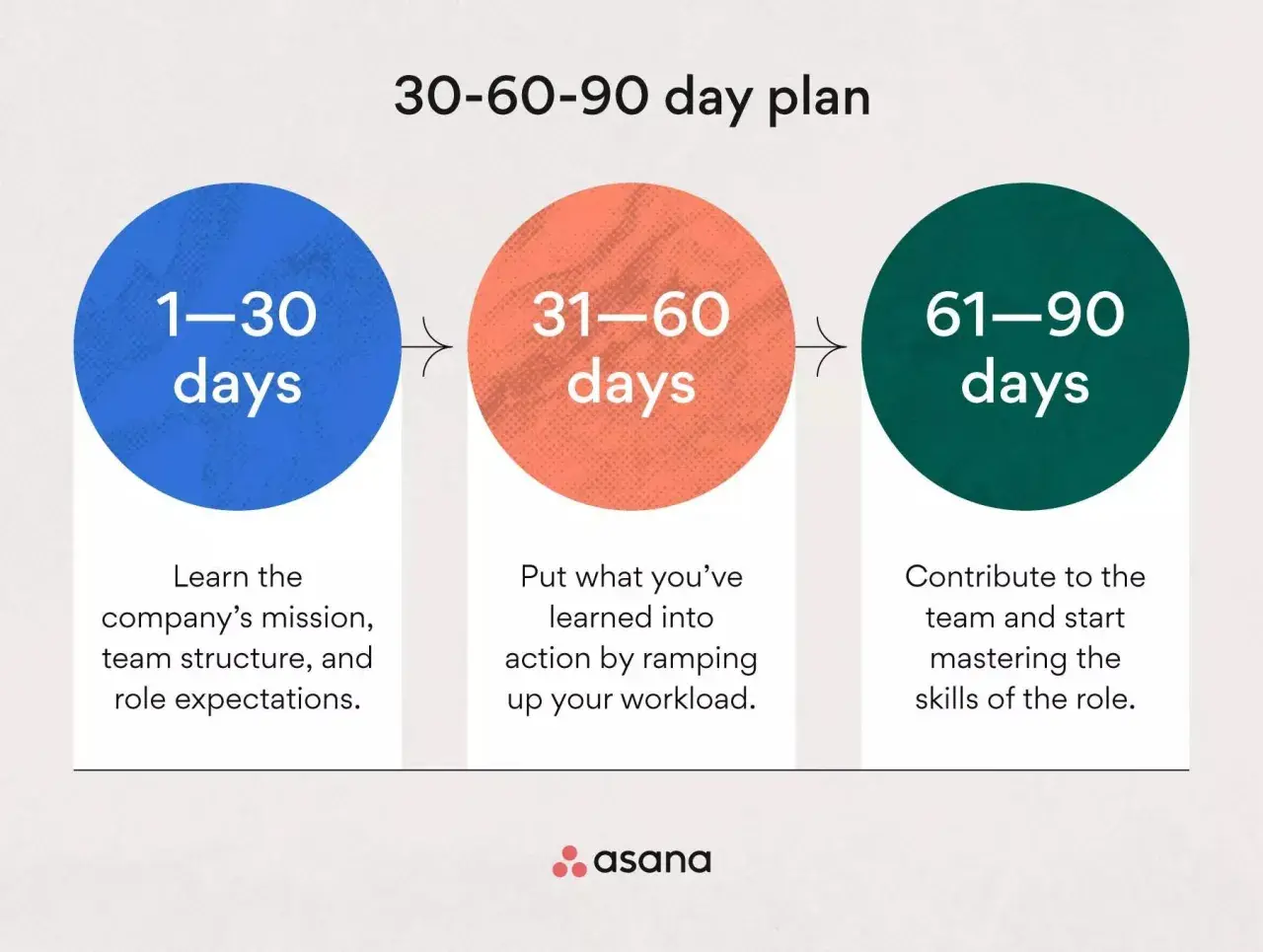
The first 90 days matter less because you need to be brilliant on day one and more because the people around you are deciding whether you can be trusted, coached, and included. In a new role, speed without context is expensive: you can look busy and still miss the real priorities, the informal power map, or the team habits that shape whether your work lands. This article breaks down what to focus on, how to turn a 30-60-90-day plan into practical action, and which early mistakes quietly slow strong starts down.
The practical priorities for a strong start
- Focus on role clarity early, including outcomes, decision rights, and who needs to be kept in the loop.
- Use a 30-60-90-day rhythm to move from learning to contribution without rushing the process.
- Ask for feedback before small gaps become habits that are hard to undo.
- Watch for inclusion signals such as airtime, access to information, and how questions are handled.
- Aim for small visible wins that prove judgment, not just busyness.
Why the opening quarter matters more than most people admit
The early months are where expectations harden. People are deciding not only whether you can do the job, but also whether you understand the team, respect the culture, and know when to ask for help. Recent HBR research suggests that psychological safety can erode quickly when new hires are left guessing about norms or whether it is safe to speak up, and I think that rings true in ordinary teams more than people admit. When the environment is unclear, new people spend energy decoding the room instead of contributing to it.That is also why I pay attention to belonging from the start. If people have to wonder whether they are welcome, whether their questions are tolerated, or whether they need to shrink themselves to fit in, they will hold back. Gallup has long argued that managers account for much of what drives engagement, which makes the manager relationship one of the most important parts of a strong start. I treat the opening quarter as a learning system, not a test you can wing, and that mindset changes everything that comes next.
Once you see the first months as a period for building clarity and trust, the next step is easier: you need a simple structure that keeps learning from drifting into passivity.

A 30-60-90 roadmap that keeps the work concrete
I like a simple roadmap because it gives shape to the early ramp without pretending every role is identical. The point is not to force a rigid script. It is to make sure each phase has a different purpose, so you are not still "learning" when you should be contributing.
| Period | Main goal | What to do | What good looks like |
|---|---|---|---|
| Day 1-30 | Learn the landscape | Meet key people, read past docs, confirm expectations, and study how decisions move. | You can explain the role, the team, and the biggest risks without guessing. |
| Day 31-60 | Contribute with focus | Own a small project, remove one friction point, and ask for targeted feedback. | Colleagues start relying on you for a defined slice of work. |
| Day 61-90 | Show independent ownership | Deliver a meaningful outcome, document a repeatable process, and propose next-quarter priorities. | You can work with less supervision and know when to escalate. |
If your role is technical, the learning curve may be slower. If you are stepping into management, the relationship map matters even more. The framework stays useful because it separates learning, contribution, and ownership instead of treating the whole quarter as one blurry stretch. Once that frame is clear, the first month becomes easier to use well.
What to focus on in days 1 to 30
In the first month, I care less about output volume and more about whether you can answer three questions: what matters, who decides, and how work actually moves. Read old plans, scan recurring meetings, and ask where the bottlenecks live. If your company has a documented onboarding path, use it. If not, build your own. The goal is simple: get enough context to stop guessing.
Learn the work and the context
This is the phase for listening with intent. I would rather see a new hire ask three precise questions than pretend to understand everything. Start with these:
- What are the top three outcomes for this role in the next quarter?
- Which tasks are urgent, and which are simply visible?
- Who should I check with before I move a decision forward?
- What does strong work look like in this team's writing, meetings, and handoffs?
- Which unwritten rules matter here, even if nobody says them out loud?
Those questions do more than reduce confusion. They show that you are trying to understand the system you joined, not just your own lane in it. That builds trust quickly.
Build relationships before you need them
Do not wait until you are blocked to start building relationships. Schedule short 1:1s with your manager, peers, and the people whose work touches yours. Keep them reciprocal. Ask what helps them, where they get stuck, and what they wish new people understood sooner. In inclusive workplaces, this matters because connection is not just social, it is operational.
I also watch for who is left out of the conversation. If the team is hybrid, notice whether remote people get the same context as people in the room. If meetings move quickly, ask for written follow-ups. If the group has a strong in-joke culture, do not let that become the default access point. Small adjustments like these help you learn the team without disappearing into the background.
Once you understand the landscape and the people in it, you are ready to shift from observation to contribution.
How to build credibility in days 31 to 60
By the middle of the ramp, the goal is to show that you can turn understanding into useful action. I do not mean a giant project or a flashy presentation. I mean one small, visible win that makes someone else's work easier. That could be a cleaner process, a simpler template, a sharper report, or a handoff that no longer creates confusion.
Ship one useful thing
The fastest way to earn credibility is to solve a real problem cleanly. Pick something that is annoyingly repetitive, poorly documented, or easy to misunderstand, and improve it. That matters because it proves judgment. You saw something, you made a sensible call, and you closed the loop.
Read Also: Stay Relevant in Business - Your Guide to Lasting Value
Make your progress visible
Visibility is not self-promotion when it keeps people aligned. A short weekly update that lists wins, blockers, and next steps helps your manager support you and prevents important work from disappearing into silence. In many U.S. workplaces, the first formal review arrives later than people expect, so a midpoint calibration is worth asking for instead of waiting for a formal checkpoint that comes too late.
This phase is also where feedback matters most. Ask for it on one specific thing, not everything at once. For example, ask whether your updates are clear, whether your priorities match the team's, or whether your meetings are moving in the right direction. Specific feedback is easier to use, and it keeps small problems from becoming habits.
That is the bridge between learning the job and owning part of it. The next step is to make sure the end of the quarter shows real progress, not just activity.
What to demonstrate before the 90-day mark
By the end of the quarter, I want three things to be true: you can describe your priorities without a script, you know where to go when you need help, and you have already improved something real. That is the difference between being onboarded and being integrated. It does not mean you know everything. It means you are no longer working blind.
- You can explain the team's top priorities in plain language.
- You know which stakeholders matter and why.
- You have responded to feedback instead of waiting for a formal review.
- You have identified at least one recurring risk or inefficiency.
- You can name the norms around communication, escalation, and decision-making.
At this point, the goal is not perfection. It is reliability. People should feel that you are learning fast, making sensible trade-offs, and becoming easier to work with. That is what earns trust heading into the next quarter.
The mistakes that create avoidable drag
Most early mistakes are not dramatic. They are just expensive over time. They create rework, delay trust, and make the role feel harder than it needs to be.
- Acting before you understand. Motion feels productive, but it can create cleanup work for everyone else.
- Waiting for perfect clarity. In most teams, you will need to ask, test, and adjust before everything feels settled.
- Ignoring the culture signals. If meetings, feedback, or decision paths feel uneven, notice the pattern early instead of adapting silently.
- Overpromising to look helpful. A smaller promise delivered well does more for your reputation than a big promise that slips.
- Skipping feedback loops. If you do not ask how your work is landing, you will find out later and pay more to fix it.
- Assuming inclusion happens automatically. A company can talk about values while still making new people decode the room on their own.
The quiet danger is that these mistakes rarely fail loudly. They just make the next month harder than it needed to be. That is one reason inclusive onboarding matters so much: it lowers the amount of guessing people have to do.
What inclusive onboarding should feel like
Inclusive onboarding is not an extra initiative on top of a normal start. It is the normal start, designed well. The formal job needs to be clear, but the informal rules matter too. People should know how decisions are made, how meetings work, where to ask for help, and what the team values when the pressure rises. Belonging grows when people do not have to wonder whether their questions, identity, or working style will be treated as a liability.
For a new hire, these are good signs:
- There is a clear point of contact for questions in the first few weeks.
- Meeting agendas are shared in advance, and follow-up notes are actually used.
- Feedback is specific, respectful, and tied to outcomes.
- Different time zones, accessibility needs, or caregiving constraints are treated as normal planning factors.
- Quieter voices are intentionally invited into the room.
For a manager, the standard is just as practical. Explain the formal job and the informal norms. Make space for different communication styles. Share context before people need it. And check whether the new person is getting the same access to information and opportunities as everyone else. That is how the early ramp becomes a retention tool instead of a stress test.
What the next quarter should let you do
Once the opening quarter is over, the job changes. You stop spending so much energy decoding the place and start shaping how you contribute to it. I like to see a simple rhythm emerge: a weekly priority list, a monthly feedback check, and a habit of naming blockers early. If the role is broader than expected, ask for a reset on priorities instead of quietly carrying the overload. If the role is narrower than expected, ask where you can add value without stepping on land you do not own.
If I were starting again, I would ask for three things in writing: the top success metric, the main decision-maker map, and a midpoint check-in. Those three pieces remove most of the avoidable confusion in a new role. They are especially useful in U.S. workplaces, where formal feedback often arrives after the early momentum window has already passed.
The best sign that the start worked is not that everything feels easy. It is that you now know where your energy should go. When that happens, the role stops feeling like a test and starts feeling like a place where you can build value with clarity, confidence, and a better sense of where you fit.
