
Salary negotiation is one of the few moments in a career when a single conversation can change your earnings trajectory for years. The honest answer to whether you should always negotiate salary is no, but the more useful answer is simpler: know when you have leverage, when the offer already sits near the ceiling, and when a smarter ask is for benefits instead of base pay. I’ll walk through the signals, the exceptions, and the wording that keeps the conversation firm without turning it into a standoff.
Key takeaways for deciding whether to negotiate
- Negotiate when you have a written offer, a clear market gap, or responsibilities that exceed the title and pay band.
- Hold back when compensation is fixed, the offer is already strong, or pushing would create more risk than upside.
- In 2026, U.S. salary budgets are still modest, so the offer stage is usually the best time to move pay.
- If base salary is capped, shift to sign-on pay, bonus target, PTO, review timing, title, or flexibility.
- The best negotiations sound factual and specific, not emotional or vague.
Leverage matters more than habit
I usually treat salary negotiation as a leverage check, not a ritual. In many U.S. companies, recent compensation budgets are still relatively tight, with average merit increases around 3.2% and total increases around 3.5% for 2026, which means the hiring offer is often the only real moment to create a meaningful jump.
That is why I do not ask, “Should I negotiate?” first. I ask three better questions: Can the company still move? Is the market supporting a higher number? Does my ask match the scope of the role? If all three answers are weak, a hard push usually adds friction without much gain. If two are strong, there is probably room to make a case.
- Company room means the recruiter has budget, approval flexibility, or a compensation band with space left in it.
- Market support means your target salary is backed by real comparisons, not just a feeling.
- Scope fit means you can point to results, specialization, or responsibility that justify more pay.
Once that logic is clear, the next question is when I would actively push for more money rather than accept the first number.
When I would push for more money
There are moments when I think negotiating is not only reasonable, but the responsible thing to do. One recent U.S. tech field experiment found that candidates who countered improved offers saw average total compensation gains of 13.9%, or $34,817, among offers that moved. Not every negotiation will look like that, but it is a good reminder that silence can be expensive.
- The written offer is below your researched range.
- The job scope is clearly larger than the title suggests.
- You bring niche skills, certifications, or direct experience that shorten the employer’s ramp-up time.
- You have another credible offer, or the market is actively competing for your profile.
- The company has not said the number is final, and the recruiter is still calibrating the package.
If the gap is real, I would usually ask. Not aggressively, not theatrically, just clearly. The goal is to close a mismatch, not to “win” the conversation. That distinction matters because some offers deserve a quieter response instead of a counter.
When I would not push hard
There are also situations where holding back is the better call. I do not mean “accept less than you deserve”; I mean “choose the right lever.” If the employer has already made the pay structure clear, the room for movement may be elsewhere.
- The salary is already at the top of the posted band.
- The employer has said compensation is standardized or tightly fixed.
- You are in a public-sector, union, internship, or highly structured entry-level setting where base pay is usually non-negotiable.
- The company is moving quickly and has signaled that the current offer is its ceiling.
- You do not have a factual basis for a higher ask and would be negotiating on instinct alone.
In those cases, I usually avoid forcing a salary-only conversation. A small bump that costs trust can be worse than a clean acceptance if the role is strong and the rest of the package is workable. From there, the smarter move is often to negotiate the parts of compensation that are easier to adjust.

The trade-offs beyond base pay
When salary is constrained, I widen the lens. Base pay matters, but it is not the only thing that shapes the value of an offer, especially if the role is remote, hybrid, high-travel, or tied to a promotion path.
| Item | Best when | Why it helps | What to watch |
|---|---|---|---|
| Sign-on bonus | Base salary is capped | Closes the gap in year one without changing the salary band | One-time money does not compound |
| Annual bonus target | The role has variable comp | Raises total compensation if performance is strong | Targets can be hard to predict if the company misses goals |
| PTO or flexibility | Work-life fit matters as much as pay | Can improve quality of life without altering payroll too much | Make sure the policy is written, not informal |
| Review timing | You can prove value quickly | Creates a near-term path to a raise | Ask for a specific date and review criteria |
| Title or level | The role is slightly under-leveled | Can affect future raises and internal mobility | A shiny title with no scope change is not enough |
| Learning budget or certification support | Growth and specialization matter | Builds long-term earning power | Confirm reimbursement rules up front |
| Remote or hybrid terms | Commuting costs or caregiving logistics matter | Can be worth thousands per year in time and expenses | Be explicit about expectations and eligibility |
I prefer to ask for the item that the employer can approve most easily, not the one that sounds biggest on paper. That usually means trading for something that improves the first-year package or the next review date, and it keeps the negotiation practical instead of abstract.
How I would handle the conversation
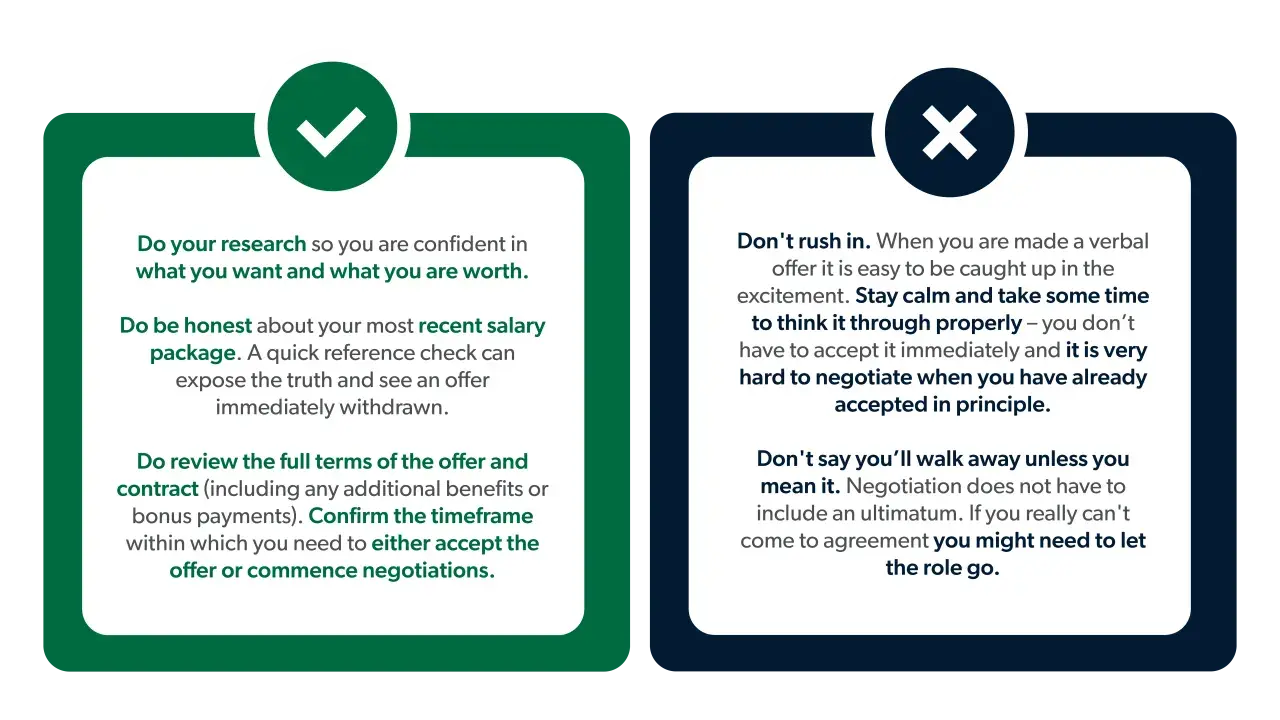
The cleanest salary conversations feel calm because they are specific. I wait for a written offer, open with appreciation, and then make one focused counter with numbers I can defend.
- Wait until the offer is official.
- Lead with enthusiasm so the conversation starts in good faith.
- Use a range, not a fantasy number.
- Anchor your ask to market data, scope, or results.
- Make one counter, then pause.
- Get the final package in writing before you consider it done.
A simple script works better than a clever one: “I’m excited about the role and the team. Based on the scope and the market range I reviewed, I was expecting something a bit closer to X to Y. If base salary is fixed, I’d love to talk about a sign-on bonus, an earlier review, or additional PTO.”
I also avoid a few traps. I do not lead with personal bills, I do not bluff about offers I do not have, and I do not reopen every detail once the employer has made a fair final move. The best negotiators stay firm without turning the process into a test of ego. That is easier in workplaces that already treat pay as transparent rather than mysterious.
Fair pay culture changes the answer
This is where the careers conversation connects directly to workplace culture. When compensation is opaque, the burden of negotiating falls unevenly, and that tends to reward the people who are already most comfortable asking. In one study, simply stating that wages were negotiable reduced a gender gap in applications by 45 percent. That is a reminder that language around pay is not cosmetic; it shapes who applies, who asks, and who feels safe pushing back.
In the U.S., equal-pay rules already require substantially equal work to receive equal pay, including benefits, but legal protection is not the same as a healthy compensation process. Good employers make room for questions without forcing candidates to become expert negotiators just to get a fair number.
- Publish realistic salary bands instead of vague ranges.
- Explain where there is flexibility and where there is not.
- Use consistent leveling criteria for similar roles.
- Separate performance feedback from negotiation outcomes.
- Train managers not to penalize a candidate for asking a reasonable question.
When that culture exists, negotiation becomes a conversation about fit and value, not a private contest. My rule of thumb in 2026 is simple: if transparency is low, prepare more carefully; if transparency is high, ask more directly.
My rule of thumb for 2026 offers
So, should you always negotiate salary? No. I negotiate when the offer is new, the scope is real, and I can point to a specific gap between market value and proposed pay. I hold back when the range is fixed, the number is already strong, or the real upside sits in bonus, title, flexibility, or timing.
If you remember one thing, let it be this: do not negotiate out of habit, but do not accept out of fear. The best decision is the one that protects both your long-term earnings and your working relationship, and that usually starts with asking the right question about room, risk, and respect before you ask for more money.
