
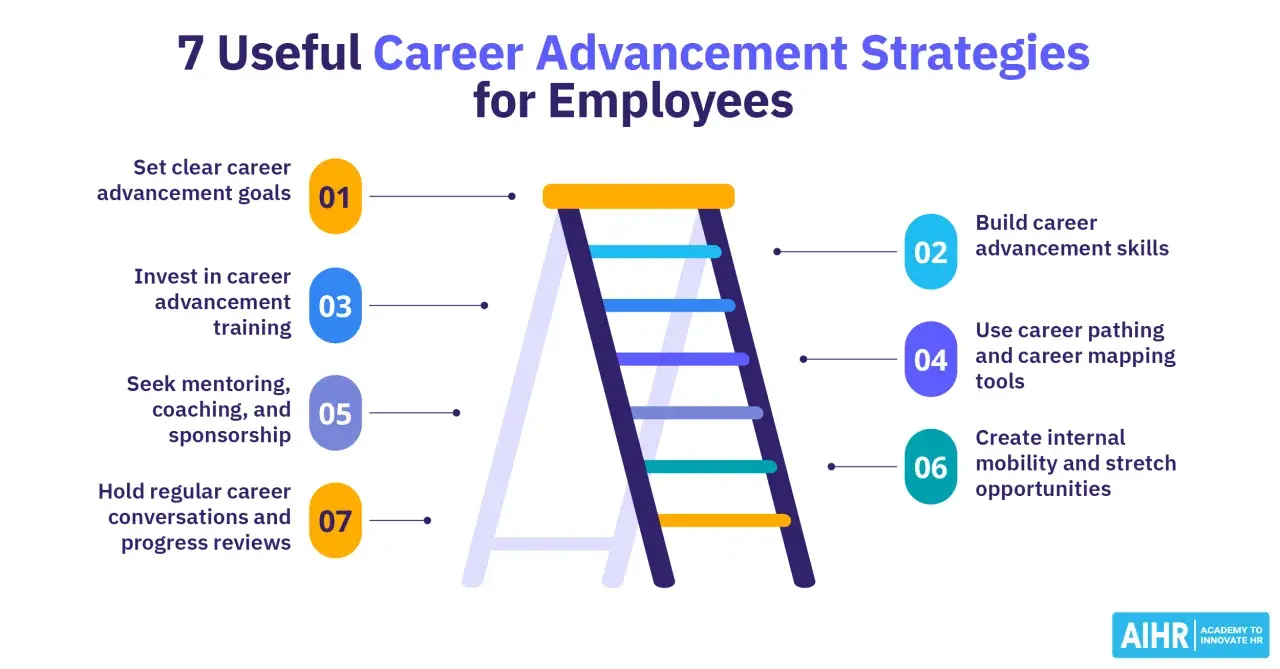
The practical answer to how to develop a career strategy is to treat it like an operating plan, not a wish list. I focus on the choices that matter most: the role you want, the skills you need, the proof you can show, and the relationships that help decisions move in your favor. In a real U.S. workplace, that also means accounting for timing, visibility, and the culture around you.
The fastest way to make a career strategy usable is to make it specific
- Choose a direction first: deeper expertise, broader scope, or leadership.
- Audit your current evidence, not just your effort.
- Work in 90-day blocks, with a quarterly review date on the calendar.
- Build skills and visibility together so progress is easy to see.
- Use managers, mentors, and sponsors deliberately, especially where opportunities are informal.
Map the direction before you map the skills
I start by asking what kind of move is actually on the table. A promotion, a lateral move into a stronger function, a specialist track, and a shift into people leadership all require different bets, so a vague goal like “grow my career” is too soft to steer by.
Harvard Business Review has argued that long-term planning can reduce career-related stress and improve how employable you feel. I agree, but only if the plan is concrete: name the role family, the level, and the kind of problems you want to own.
| Question | What you are trying to learn | Why it matters |
|---|---|---|
| Do I want depth or breadth? | Specialist versus generalist growth | It changes which skills matter most. |
| Do I want individual contribution or leadership? | Hands-on work versus people management | They are different careers, not just different titles. |
| What kind of environment helps me do my best work? | Fast-moving, structured, remote, hybrid, or highly collaborative | Fit affects sustainability. |
| What would make this move worth it? | Pay, scope, flexibility, mission, learning, or stability | Prevents chasing status alone. |
If you skip this step, every later decision gets noisy. Once the direction is clear, you can audit the gap between where you are and where you need to be.
Audit your starting point with evidence, not vibes
The simplest way to make your plan realistic is to write down the proof you already have. I look at four things: outcomes delivered, skills already used in pressure situations, feedback patterns, and constraints such as time, location, caregiving, or a boss who controls stretch work.
- Outcomes: projects shipped, revenue influenced, processes improved, conflicts resolved.
- Skills: technical depth, communication, facilitation, negotiation, analysis, or operations.
- Signals from others: repeated praise, repeated criticism, and the questions people ask you for help with.
- Constraints: whether you can travel, change industries, take a pay cut, or wait for the next cycle.
This is the point where many people overestimate effort and underestimate proof. In most U.S. workplaces, promotion decisions are shaped by scope and visible impact, not by invisible hard work alone. If your story is hard to tell, it is probably hard to reward.
Once you know what is already working, the next step is to turn it into a schedule that can survive real calendars.

Turn the strategy into a 90-day operating plan
I like a 90-day cycle because it is long enough to make measurable progress and short enough to correct a mistake. That cycle also fits how many organizations actually work: projects, performance conversations, and internal mobility decisions usually move in quarters, not in fantasy timelines.
| Time frame | Goal | Example actions |
|---|---|---|
| 30 days | Clarify direction and baseline | Choose a target role family, gather feedback, document wins |
| 90 days | Build evidence | Finish one stretch project, close one skill gap, ask for one visibility opportunity |
| 12 months | Qualify for the next move | Lead a cross-functional effort, mentor someone, prepare promotion materials |
I usually tell people to limit each quarter to one primary career objective, two skill priorities, and one visibility goal. More than that, and the plan becomes a to-do list with no narrative. The best plans are readable: anyone should be able to look at them and understand what kind of professional you are becoming.
After the calendar is in place, you can choose the skills and proof points that will make the plan credible.
Build skill and visibility in parallel
Skill growth alone is not enough. Visibility without substance is fragile. The strongest strategies do both at once: they make you better at the work and easier for decision-makers to trust when opportunities open up.
- Pick one hard skill that changes your output. For an analyst, that might be Python or forecasting. For a manager, it might be coaching or conflict handling.
- Pick one judgment skill that changes your decisions. That could be prioritization, stakeholder management, or product sense.
- Pick one proof channel. Use a monthly update, a project retrospective, a demo, or a portfolio of work so your impact is visible.
- Choose stretch work that aligns with the target role. A future leader needs cross-functional exposure; a future specialist needs depth and credibility.
In 2026, many roles also reward practical AI fluency, but that does not mean chasing every new tool. I would focus on the one or two workflows that save time, improve quality, or sharpen judgment in your field. If you cannot explain how a new skill changes business results, it is probably not a priority yet.
Visibility becomes much easier when it is tied to actual outcomes, which is why the people around you matter as much as the work itself.
Use managers, mentors, and sponsors on purpose
This is where career strategy gets more realistic. A mentor gives perspective, a manager controls your current work and evaluation, and a sponsor uses their credibility to open doors. If you treat them as interchangeable, you will miss the kind of support that actually moves careers.
| Person | What they do | What to ask for |
|---|---|---|
| Manager | Sets expectations and allocates work | Clear goals, stretch assignments, honest feedback, promotion criteria |
| Mentor | Shares perspective and pattern recognition | Advice on blind spots, timing, and career moves |
| Sponsor | Advocates when opportunities are decided | Introductions, nomination, and support in rooms you are not in |
That distinction matters even more in inclusive workplaces, where access to high-visibility work should not depend on who speaks loudest or who already fits the dominant mold. McKinsey’s Women in the Workplace 2025 report still shows that many women face less career support and fewer advancement opportunities, which is a reminder that strategy should include advocacy, not just performance.
If your organization is opaque, your plan needs extra documentation. Ask how promotion decisions are made, what “ready now” actually means, and which behaviors get rewarded. If the answers stay fuzzy, assume you will have to make your value easier to see.
Once the network is working for you, it becomes much easier to spot the mistakes that quietly slow progress.
Avoid the mistakes that quietly stall growth
- Vague goals: “Get better” does not help. Name the role, level, or scope you want.
- Only chasing titles: a title without scope or authority can leave you stuck again in six months.
- Collecting skills without using them: courses feel productive, but evidence comes from application.
- Waiting for permission: many moves require you to ask for the project, the feedback, or the introduction.
- Ignoring market signals: if the role you want is shrinking, your strategy needs adjustment.
- Writing the plan once: review it at least once a quarter or it will become stale fast.
The biggest pattern I see is people confusing motion with momentum. A career strategy should change what you do on Monday morning, not just how you describe your ambition.
That brings the process to the practical question: what should happen next if you want this to become real quickly?
The next 30 days can make the plan real
If I were starting from scratch, I would spend the first week choosing a direction and gathering feedback, the second week mapping the gap, the third week asking for one stretch assignment or one new visibility channel, and the fourth week setting a review date. That is enough to move from intention to action without drowning in planning.
- Pick one target role family and one backup option.
- Write down three wins, three gaps, and three people who can help.
- Book a monthly check-in with yourself and a quarterly conversation with your manager or mentor.
