
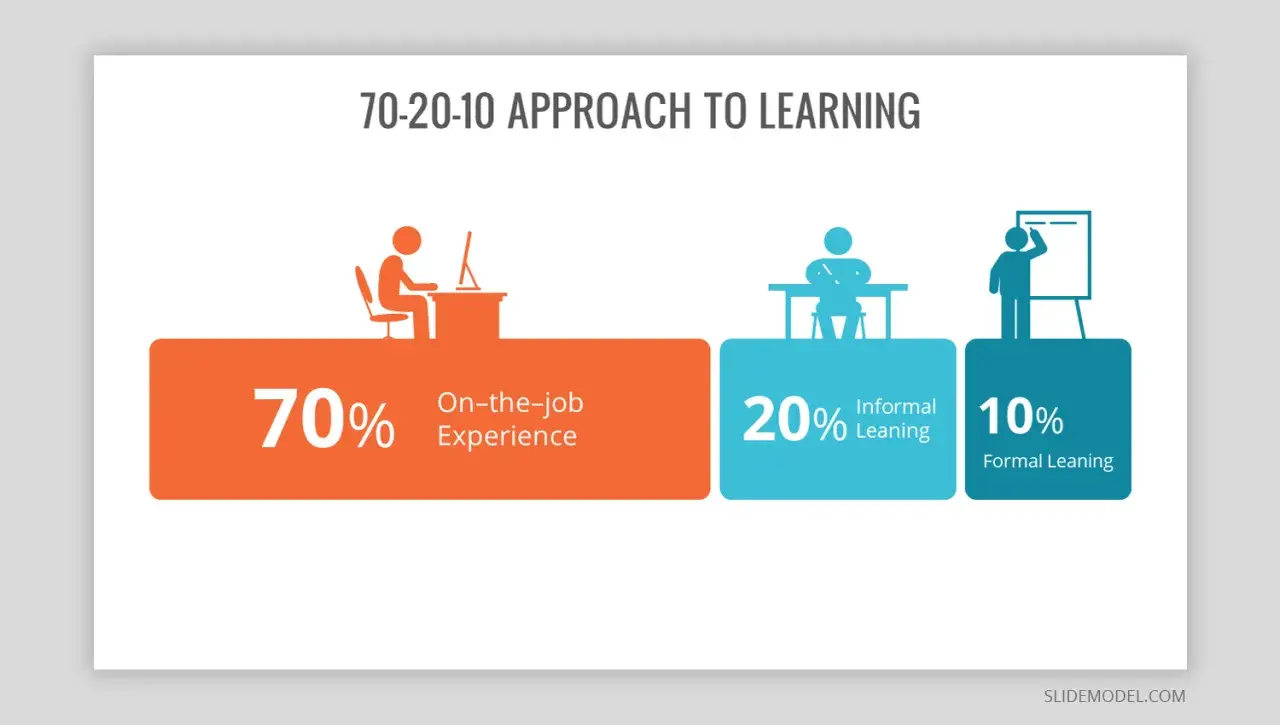
The 70-20-10 learning model is a practical way to think about career growth: most development comes from challenging work, a meaningful share comes from other people, and a smaller but important slice comes from formal training. I find it useful because it shifts the question from “Which course should I take?” to “What experiences, relationships, and structure will actually move my career forward?”
That matters in 2026, especially in the U.S., where hybrid teams, faster skill shifts, and internal mobility have made continuous development part of the job. The model works best when it is treated as a planning lens, not a rigid formula.
The core idea at a glance
- Most career learning happens through real work, not classrooms alone.
- Relationships matter because feedback, coaching, and sponsorship speed up growth.
- Formal learning is still necessary when you need structure, vocabulary, or a safe first pass.
- The model is a guide for development planning, not a scientific law.
- Inclusive workplaces make the model more effective by widening access to stretch work and mentorship.
Why this framework still matters for careers
The classic 70/20/10 framework is usually explained as 70% learning from experience, 20% from developmental relationships, and 10% from coursework and training. The Center for Creative Leadership has helped popularize that idea, and it remains a useful shorthand because it mirrors how most people actually build competence at work.
At the same time, I would not treat the ratio as a rule you can measure with a stopwatch. ATD has repeatedly pointed out that the model is not a universal scientific law, and that is exactly why it should be used carefully. The useful part is the balance, not the arithmetic. It reminds you to stop overinvesting in training events and underinvesting in the conditions that make learning stick.
That matters for careers because advancement rarely comes from knowledge alone. Employers promote people who can apply skills under pressure, collaborate across teams, and make judgment calls in messy situations. The framework helps you design for that reality, which leads naturally to the question of what each part looks like in practice.

What each part of the model looks like in real work
| Part of the model | What it means | Examples | Common mistake |
|---|---|---|---|
| 70% experience | Learning by doing work that stretches your current ability | Leading a project, solving a client problem, managing a launch, handling an escalation | Confusing busy work with real development |
| 20% relationships | Learning through feedback, observation, coaching, and sponsorship | Mentoring, shadowing, manager check-ins, peer feedback, cross-functional collaboration | Assuming networking alone counts as development |
| 10% formal learning | Structured learning that builds language, concepts, and technique | Courses, certifications, workshops, webinars, reading, compliance training | Expecting one class to change performance by itself |
In my experience, the 70% works only when the assignment is genuinely new. Repeating the same task with no feedback is repetition, not growth. The 20% matters when someone can tell you what you missed, what you did well, and how to improve without making the process political. The 10% matters when you need a framework, a shared vocabulary, or a low-risk way to build confidence before you try the skill in public.
That last point matters for inclusion. If only the most visible employees get mentors, sponsors, and stretch projects, the model quietly reproduces inequality instead of solving it. That is why the next step is not just using the framework, but using it intentionally.
How to turn the framework into a 90-day career plan
The easiest way to make this model useful is to tie it to one concrete career outcome. I would not try to “improve everything” at once. I would pick one skill gap that matters for the next role, then build a small plan around it.
- Choose one outcome. For example, you may want to lead meetings more confidently, move into people management, improve data analysis, or become stronger at cross-functional influence.
- Pick one stretch experience. Choose work that requires the skill you want, not work that merely keeps you busy. A project owner role, a client presentation, or a process redesign is usually better than another routine task.
- Name two people who can help. One can be your manager or a coach who gives feedback. The other can be a peer, mentor, or subject-matter expert who shows you how the work is done in practice.
- Add one formal learning input. Keep it targeted. A two-hour course, a short certification module, or a focused workshop is often enough if it directly supports the stretch assignment.
- Decide how you will prove progress. Use something visible: better client feedback, fewer errors, a successful presentation, a quicker turnaround time, or a manager’s sign-off on your readiness for the next step.
Once that structure is in place for the individual, the real test becomes whether the organization makes those opportunities fair and accessible.
How managers can make development more equitable
This is where many companies unintentionally weaken the model. The 70/20/10 framework sounds broad and inclusive, but in practice the 20% and 70% often depend on access, visibility, and informal power. People with stronger networks get better projects, better feedback, and more sponsorship. People who are remote, new, underrepresented, or simply quieter can be left with the 10% and told to “own their growth.” That is not a development strategy.
Access is development. If managers want the model to support retention and internal mobility, they need to design access on purpose.
| Common gap | What it looks like | Better practice |
|---|---|---|
| Stretch work | The same high-visibility projects always go to the same people | Rotate assignments and publish clear selection criteria |
| Mentorship | Informal mentoring happens through affinity or proximity | Build structured mentoring and sponsorship pathways |
| Training budget | Only top performers get access to formal learning | Offer a baseline budget or learning allowance to everyone |
| Hybrid visibility | In-office staff get more coaching and exposure than remote staff | Schedule intentional feedback, shadowing, and presentation opportunities for all locations |
When those conditions are missing, the model can still be useful, but it stops being a full answer. That is the point where its limitations matter.
Where the model falls short
The biggest mistake I see is treating the framework as if it fits every role, every person, and every moment equally. It does not. Some skills are best learned by doing. Others need formal instruction before practice is safe or effective. If you work in a regulated, safety-sensitive, or compliance-heavy field, formal training may need to come first, not last.
- It can understate the importance of formal learning in early stages of a career change.
- It can ignore hidden barriers such as bias, burnout, caregiving load, or lack of access to mentors.
- It can be misused by organizations that want to cut training budgets while still sounding progressive.
- It does not guarantee transfer of learning, which means a course without practice may still fail.
That is why I would use the model as a balance check, not a substitute for judgment. If you are changing fields, I would usually lean a little more heavily on formal learning at the start. You need enough structure to build vocabulary and confidence before the experience-based part pays off. Once that foundation exists, the balance can shift toward real work and feedback.
The simplest version of the framework is not the most literal one. It is the one that helps you decide what to do next, which is where the practical value really shows up.
A simple way to use it for your next move
If I were applying this to a promotion, a lateral move, or a career pivot, I would keep the plan small and concrete. I would choose one skill, one stretch assignment, one person for feedback, and one formal learning resource. Then I would review progress every 30 days and adjust the mix if the work changes.
- Write down one capability that matters for your next role.
- Choose one project or responsibility that forces you to use it.
- Ask one person to give you specific feedback on your performance.
- Take one course, workshop, or reading path that fills a real gap.
- Save one measurable result you can use on your resume or in an interview.
That last step matters more than people expect. Career growth becomes much easier to explain when you can describe the challenge, the support you used, and the result you produced. The strongest version of the 70/20/10 approach is not about dividing learning into neat percentages. It is about creating a workplace where experience, relationships, and formal learning all work together, and where that opportunity is available to more than the most connected people in the room.
