
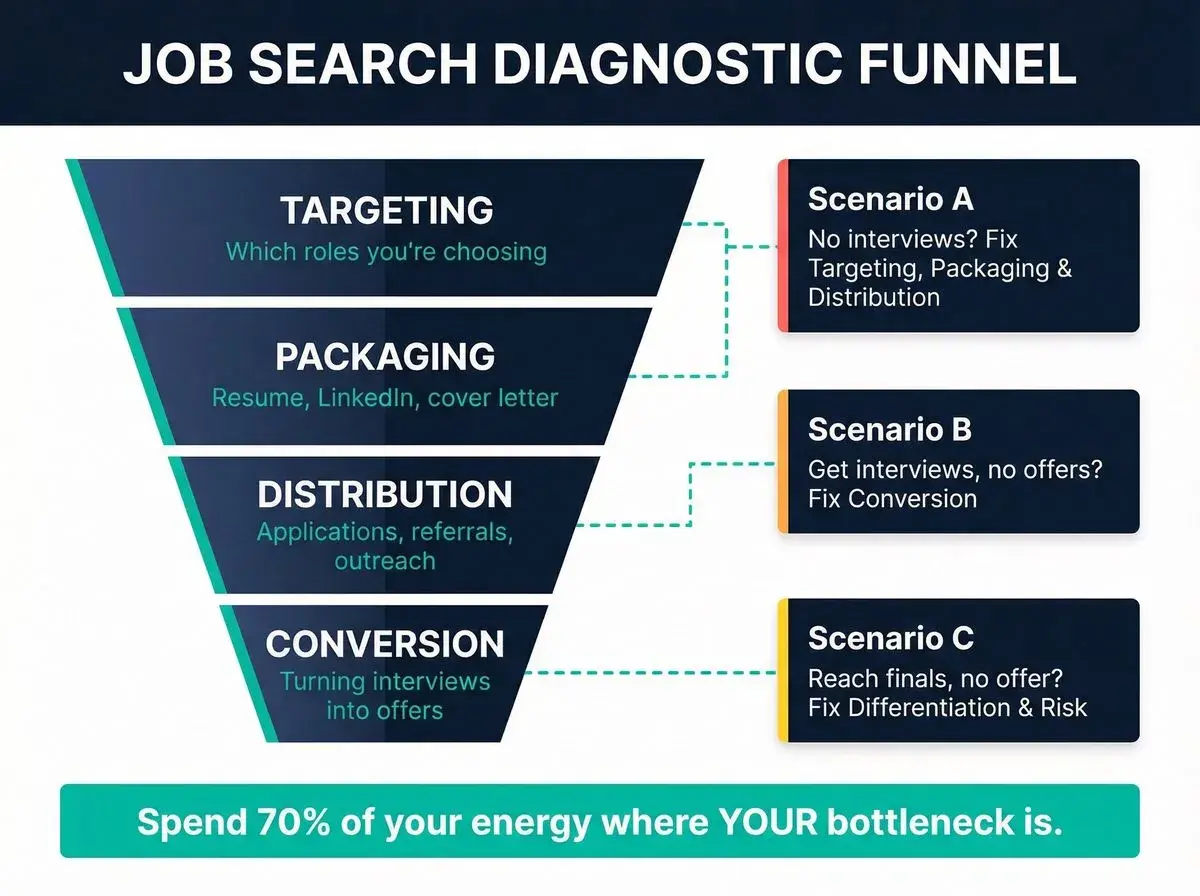
Getting hired usually breaks down for a few predictable reasons: the role is a mismatch, the resume never clears screening, interviews do not build enough trust, or the search strategy is too broad to create traction. In 2026, the U.S. labor market still has openings, but the match is slower and more selective than many job seekers expect. The real answer to why cant i get a job is usually a mix of market friction, weak targeting, and a process that breaks somewhere between application and offer.
The main reasons a job search stalls are usually fixable
- The market is still hiring, but openings are uneven across industries, so a broad search can feel much harder than the headline numbers suggest.
- Resumes often fail because they do not match the job title, keywords, or formatting rules used in screening systems.
- Interview losses usually come from vague examples, weak impact storytelling, or a salary story that does not fit the role.
- Referrals and warm introductions still matter because many jobs are filtered before they ever feel public.
- Bias and poorly designed hiring processes can block strong candidates, which is why structured and inclusive employers stand out.
The market is hiring, but the match is narrower than it looks
When I look at the current U.S. job market, I do not see a system with no opportunities. I see a system where the fit problem has become more painful. According to the U.S. Bureau of Labor Statistics, unemployment held at 4.3 percent in May 2026, while job openings reached 7.6 million in April and hires were 5.1 million. That tells me there is still demand, but the demand is selective and uneven.
That matters because a person can be fully capable and still lose out when the employer is hiring for a very specific title, a narrow salary band, a local commute, or a stack of skills that only one or two candidates match perfectly. In other words, the problem is not always “you are unemployable.” Often it is that your profile is not lining up cleanly with where the market is actually moving.
This is where a lot of job seekers waste energy. They keep assuming the issue is volume when the real issue is fit. Once you understand that, the next step is to diagnose where the process is breaking instead of guessing.
A quick diagnostic can tell you where the search is breaking
I like to separate job-search problems into three layers: getting seen, getting interviewed, and getting hired. If you know which layer is failing, the fix becomes much clearer.
| What you are seeing | Likely issue | First thing to change |
|---|---|---|
| Lots of applications, almost no replies | Resume, title mismatch, or screening filter problem | Align the resume to one target role and simplify the format |
| Recruiter calls, but no real interviews | Your target may be off, or your opening pitch is too vague | Tighten the role, industry, and seniority level you are pursuing |
| Interviews, but no offers | Your examples are not showing enough impact or fit | Rebuild answers around outcomes, numbers, and decision-making |
| You reach final rounds, then stall | Compensation, culture fit, or confidence in your story | Prepare a clearer salary range and a sharper closing narrative |
| Only low-level or off-target roles respond | Your current positioning does not match the roles you want | Reset the headline, summary, and target titles to reflect your real level |
If this table feels uncomfortably accurate, that is useful data. It means the solution is probably not “apply harder.” It is more likely “change the layer that is failing.”

Why your resume may never reach a recruiter
One of the most common reasons people feel stuck is that the resume is being filtered out before a human has a real chance to read it. Applicant tracking systems, or ATS, are software tools employers use to sort applicants, and many recruiters still rely on them as a first pass. That does not mean you need to game the system. It does mean your resume has to be easy to parse and obviously relevant.
In practice, I look for a few things when I review a stalled resume:
- The target title is clear. If the posting says “Operations Coordinator” and your resume headline says only “Professional,” you are making the screen work too hard.
- The key skills appear naturally. If the role asks for Excel, scheduling, vendor management, and reporting, those terms should appear where they honestly fit.
- Impact is visible. Duties are not enough. “Managed invoices” is weaker than “Processed 120 invoices per month with a 99 percent on-time rate.”
- The layout is simple. Columns, icons, text boxes, and graphic-heavy templates can look polished and still confuse parsing tools.
- The level matches the job. If you are targeting senior roles, the resume needs leadership scope, budget ownership, or cross-functional work. If you are targeting entry-level roles, it should not look overbuilt or detached from the role.
The biggest mistake I see is keyword stuffing. That usually makes the resume harder to read and easier to dismiss. A better approach is precision: one target role, one clean format, and a story that proves you can do the job in the language employers already use.
Once the resume is readable, the next bottleneck is usually relationships, which is where many searches either speed up or quietly stall.
Why referrals and networking still open more doors than volume
People dislike hearing this, but it is still true: a warm introduction often beats another blind application. Not because merit disappears, but because hiring is a trust-heavy process. Recruiters and hiring managers are more likely to give a faster look to someone referred by a current employee, a former colleague, or a person they already know from the field.
I am not suggesting you need an elite network. I am suggesting you need a deliberate one. The strongest job searches I see usually include a few practical habits:
- Reconnect with former managers, teammates, clients, and vendors who have seen your work firsthand.
- Ask for short informational conversations, not favors. A 15-minute call is easier to say yes to than a vague request for help.
- Say clearly what you want: the target role, the industries you are aiming at, and the kind of company size you want.
- Follow up with one useful line, not a long update. Keep the conversation easy to continue.
- Use communities where hiring actually happens, such as alumni groups, industry associations, and professional Slack or LinkedIn groups.
There is also an equity point here. Many people do not have the same access to informal hiring networks, which is why inclusive hiring practices matter so much. A workplace that relies only on “who already knows whom” can quietly exclude strong candidates. If your search is hitting that wall, you do not need to take it personally; you need to widen the channels you are using.
Interview performance often looks worse than it is
When I coach people through interviews, I usually find that the failure is not confidence. It is proof. Candidates talk about responsibilities when the interviewer is listening for judgment, results, and fit. That gap can make a solid worker sound interchangeable.
A few patterns show up again and again:
- Answers are too long. If every response runs three or four minutes, the strongest point often gets buried before it lands.
- Stories are generic. “I’m a hard worker” is not evidence. A quick example of solving a problem, improving a process, or calming a tense situation is far better.
- Metrics are missing. Numbers are not the only proof, but they help. Time saved, error rates, revenue influenced, customer satisfaction, and team size all make a difference.
- Transitions are unclear. If you are changing fields, explain the bridge. Do not assume the interviewer will connect the dots for you.
- Salary questions are handled late or awkwardly. If your range is far outside the role, you may be screened out even after a strong interview.
My rule of thumb is to prepare three short stories before any interview: one about solving a problem, one about working with other people, and one about handling a difficult change or setback. Keep each answer to about 60 to 90 seconds unless the interviewer asks for more. Then close by asking thoughtful questions about how success is measured, how the team makes decisions, and what the first 90 days really look like.
That kind of preparation does more than improve performance. It also exposes whether the employer has a serious process or just a messy one.
When bias or a poor hiring process is part of the answer
Not every rejection is about your qualifications. Some hiring processes are simply weak, inconsistent, or biased. I think it is important to say that plainly, especially on a site that values inclusive leadership and workplace culture. A fair process should help the best candidate stand out. A poor one can reward familiarity, speed, or unconscious bias instead.
There are a few red flags I pay attention to:
- The job description asks for an unrealistic number of must-haves, even for an entry-level role.
- Interviewers ask different questions of different candidates without a clear rubric.
- The employer cannot explain how decisions are made or when you will hear back.
- The company uses unpaid tasks that are large enough to function like free labor.
- The role changes shape every round, which usually means the team does not know what it wants.
Structured interviews and scorecards help reduce that kind of drift. A scorecard is just a simple rubric that forces the interviewer to rate each candidate against the same criteria, instead of relying on memory or instinct alone. Companies that use clear criteria, accessible communication, and consistent evaluation usually treat candidates more fairly and tend to make better hires.
If you keep running into vague feedback, repeated ghosting, or shifting requirements, I would treat that as signal, not noise. Sometimes the best move is not to keep optimizing for that employer. It is to decide whether that hiring culture is one you actually want to join.
A seven-day reset that gives your search a better signal
If I had to restart a stalled search from scratch, I would stop trying to fix everything at once and run a focused seven-day reset. The goal is not more activity. The goal is better data.
- Day 1: Choose one target title, one industry cluster, and one salary range. If you are applying to ten different kinds of jobs, you are making your own search harder.
- Day 2: Rebuild your resume for that target. Tighten the headline, rewrite the summary, and replace duties with results.
- Day 3: Prepare three interview stories and a short, plain-language explanation of why you want this kind of work.
- Day 4: Reach out to five people who know your work or are close to your target field. Keep the message specific and brief.
- Day 5: Apply to three to five high-fit roles, not twenty loose ones. Quality matters more than raw volume here.
- Day 6: Review responses. If you are getting no callbacks, the resume is the issue. If you are getting interviews but no offers, the interview story is the issue.
- Day 7: Decide whether you need a portfolio, a certification, a stronger referral path, or a broader geographic target. Pick one lever, not four.
That reset is simple, but it works because it forces the search to produce evidence. After a week or two, you should be able to see whether the problem is positioning, proof, network access, or the employer side of the process. Once you know that, the search becomes much less random and a lot more controllable.
