
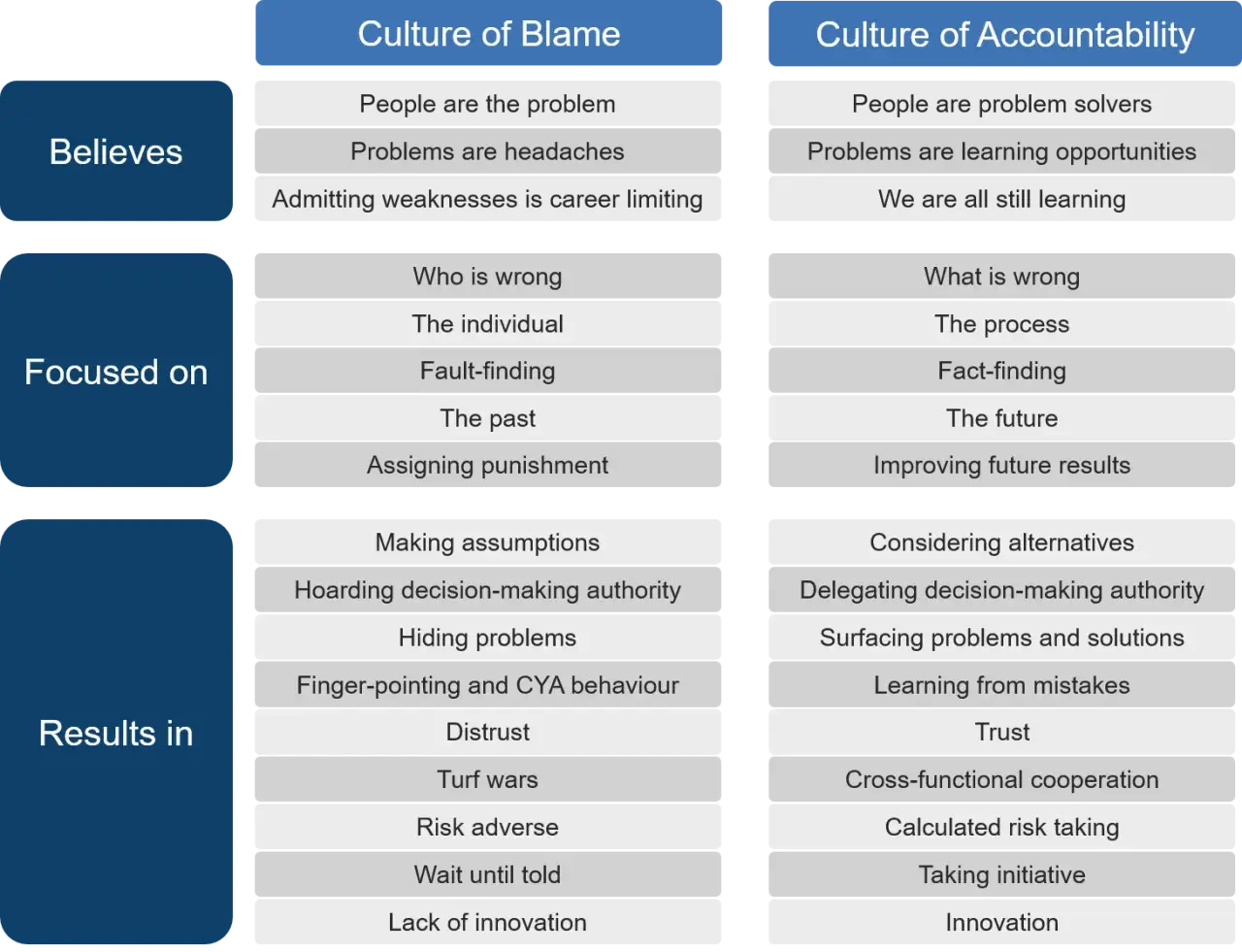
Accountability at work is less about policing people and more about making responsibility visible. It affects how teams handle missed deadlines, how leaders respond to mistakes, and whether a workplace feels fair enough for people to speak up early instead of hiding problems until they grow.
In this article, I break down what it really means, how it shapes workplace culture, what healthy accountability looks like day to day, and how leaders and teams can build it without turning the environment into blame or micromanagement.
The fastest gains come from clear ownership and consistent follow-through
- Healthy accountability means owning decisions, communicating early, and correcting course fast.
- It strengthens trust when expectations are clear and consequences are consistent.
- Blame culture and micromanagement look busy, but they usually weaken performance and candor.
- Leaders set the tone by modeling mistakes, feedback, and repair instead of silence.
- Distributed and hybrid teams need outcome-based standards, not visibility-based assumptions.
- The best systems make ownership easy to see, track, and discuss without fear.
What accountability in the workplace really means
At its simplest, accountability is the obligation to accept responsibility for actions, decisions, and results. In practice, that means three things: people know what they own, they follow through on commitments, and they speak up quickly when something changes or goes wrong. I would separate that from punishment. Accountability is about ownership; punishment is about making someone feel bad after the fact.
That distinction matters because many teams confuse responsibility with blame. A healthy culture does not need perfect people. It needs people who are clear about their role, honest about constraints, and willing to repair mistakes without hiding them. When that happens, accountability becomes a normal part of how work gets done rather than a dramatic event reserved for performance reviews.
That is the baseline. The next question is why this simple idea changes culture so much.
Why it changes culture faster than policy language
Policies can set the rules, but culture is shaped by what happens repeatedly. If leaders say “we value ownership” but ignore missed commitments from high performers, the real message is that standards are flexible for some people and rigid for others. Employees notice that immediately. They also notice whether feedback is direct, whether people can admit errors without being embarrassed, and whether decisions are explained or simply imposed.
Workplace culture gets stronger when accountability feels predictable. It gets weaker when it depends on who is in the room, who has status, or who is easiest to challenge. That is why inclusive leadership and accountability belong together. A fair culture does not lower the bar; it makes the bar visible and applies it consistently.
Gallup has repeatedly shown that managers account for a large share of team engagement, which is one reason the manager layer matters so much here. When leaders avoid hard conversations, the team usually fills the gap with guessing, resentment, or silence. That is a culture problem, not a communication quirk.
Before I get into how leaders build the right habits, it helps to see the difference between healthy accountability and the versions people usually dislike.
What healthy accountability looks like in daily work
People often say they want accountability, but they mean very different things. The table below shows the difference I pay attention to first.
| Pattern | What it sounds like | What it creates |
|---|---|---|
| Healthy accountability | “Here is the goal, here is who owns what, and here is when we will review progress.” | Clarity, trust, faster course correction, better follow-through. |
| Blame culture | “Who caused this?” before the facts are understood. | Defensiveness, hidden problems, low candor, fear of mistakes. |
| Micromanagement | “Show me every step so I can monitor everything.” | Low autonomy, shallow ownership, slower decisions, burnout. |
The healthiest teams do a few things consistently. They define the expected outcome before the work begins. They track progress often enough to catch problems early, but not so often that every update feels like surveillance. And when something slips, they discuss the cause, the repair, and the next step in that order. That sequence matters because it keeps the focus on learning and delivery, not just fault.
One useful test is this: after a mistake, does the team leave with a clearer system, or just a more nervous person? If the answer is the second one, accountability has probably turned into pressure without improvement.
Those daily behaviors are easiest to sustain when leaders model them first.

How leaders can build it without creating fear
Leaders set the emotional terms of accountability. If they avoid their own mistakes, dodge follow-up conversations, or change expectations without explanation, the team learns that responsibility is optional. If they are direct, calm, and consistent, the team usually becomes more precise and less anxious.
- Make ownership explicit. Name the decision owner, the deadline, and what “done” actually means.
- Use outcome-based check-ins. Ask what was delivered, what changed, and what support is needed, not just whether someone looked busy.
- Correct early. A quiet two-minute adjustment in week one is better than a dramatic escalation in week four.
- Model repair. When you miss something, say it plainly and explain the fix. That gives everyone permission to do the same.
- Keep standards even. High performers should not get a pass on poor behavior, and newer employees should not be set up to fail by vague expectations.
I also think leaders underestimate how much clarity reduces emotional friction. A direct conversation is often kinder than a vague one. People can handle pressure if they understand it. What they cannot handle for long is ambiguity that looks like favoritism or avoidance.
That is especially important in inclusive workplaces, where the goal is not to make everyone behave identically, but to make expectations and consequences transparent enough that people from different backgrounds can succeed on equal footing.
Once leaders have that part in place, the next layer is how teams hold shared ownership day to day.
How teams keep ownership visible when work is distributed
Hybrid and distributed work can make accountability feel harder because you lose some of the informal cues people used to rely on. That does not mean accountability gets weaker. It means it has to become more deliberate. In many U.S. organizations, the shift is away from “I saw you at your desk” and toward “I can see what was delivered, when, and with what quality.”
- Start meetings with priorities. Each person states what they own this week and what success looks like.
- Use visible task ownership. Shared docs or project boards work better than scattered side conversations.
- Flag blockers early. A delay is manageable when it is raised at the start, not after the deadline.
- Separate urgency from importance. Not every late request is a crisis, and not every quiet task is low-value.
- Review commitments, not personalities. “What changed?” is a better question than “Why are you like this?”
There is also a fairness issue here. Remote employees should not be judged by visibility, and in-office employees should not be rewarded simply for being physically present. If a culture treats proximity as proof of commitment, it will quietly penalize caregivers, disabled workers, and anyone whose best work does not happen in front of a manager’s eyes.
That is why strong teams make their working agreements explicit: response times, handoff rules, decision rights, and escalation paths. The more distributed the work, the less room there is for guesswork.
Even with good habits, though, accountability can drift. That is where a reset helps.
A 30-day reset when ownership has gone fuzzy
When accountability starts slipping, I would not begin with a sweeping culture campaign. I would start with one team, one manager, and one set of behaviors that can be changed in a month. Broad slogans rarely fix a specific problem. Concrete routines do.
- Week 1: Define three outcomes that matter most, and assign a single owner to each one.
- Week 2: Agree on a check-in cadence, such as a 15-minute weekly review of progress and blockers.
- Week 3: Address one missed commitment directly, with the facts, the impact, and the repair plan.
- Week 4: Review what improved, what still feels unclear, and which expectations need to be rewritten.
If the real problem is fear, not clarity, then the reset has to start with leadership behavior. People will not own mistakes in a culture where they expect humiliation. Likewise, if the problem is chronic overload, you cannot coach your way out of impossible workloads. Sometimes accountability issues are actually resourcing issues wearing a performance-management costume.
What I have found most useful is to treat accountability as a system, not a personality trait. Clear roles, fair standards, predictable feedback, and timely repair create far more than a compliance mindset. They create a culture where people can be trusted because they are trusted to respond, not to be perfect.
