
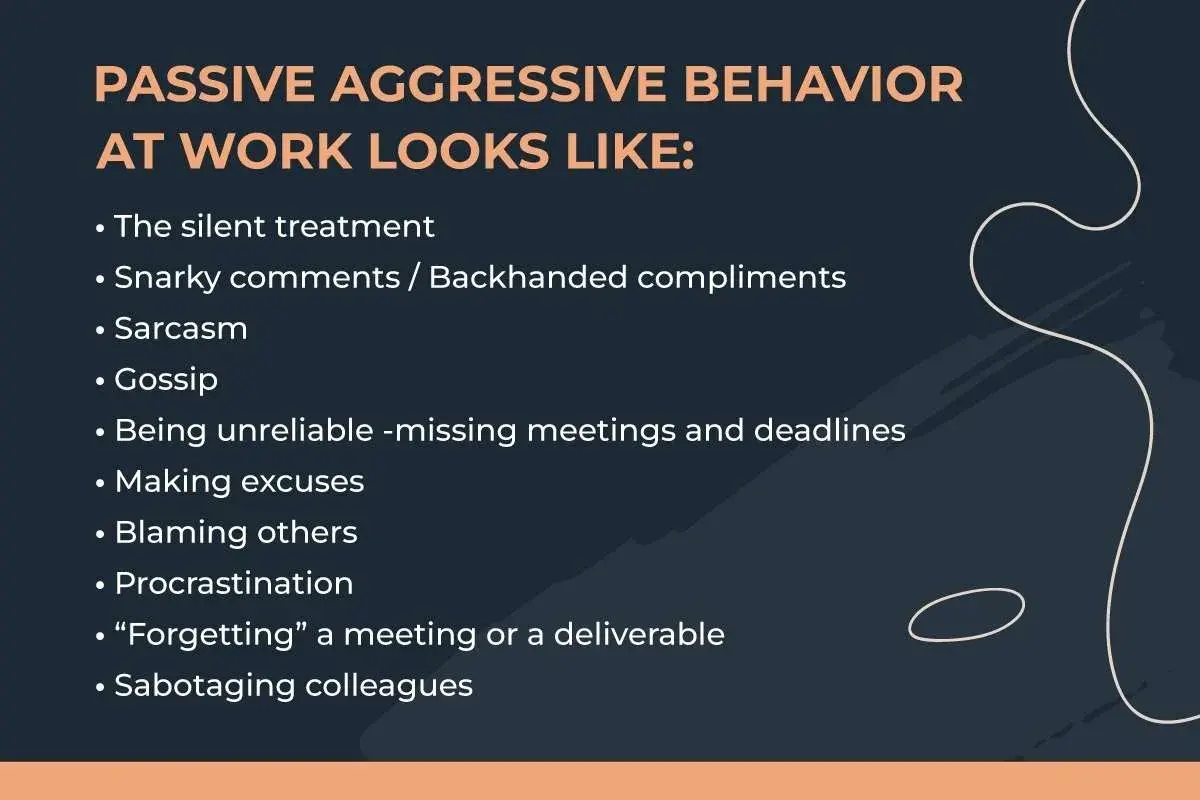
Passive-aggressive behavior at work is exhausting because it hides in sarcasm, delay, silence, and carefully chosen ambiguity. This guide shows how to deal with passive aggressive coworkers without escalating the conflict, including what to say, when to document, and how teams can reduce the behavior at the culture level. I’m also going to separate real passive aggression from simple confusion, because those two get mixed up far too often.
Key takeaways for handling indirect hostility at work
- Look for repeated patterns, not one-off bad moods.
- Respond to the behavior you can observe, not the personality you are tempted to diagnose.
- Use short, neutral language that asks for a direct answer or a concrete next step.
- Document patterns when they start affecting deadlines, meetings, or trust.
- Escalate sooner if the conduct becomes harassment, retaliation, or sabotage.
- Inclusive teams reduce the problem by making expectations, feedback, and ownership explicit.

What passive aggression looks like before it becomes a bigger problem
I do not label someone passive-aggressive after a single awkward email. I look for repetition: the same person keeps “forgetting” handoffs, answers questions with a jab, goes silent when challenged, or agrees in the meeting and resists afterward. SHRM’s conflict guidance treats those kinds of patterns as early signs of brewing conflict, which is exactly how I read them too.
| Behavior | What it often does | Best first response |
|---|---|---|
| Sarcastic praise or backhanded compliments | Signals resentment without owning it | Ask for the concern directly and keep the reply brief |
| Silent treatment or delayed replies | Creates pressure and uncertainty | Restate the deadline and the needed decision in writing |
| “Forgetting” tasks or meetings | Lets the person resist without saying no | Confirm the assignment, date, and owner in a follow-up note |
| Agreeing publicly, opposing privately | Undermines trust and slows execution | Bring the issue back to the facts and the shared goal |
| Polite words with sharp tone | Makes every exchange feel loaded | Do not mirror the tone; stay flat, direct, and specific |
The point is not to play amateur psychologist. The point is to notice when someone is communicating resistance indirectly and decide whether the pattern is strong enough to require a clearer response. Once you can name the behavior, you can answer it without making the situation more emotional.
Why direct, calm responses work better than hints
Indirect hostility survives when everyone dances around it. Hints, eye rolls, and matching sarcasm usually feed the same pattern back into the room, which is why I prefer plain language and a low emotional temperature. In many U.S. workplaces, directness is valued, but it still has to be calm, specific, and professional. APA’s anger guidance points in the same direction: slow the reaction down before you respond, because escalation rarely improves clarity.
My rule is simple. I respond to the content, not the vibe. If the other person is being vague, I ask for a concrete answer. If they are late, I ask for a new time. If they sound annoyed, I do not chase the emotion unless it is blocking the work.
- Name the observable problem. “The file was due at 10 and it is still missing.”
- Ask one direct question. “Can you send it by 2, or should I reassign it?”
- Close with a decision point. “If I do not hear back, I will move ahead without it.”
- Keep your body language boring. Neutral tone, steady pace, no sarcasm back.
This approach does two things at once: it protects your professionalism, and it removes the payoff that passive-aggressive behavior often depends on. If there is a real concern underneath the behavior, a calm direct answer gives the other person room to say it plainly. If there is no real concern, the tactic loses its cover.
What to say in the moment
The hardest part is often the first sentence. I use short scripts because long explanations create more material for the other person to twist. The goal is not to win a debate; it is to make the next step obvious.
When the comment is a jab
Try this: “That sounds pointed. If there is a concern, say it directly so I can respond to the actual issue.”
This works because it names the tone without matching it. You are not accusing, but you are also not pretending the jab was harmless.
When the problem is delay or “forgetting”
Try this: “I need this by 3 p.m. If that does not work, tell me now so I can adjust the plan.”
I like this script because it moves the conversation away from excuses and toward ownership. It also makes it harder for the person to hide behind vague agreement.
When they go quiet in a meeting
Try this: “I want your view on this directly. Do you support the plan, or is there a concern we need to address now?”
Silence can be a power move, but it can also be discomfort or uncertainty. Either way, a clear yes-or-no question helps you find out which one it is.
Read Also: Psychological Safety Examples - Build a Truly Safe Workplace
When they send a passive email
Try this: “I may be missing your point. Can you restate the request or issue plainly?”
That line is useful because it does not reward the passive tone with extra attention. It simply asks for clarity, which is usually what the exchange needed from the start.
One thing I avoid: over-explaining. The more you justify yourself, the more room you give the other person to keep the conversation muddy. A clean, direct sentence is often enough.
When the pattern needs documentation or escalation
Not every irritating exchange needs a formal trail. Repeated irritation does. When the same behavior starts affecting deadlines, public credibility, or team morale, I stop treating it as a personality quirk and start treating it as a performance and conduct issue.
SHRM’s conflict-handling guide recommends a private one-on-one, neutral observation-based language, and logging the issue when conflict starts brewing. That matches my own threshold: once a pattern is visible, write it down before it gets normalized.
| Signal | Why it matters | What I would do next |
|---|---|---|
| The behavior repeats after a direct request | It is no longer a misunderstanding | Document the dates and the exact behavior |
| Projects keep slipping after reminders | The impact is now operational | Send a written recap with owner and deadline |
| Sarcasm or exclusion happens in front of others | Trust and team standing are being affected | Bring in a manager with examples, not emotions |
| The behavior carries a hint of retaliation, bias, or harassment | It may cross into a formal workplace issue | Use the company reporting process promptly |
| You have already tried direct conversation twice | The informal path may be exhausted | Escalate with a timeline and supporting records |
My documentation rule is basic: record the date, the words or action, the impact on work, and any witness. Keep it factual. Do not write, “She was being toxic.” Write, “At 11:10 a.m. in the team meeting, she said X, then refused to confirm Y, which delayed the handoff by one day.” Facts travel better than frustration.
That record is useful for a manager, HR, or even your own sanity, because it shows whether you are dealing with a pattern or a few isolated bad moments. Once the pattern is visible on paper, it is much easier to decide whether the next step is a manager conversation, mediation, or formal reporting.
How inclusive leadership reduces the behavior before it spreads
I have seen passive aggression thrive in teams where people do not feel safe saying, “I disagree,” “I need more time,” or “I do not understand the decision.” When open disagreement feels risky, people route frustration through delay, sarcasm, or silence. That is a culture problem as much as an interpersonal one. Psychological safety, in plain English, means people can raise concerns without fear of humiliation or punishment.The best teams make direct communication normal enough that it does not feel rude. In practice, that means a few boring but powerful habits.
- Make ownership visible. Every task should have a named owner, a deadline, and a next check-in.
- Separate behavior from character. Feedback should describe what happened and what needs to change, not label people.
- Close loops in writing. If a decision matters, recap it in a message so nobody can claim confusion later.
- Reward honest pushback. When someone disagrees directly, respond to the idea, not the courage it took to say it.
- Use private correction for public mistakes. Public shaming tends to produce more covert resistance, not less.
For leaders, the test is simple: can people raise a problem before it turns into a silent deadline slip or a snide meeting comment? If the answer is no, the team will keep paying for that gap in hidden ways.
A three-day reset for the next time it happens
If I had to reduce the whole playbook to something usable this week, I would keep it tight. The first step is noticing the pattern. The second is answering it once, clearly. The third is deciding whether the response worked.
- Day 1: Capture one concrete example. Write down what happened, when it happened, and how it affected the work.
- Day 2: Respond directly once. Use a short script, ask for a direct answer, and set the next deadline or decision point.
- Day 3: Judge the pattern, not the hope. If the behavior repeats, move to documentation and escalation instead of giving it endless benefit of the doubt.
The real mistake I see is people waiting too long because they do not want to seem difficult. Being clear is not the same as being combative. In a healthy workplace, directness protects the relationship; it does not threaten it.
If you keep your language factual, your boundaries calm, and your records clean, you make indirect hostility much less effective. And if the behavior does not improve, you will still have a credible trail showing that you handled it professionally before asking for help.
