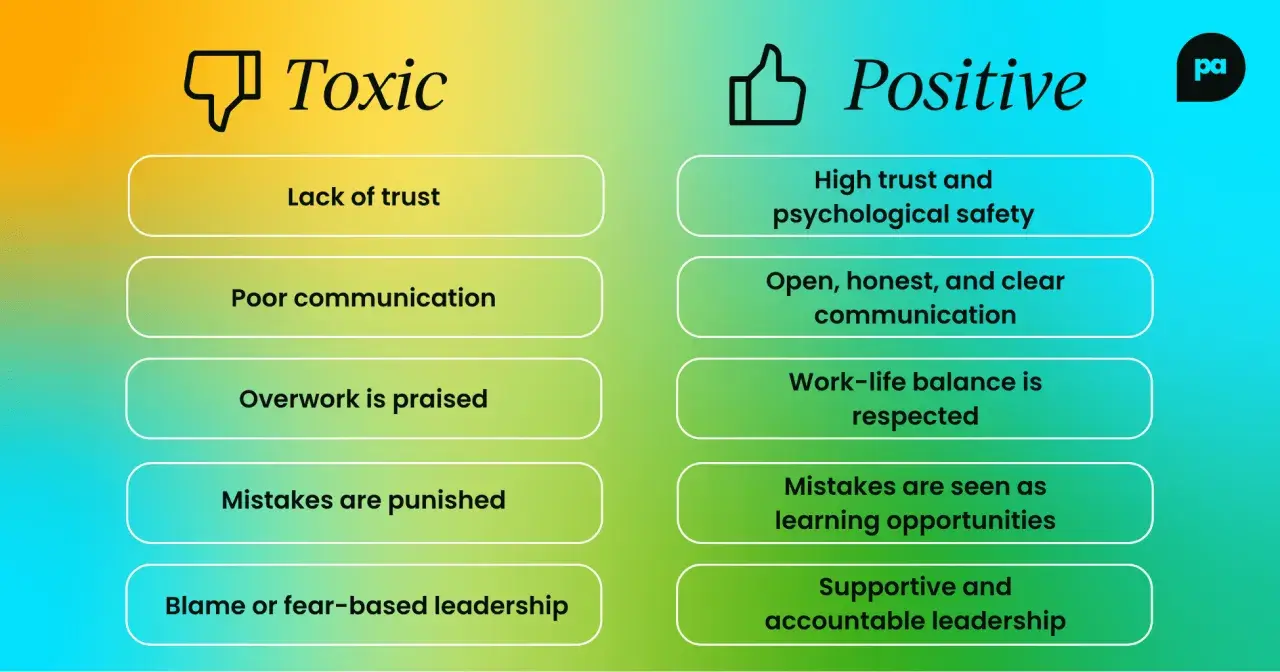
Key points to keep in mind
- Culture shapes whether people feel respected, safe, and able to do good work.
- Clarity, recognition, growth, and fairness are stronger motivators than generic perks.
- Inclusive leadership and psychological safety affect both retention and performance.
- Motivation can fluctuate day to day, while engagement is the steadier bond between employee and organization.
- Measurement only matters when leaders act on what employees say.
Employees do not need a perfect culture; they need a credible one. They watch whether leaders keep promises, whether speaking up changes anything, and whether good work gets noticed or simply absorbed into the background. Gallup's mid-2025 U.S. data put engagement at 32%, which tells me the problem is not a lack of talent so much as a gap between what organizations say and what people experience day to day.
The pattern matters more than any single perk. People usually become less committed when expectations are fuzzy, workload feels endless, or decisions seem arbitrary. When those basics are handled well, culture feels lighter and energy is easier to sustain, which is why I start with the elements employees notice first.

The cultural factors that most affect commitment and drive
In practice, culture is a bundle of signals. Employees read those signals fast, and they often trust what they observe more than what the company says on the website. The table below shows the factors I see shaping commitment most often.
| Cultural factor | What employees feel | What helps |
|---|---|---|
| Clarity | “I know what good looks like.” | Plain goals, clear priorities, and fewer mixed messages. |
| Recognition | “My effort is visible.” | Specific feedback tied to impact, not generic praise. |
| Fairness and inclusion | “I have a real place here.” | Transparent decisions, equitable access to growth, and inclusive meetings. |
| Manager quality | “My manager removes friction.” | Regular coaching, fast follow-up, and support when priorities shift. |
| Workload and wellbeing | “I can keep doing this without burning out.” | Realistic deadlines, enough staffing, and room to recover. |
| Purpose and connection | “My work matters.” | A mission that is explained in real terms and connected to daily work. |
Clarity comes first because ambiguity drains energy. If people spend half their week decoding priorities, they have less capacity for problem solving and collaboration. Recognition matters just as much, but only when it is specific enough to teach people what to repeat.
Inclusion is where many organizations still miss the mark. McKinsey found that nearly three-quarters of employees who feel very included are fully engaged, while only about one-quarter of those who do not feel included say the same. That gap is a reminder that people do not commit fully when they feel like visitors in their own workplace.
Autonomy also matters, but it has to be paired with structure. Too much control creates passivity; too little structure creates confusion. The sweet spot is a team that understands the destination and has room to choose the route. When those six factors work together, motivation becomes much easier to sustain, and the next question is how that differs from engagement itself.
Why motivation and engagement are linked but not identical
Motivation is the spark; engagement is the structure that keeps the spark from burning out. I see teams get this wrong when they assume a bonus, a rallying speech, or a fresh project will solve a deeper trust problem. A person can be highly motivated for a sprint and still feel detached from the organization.
| Dimension | Motivation | Engagement |
|---|---|---|
| Core idea | Energy to act right now | Ongoing commitment to the work and the organization |
| Time frame | Shorter and more variable | More durable over time |
| Main trigger | Goals, incentives, urgency, or inspiration | Trust, clarity, growth, and belonging |
| What it answers | “Do I want to do this today?” | “Do I want to invest myself here?” |
| What leaders can do | Use meaningful goals and immediate rewards | Build a culture that makes effort feel worthwhile |
This distinction matters because rewards can lift energy quickly, but only culture can make that energy repeatable. In 2026, I would still treat that as a management design problem, not a messaging problem. If leaders want stronger results, they have to give people both a reason to start strong and a workplace that makes it worth staying involved.
What leaders can change without a full culture overhaul
If I were coaching a leadership team, I would start with six habits that change culture without waiting for a rebrand or a large budget. None of them are glamorous. All of them are visible to employees within weeks.
- Write expectations in plain language. People should know what success looks like, what has priority, and what trade-offs are acceptable. If employees are guessing, they are spending energy on interpretation instead of execution.
- Use weekly feedback, not annual surprises. A short check-in beats a once-a-year review that only appears after problems have hardened. The point is to correct course early, while the work is still movable.
- Make speaking up safe. Psychological safety means people can raise a risk, disagree, or admit a mistake without being punished for it. When that is missing, you get silence, not honesty.
- Audit who gets growth. Stretch assignments, sponsorship, and visibility often matter more than formal training budgets. If the same people keep getting the best opportunities, motivation drops in everyone else.
- Protect workload and recovery. Burnout does not build commitment; it converts it into survival mode. Teams need realistic deadlines and enough staffing to do quality work well.
- Train managers to lead inclusively. Inclusive leadership shows up in who gets heard, who gets credit, and who gets access to decision makers. It is a daily behavior, not a values poster.
The fastest gains usually come from manager habits, because managers translate culture into daily experience. Once those routines are in place, measurement becomes far more honest, which is where the next layer of work begins.
How to tell whether the culture is actually improving
You cannot improve what you only measure once a year. The better approach is a small dashboard that combines sentiment with behavior, then a real conversation about what the numbers mean.
| Indicator | What it can show | What to watch for |
|---|---|---|
| Pulse survey trends | Whether people feel clearer, safer, and more supported | Scores that stay flat even after visible changes |
| Voluntary turnover | Whether people choose to leave | Departures concentrated in one team, level, or demographic group |
| Internal mobility | Whether employees can grow without leaving | Few lateral moves or promotions outside a small inner circle |
| Absenteeism and burnout signals | Whether workload is sustainable | Rising unscheduled time off, overtime, or exhaustion |
| Meeting participation | Whether voice is shared or concentrated | Only senior voices speaking, or the same people dominating every discussion |
| Stay interviews and comments | What people value and what is missing | The same complaints repeating over and over |
I would also break those results down by team, level, location, and demographic group. A healthy average can hide a very unhealthy pocket, and inclusive workplaces do not ignore those differences. The goal is not to collect more data; it is to catch the gaps early enough to fix them before people quietly disconnect.
The warning signs that commitment is slipping
The warning signs are usually boring before they become expensive. People do not announce disengagement; they start withdrawing in small ways.
- Questions stop in meetings, and disagreement disappears.
- High performers are praised for endurance instead of results.
- Promotions and stretch projects keep going to the same inner circle.
- Employees talk about avoiding mistakes rather than creating value.
- Exit interviews repeat the same complaint about poor communication or blocked growth.
- Teams look busy but do not look energized.
When I see two or three of these at once, I do not blame attitude first. I look for a system problem: unclear priorities, weak manager habits, or a culture that rewards compliance more than contribution. Fixing that early is far cheaper than trying to win trust back later, and it also tells you where the real bottleneck sits.
Why trust outlasts perks in daily work
Trust is the part of culture that perks cannot buy. It is built when people see fairness in decisions, respect in meetings, and follow-through after feedback. That is why the strongest teams are rarely the loudest; they are the ones where employees can do good work without second-guessing whether the organization has their back.
If you want a practical starting point, focus on three questions this week: Do people know what matters most? Do they feel safe telling the truth? Do they see a path to grow here? If any answer is shaky, the next improvement should be structural, not cosmetic. That is the kind of culture that keeps earning commitment instead of trying to demand it.