
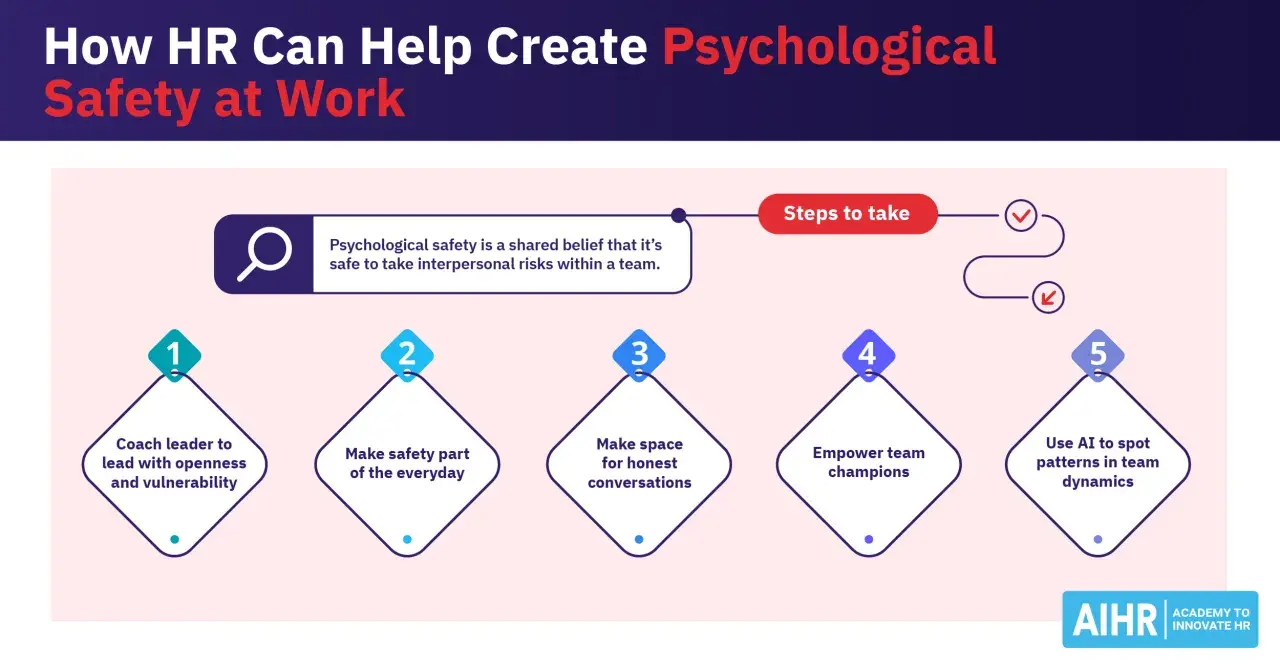
The strongest signal is whether people can speak up and still feel respected
- Psychological safety shows up in everyday behavior, not just in surveys or workshops.
- The clearest signs are questions, dissent, mistake reporting, and boundary-setting without punishment.
- Safe teams do not avoid conflict; they handle it without humiliation or retaliation.
- Managers shape the culture most through their reactions in the first few seconds after someone speaks up.
- You can measure progress with simple monthly checks, not vague impressions.
What psychological safety looks like at work
At work, psychological safety is the belief that speaking honestly will not lead to embarrassment, retaliation, or social punishment. It does not mean every opinion gets equal weight or that conflict disappears. I think of it as the difference between a team where people protect themselves and a team where people can focus on the work.
APA’s 2024 Work in America survey links psychological safety with creativity, innovation, and effective teamwork, while Google re:Work describes high-safety teams as places where people can take interpersonal risks without fear of being embarrassed or punished. That lines up with what I see in healthy cultures: people spend their energy solving problems instead of managing impressions.
| Healthy signal | What it tells you |
|---|---|
| Someone says, “I do not understand this part” in a meeting. | Questions are treated as useful, not as proof of incompetence. |
| A manager says, “I may be missing something here.” | Authority is not being used to shut down uncertainty. |
| A teammate admits a mistake before it becomes a bigger problem. | The team is more likely to catch issues early. |
| An employee names a boundary or access need without overexplaining. | Difference is accepted as part of normal work, not as an inconvenience. |
What psychological safety is not is just as important. It is not constant comfort, and it is not a no-accountability zone. Teams still need deadlines, standards, and difficult feedback. The difference is that people can discuss those standards without fearing humiliation. Once you can spot that distinction, the next step is seeing how it plays out in real workplace moments.

Everyday moments that show safety is real
The strongest clues are small, repeated interactions. One polished all-hands meeting does not prove anything. A week of ordinary behavior does.
| Situation | Safe response | Why it matters |
|---|---|---|
| A junior employee asks a basic question. | “Good question. Let’s make sure that is clear before we move on.” | People learn that asking for clarity will not damage their standing. |
| Someone flags a mistake before launch. | “Thank you for catching that early. Let’s fix it now.” | Early candor saves time, money, and trust. |
| A teammate disagrees with a popular idea. | “Push back if you see a risk. I want the strongest version of the plan.” | Dissent becomes part of decision quality instead of a personal threat. |
| An employee says their workload is not sustainable. | “Let’s look at priorities and tradeoffs, not just effort.” | People stop hiding burnout until it turns into missed deadlines or turnover. |
| A worker requests flexibility for caregiving or health reasons. | “Thanks for telling me early. Let’s find a workable schedule.” | Inclusion is real when people do not have to choose between honesty and employment security. |
| A remote employee adds an objection after the live meeting. | “I saw your note in the doc. Let’s bring it into the decision.” | Hybrid teams stay inclusive when asynchronous input gets equal respect. |
| Someone calls out a biased comment or repeated interruption. | “You are right to raise that. We need to address it.” | Minor slights do not get normalized into the culture. |
These examples matter because they reveal whether the team is actually safe or only polite. Politeness can hide a lot: silence in meetings, side-channel complaints, or bad news that arrives too late. Safety is more visible. It produces earlier escalation, cleaner feedback, and more people willing to contribute.
How managers create safety through routine behavior
The leaders who build this well are usually not trying to be inspirational. They are consistent. In my experience, safety grows from a few habits repeated often enough that the team starts to trust them.
Open meetings with a real question
Start with something that invites uncertainty, not just updates. I like questions such as “What are we not seeing?” or “Where is the risk if we move forward?” Those prompts tell people that incomplete information belongs in the room.
Respond to bad news with curiosity first
When someone surfaces a mistake, pause before reacting. Ask what happened, what the team can learn, and what support is needed. The first reaction teaches the room whether honesty is welcomed or punished. If your instinct is to defend your own decision, people will notice.
Make dissent part of the workflow
Good teams do not rely on personality to produce debate. They use structure. A pre-mortem, a red-team review, or a simple rule that one person must argue the opposite side before a decision closes lowers the social cost of disagreement. That is especially useful in larger U.S. teams where hierarchy can quietly silence quieter voices.
Read Also: Stop Constant Complaining - Transform Your Workplace Culture
Close the loop after feedback
This is the part many leaders skip. If people share concerns and never hear what changed, they stop bothering. A short follow-up such as “We heard the issue, here is what we changed, and here is what is still open” builds more trust than another round of vague encouragement ever will.
Those routines sound modest, but they change the culture faster than slogans do. The reason is simple: people believe what leaders repeatedly do, not what they occasionally say. And when leaders get this wrong, the damage is often more immediate than they expect.
What breaks safety faster than leaders expect
Most teams do not lose psychological safety in one dramatic event. They lose it through contradictions. A leader asks for candor, then punishes the answer. A manager says “be honest,” then reacts defensively. That gap is where trust drains away.
| Common mistake | Why it hurts | Better move |
|---|---|---|
| Asking for honesty and then arguing with the person who gave it. | People learn that speaking up creates friction. | Thank the person first, then separate the issue from the ego. |
| Praising candor only when it agrees with the leader. | Employees notice when “open culture” is conditional. | Reward the act of raising a concern, not only the conclusion. |
| Correcting people publicly to “set the standard.” | Public correction can feel like a warning shot, not coaching. | Use private correction for most issues and public praise for learning. |
| Letting senior voices dominate every discussion. | Quiet, new, or underrepresented employees stop participating. | Invite input in rounds, written docs, or smaller-group discussions. |
| Using inclusion language without changing behavior. | People read the gap between messaging and reality very quickly. | Audit who speaks, who is interrupted, and whose concerns get action. |
| Ignoring small slights, jokes, or dismissive tone. | Minor cuts accumulate into a culture of caution. | Address low-grade disrespect early, before it becomes normal. |
If I had to name the fastest trust killer, it would be this: leaders asking for the truth and then making that truth costly. People do not need perfection. They need consistency. That is also why measurement matters, because culture is easy to misread if you only go by vibe.
How to measure whether the culture is actually improving
Do not rely on gut feeling alone. A team can sound friendly and still be unsafe. I prefer a simple monthly pulse plus a few observable behaviors, because you want to know whether people are speaking earlier, more often, and with less fear.
- Are questions asked in meetings, or only after the meeting in private messages?
- Do junior employees speak before the manager speaks most of the time?
- Are mistakes reported early, or only after they become impossible to hide?
- Do people from different backgrounds contribute at similar rates?
- When someone disagrees, does the conversation stay focused on the issue?
One useful pulse statement is, “If I make a mistake on this team, it is not held against me.” I would pair that with two more: “I can bring up problems and tough issues” and “My unique skills and perspective are valued here.” If those scores improve but the same three people still do most of the talking, the culture has not changed enough.
Silence is another trap. It can look like agreement when it is actually caution. In the best teams, people do not just feel safe in theory; they show it by speaking earlier, disagreeing sooner, and naming problems before they harden into patterns. That is the behavior I would want in any U.S. workplace, especially in fast-moving teams where one missed concern can become an expensive mistake.
The first change I would make in a U.S. team
If I had to start in one place, I would change how leaders react in the first 30 seconds after someone raises a concern. That single moment teaches the team whether truth is useful or risky.
- Ask one follow-up question before giving your opinion.
- Thank the person for surfacing the issue early.
- Write down the next step so the concern does not disappear.
Once that pattern becomes normal, meetings get cleaner, feedback gets braver, and inclusion becomes something people can feel instead of something they are told to trust. That is the practical difference between a workplace that merely talks about safety and one that actually builds it.
