
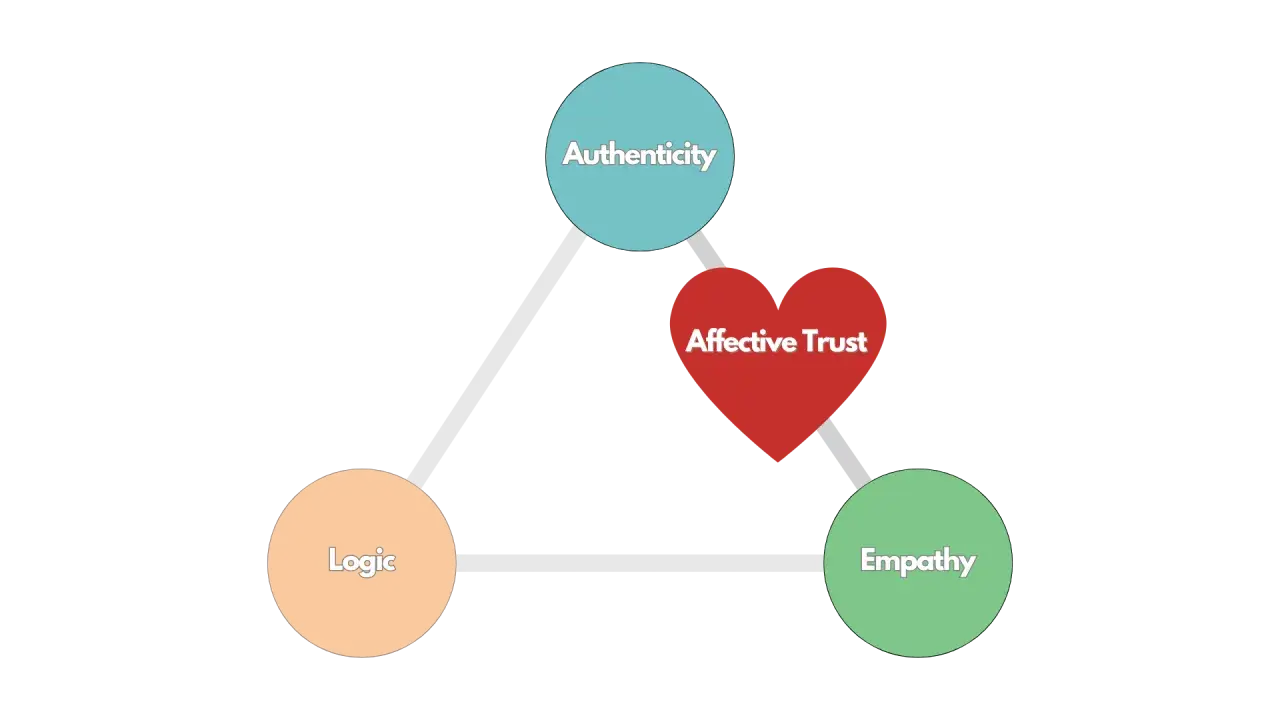
Strong workplace culture rarely fails in one dramatic moment. It usually slips through small gaps: a decision that is not explained, a manager who says one thing and does another, or a team that no longer feels safe raising a concern. A triangle of trust is a useful lens for understanding why some teams stay open and resilient while others start to protect themselves.
What makes trust hold or break in a team
- Trust is not one feeling, but three signals working together: authenticity, logic, and empathy.
- When one signal weakens, people start second-guessing decisions, withholding ideas, or escalating everything.
- High-trust teams move faster because they spend less time decoding hidden motives.
- Inclusive cultures depend on trust, because people speak honestly only when they expect fairness and respect.
- The fastest repair is usually a visible behavior change, not a polished values statement.

What the model means in a workplace
In leadership writing, the model is best understood as a way to diagnose how trust is built and why it breaks. In practice, it is about a three-way relationship between the person making the case, the person receiving it, and the organizational context that shapes what both sides expect. The three drivers are simple on paper, but they describe very real workplace dynamics: authenticity means people believe they are seeing the real you, logic means your reasoning makes sense, and empathy means people feel you care about their success and constraints.
I find this especially useful because it moves the conversation away from vague frustration. Instead of saying, "people do not trust leadership," you can ask which part is wobbling. Is the problem that the message feels performative, the decision feels arbitrary, or the tone makes people feel invisible? That diagnosis matters, because each failure needs a different repair, and that is what turns theory into something you can actually use.
Once you can name the weak point, the next step is understanding why the weakness spreads so quickly across a team.
Why trust changes culture faster than policy
Trust changes behavior faster than almost any policy because people adjust how much effort, honesty, and risk they bring into the room. Gallup has reported that employees who trust their leaders are 61% more likely to stay with their company, and that trust can drive a three-fold increase in engagement. PwC's Trust in Business Survey shows another useful pattern: leaders often believe trust is stronger than employees feel it is, which tells me perception gaps are a real management problem, not a side issue.
In practical terms, low trust makes teams slower and more defensive. People ask for more approvals, hide bad news until it becomes expensive, and stop offering half-formed ideas that could have become useful. In hybrid and distributed teams, this gets worse because fewer casual interactions are available to repair misunderstandings. When trust is thin, people fill in blanks with caution, and caution is a drag on collaboration.
That is why trust is not just a "soft" culture topic. It affects retention, speed, and whether employees feel safe enough to tell the truth early, which is usually when problems are cheapest to solve.
With that in mind, the useful question becomes what the three drivers look like in day-to-day behavior.
How authenticity, logic, and empathy show up day to day
I prefer to look at the model as a set of visible habits rather than a personality test. The table below is the version I use most often when I’m helping leaders separate a vague trust complaint from a specific behavior problem.
| Driver | What people need to feel | When it breaks | What rebuilds it |
|---|---|---|---|
| Authenticity | “This person is not performing a role.” | Polished words, but inconsistent actions or over-scripted updates. | Admit uncertainty, keep your story and behavior aligned, and be honest about stakes. |
| Logic | “The reasoning holds up.” | Shifting criteria, hidden trade-offs, or unexplained exceptions. | Show your reasoning, explain the criteria, and make decisions traceable. |
| Empathy | “My reality matters.” | Dismissive tone, one-size-fits-all rules, or ignored constraints. | Ask about impact, adjust support where possible, and close the loop. |
The important part is that none of these drivers stands alone. A manager can be warm but evasive, brilliant but dismissive, or transparent in style but inconsistent in practice. When that happens, people do not experience "a little less trust"; they experience a wobble, and that wobble changes how they participate.
Once you know which signal is weak, the next step is to change what people can see and hear from you in ordinary work.
How to rebuild trust without waiting for a culture initiative
Most trust repair does not require a big program. It requires a leader or peer to behave differently in ways people can verify quickly. In U.S. workplaces, where people are often juggling speed, hybrid schedules, and cross-functional pressure, I have found that small, repeated behaviors matter more than a one-time apology.
- Explain the decision before announcing it. People tolerate hard outcomes better when they understand the criteria, the trade-offs, and what was not possible.
- Close the loop after feedback. If someone raises a concern and never hears what happened next, they learn that speaking up is low value.
- Keep standards consistent. Flexibility is not trust if it only applies to people with status, visibility, or a strong manager.
- Say what you know and what you do not know. That kind of honesty usually reads as strength, not weakness.
- Repair fast when you miss. A short, specific correction is often better than a long explanation that tries to protect your image.
- Make one recurring space safe for dissent. One meeting, one retro, or one check-in where disagreement is actually welcomed can change the tone of a team.
These habits work because they reduce uncertainty, but they only stick if the wider culture does not punish candor behind the scenes. That is where inclusive leadership becomes the real test.
Where inclusive leadership gets the trust test wrong
Inclusive culture depends on trust because people will not contribute honestly if they believe the room is only safe for some voices. I see a few failure patterns over and over: meetings that reward the most assertive person, flexibility that is offered unevenly, performance feedback that is harsher for some groups than others, and policies that sound fair but are applied with too much discretion.
One of the most damaging patterns is proximity bias, which means managers trust and reward the people they see most often. In remote or hybrid settings, that can quietly skew promotions, access to projects, and who gets invited into important conversations. Another common problem is tone policing, where the content of a concern is ignored because the speaker was not perfectly polished. That tells people the room values comfort over truth.
I also pay attention to whether leaders invite input and then override it without explanation. Even a thoughtful decision can damage trust if people feel they were asked to participate only for optics. If you want an inclusive culture, the standard has to be more than representation on paper; it has to be predictable fairness in how people are heard, judged, and supported. Without psychological safety, even a well-designed process will not invite honest input.
These failure points are visible, which is good news, because visible problems are the easiest ones to start fixing.
What I would check first if your team feels off
If I were diagnosing a fragile team culture this week, I would start small. I would choose one recent decision, one recent meeting, and one recent piece of feedback, then ask whether each one felt authentic, logical, and empathetic from the employee side. That quick audit usually shows whether the problem is communication, fairness, or care.
- Did people see the real reason behind the choice?
- Did the reasoning hold up under scrutiny?
- Did people feel their constraints were considered?
- Were the same standards applied to everyone?
- Was there a visible follow-up after concerns were raised?
If the answer is no in more than one place, the culture is already teaching people to hold back. The good news is that trust usually starts to come back when the pattern changes in public, not when it is simply promised in private.
