
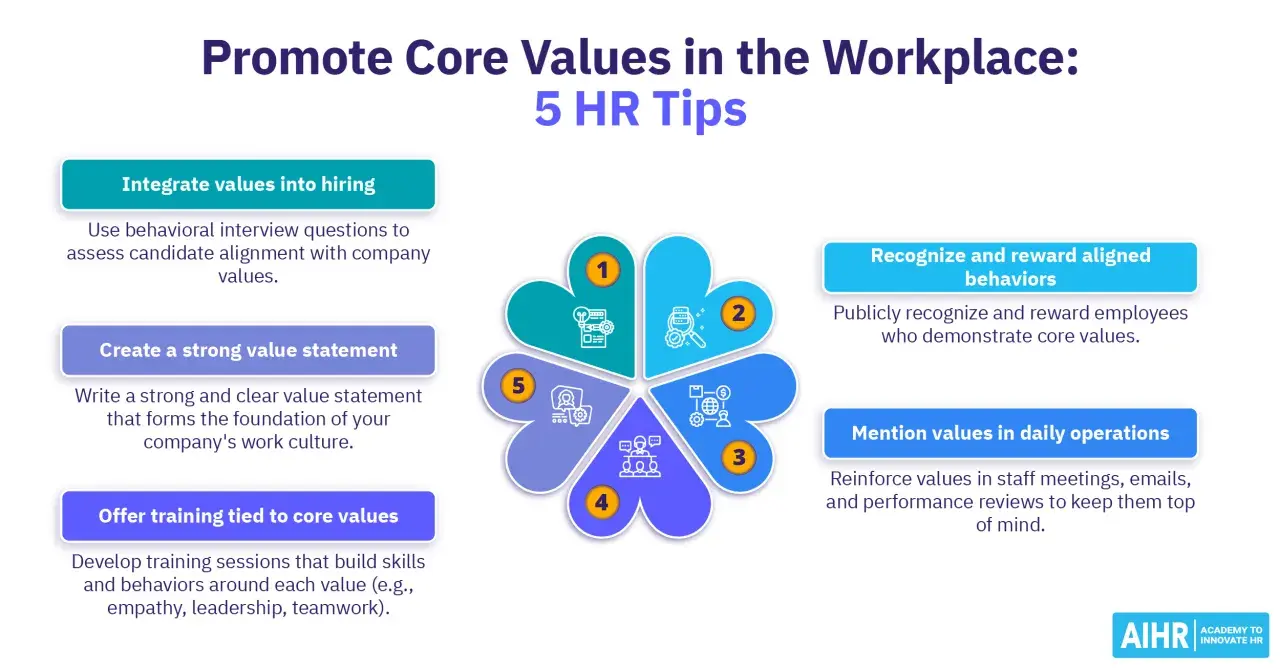
Values matter most when they change how people act
- In a workplace, values are the beliefs that guide choices, priorities, and behavior.
- Culture is the lived result of those values, not the sentence on the company website.
- Healthy values show up in hiring, feedback, promotions, conflict handling, and everyday meetings.
- Teams usually work best with 3 to 5 clear values that are translated into concrete behaviors.
- If rewards, policies, and leadership behavior contradict the values, employees notice immediately.
What values mean in a workplace
I usually separate workplace values into three layers because the differences matter. Personal values are the beliefs an individual brings to work, such as integrity, stability, growth, or service. Team values describe how a group works together, such as openness, accountability, or mutual support. Organizational values are the principles the company says it wants to guide decisions, hiring, promotions, and leadership behavior.
That distinction is useful because a mismatch in any one layer creates friction. Someone can have strong personal values and still feel uncomfortable in a team whose habits contradict them. A company can also publish thoughtful organizational values and still create confusion if managers behave differently. Once you see those layers clearly, the next question is not what values are in theory, but how they show up in real work.
| Value level | What it means | Workplace example |
|---|---|---|
| Personal | What matters most to one person | Choosing honest feedback over politeness that hides the truth |
| Team | How a group works together | People share credit instead of competing for visibility |
| Organizational | The principles the company uses to make decisions | Promotions are tied to performance and behavior, not just politics |
Why values matter more than slogans
A value written on a wall is cheap. A value that shapes a hard decision is what people remember. I have seen many teams say they value collaboration, then reward only individual heroics; the message employees receive is not the slogan, but the incentives. That is why culture is often the real-world expression of values, not the other way around.
When values are clear and consistent, they improve trust, speed up decisions, and reduce the mental load of guessing what leaders want. They also matter for inclusion. In practice, fairness, respect, curiosity, and accountability are not abstract virtues; they determine who gets heard, whose ideas survive pressure, and whether people feel safe enough to speak up. If psychological safety is missing, even good values stay theoretical because people do not trust the room enough to use them.| Stated value | What it looks like when it is real | What it looks like when it is fake |
|---|---|---|
| Collaboration | People ask for input and share credit | People compete for attention while saying they are a team |
| Respect | Meetings are orderly and interruptions are rare | Strong voices dominate and quiet people disappear |
| Transparency | Decisions come with context and criteria | People are asked to trust decisions they cannot understand |
| Inclusion | Different perspectives shape outcomes | Everyone is invited, but only a few voices matter |
Once values stop being slogans and start becoming filters, they affect the rest of the workplace in visible ways.

Common values that actually support a healthy team
In U.S. workplaces, the values that tend to matter most are not flashy. They are the ones that make daily collaboration possible. I look for values that help people work together without constant correction, because those are the values that hold up when deadlines are tight and pressure rises.
- Respect - people listen, do not interrupt, and treat disagreement as part of the work.
- Accountability - commitments are visible, and missed promises are addressed early instead of ignored.
- Transparency - decisions are explained, even when they are unpopular.
- Fairness - similar situations are handled through similar standards, not personal favoritism.
- Curiosity - leaders ask questions before they judge, which is essential for inclusive leadership.
- Inclusion - different backgrounds and work styles are treated as assets, not exceptions to manage.
- Reliability - people can trust each other to follow through.
- Growth - feedback, learning, and improvement are treated as normal parts of work.
The point is not to collect the longest list. In my experience, teams do better with a small set of values they can actually remember and use. If a value cannot shape a behavior, it is probably too vague to help anyone.
That leads naturally to the practical question: where do values matter most inside the organization?
How values shape hiring, feedback, and promotions
Values are most useful when they influence repeatable decisions. Hiring is one of the biggest. If a company says it values inclusion but only hires people who match one communication style, it will quietly narrow its own culture. The same is true in promotions: if the organization says it values collaboration but rewards only visible individual output, people will learn to perform for the metric, not the mission.
Feedback is another place where values either live or die. A respectful culture gives direct feedback without humiliation. An accountable culture names problems early instead of letting resentment build. A fair culture uses standards that managers can explain and defend. Inclusive leaders do this well when they seek out quieter voices, make criteria visible, and challenge their own blind spots before they shape talent decisions.
- In hiring, values can guide interview questions and role-play scenarios.
- In feedback, values can shape tone, timing, and honesty.
- In promotions, values should affect who gets recognized and why.
- In conflict, values should define how people disagree without escalating harm.
- In meetings, values decide whether everyone has room to contribute.
When values are built into these moments, they stop being abstract. They become part of how work gets done, which is exactly where culture is formed.
How to define or reset values without making them generic
If I were helping a team define its values from scratch, I would keep the process simple and specific. Too many organizations try to sound inspiring and end up with language nobody uses. A better approach is to choose a small number of values, define what each one looks like in behavior, and then test whether leaders are prepared to live with the consequences.
- Choose 3 to 5 core values that genuinely matter to the business and the team.
- Translate each value into observable behavior, not just a noun on a slide.
- Check whether current rewards and policies support those behaviors.
- Pressure-test the values against real scenarios, such as hiring, layoffs, conflict, or customer complaints.
- Teach managers how to explain the values in everyday language, not corporate jargon.
The pressure test is important. A value only deserves to stay on the list if it can survive a difficult Tuesday, not just a polished all-hands meeting. If the team cannot tell the difference between the value and the behavior, the value is still too abstract.
After that, the next challenge is avoiding the mistakes that make values feel fake in the first place.
Common mistakes that make values feel fake
Most value systems fail for predictable reasons. The first is overload. If a company has ten or twelve values, none of them will guide behavior very well. The second is vagueness. Words like excellence or integrity can be useful, but only if they are defined in a way people can actually use. The third is inconsistency, which is the fastest way to lose credibility.
- Too many values - people remember none of them.
- Abstract language - no one can tell what to do differently.
- Leadership exceptions - executives get a pass while everyone else is held accountable.
- Reward mismatch - the company praises one behavior but pays for another.
- No process change - values are announced, but hiring, reviews, and meetings stay the same.
- One-size-fits-all enforcement - values are treated as rules instead of decision guides.
I would add one more mistake: confusing agreement with alignment. People do not need to share every opinion, but they do need to share enough principles to work together without constant friction. That distinction is especially important in diverse teams, where culture becomes stronger not by eliminating difference, but by giving it a fair structure.
Use values as a decision filter, not wall art
The best test of a value is simple: does it help people make a better choice when the answer is not obvious? If the answer is yes, the value is doing real work. If the answer is no, it is probably decorative. I think that is the cleanest way to understand values in workplace culture, because it keeps the focus on behavior instead of branding.
- Before a decision, ask which value it supports.
- After a decision, ask whether the process matched the stated values.
- In a hiring interview, ask for examples that prove the value in action.
- In a meeting, notice who gets heard and who gets interrupted.
- In performance reviews, check whether the values influence promotion, not just praise.
If you want a practical next step, pick one recent workplace decision and test it against the values you claim to hold. If the explanation feels thin, the value system needs work. If the explanation is clear and repeatable, you are probably building a culture people can trust.
