
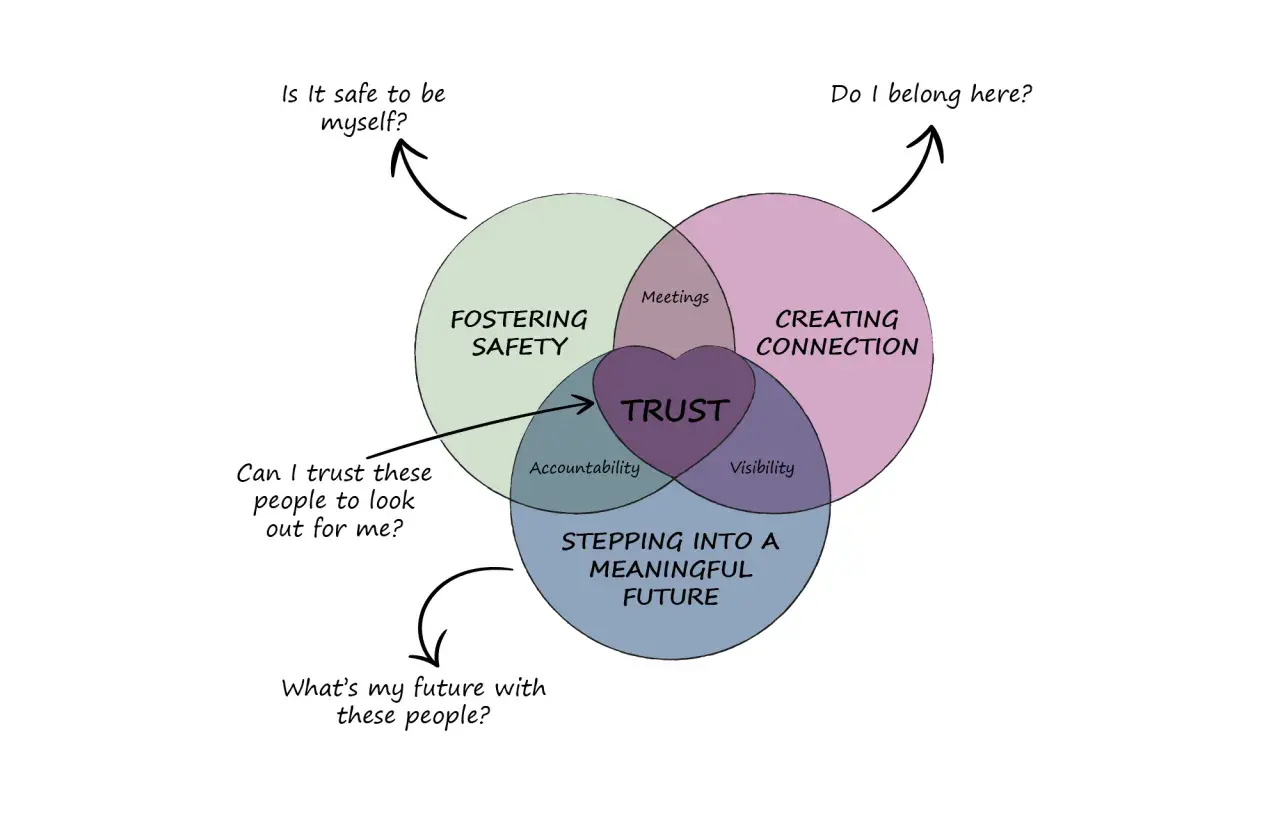
Trust is the part of workplace culture people notice before they can explain it. It shows up in whether employees speak honestly, whether managers follow through, and whether policies feel fair across teams. This article explains how to build employee trust through everyday leadership habits, better team routines, and fairer systems, with a focus on what actually matters in a U.S. workplace culture.
What you need to get right first to earn trust at work
- Trust grows from repeated proof, not polished messaging.
- Employees watch manager behavior, decision consistency, and follow-through more than mission statements.
- Fairness in pay, promotion, workload, and flexibility is one of the strongest trust signals.
- Psychological safety matters because people only speak up when they feel safe doing it.
- Hybrid and remote teams need extra clarity, because distance magnifies mixed messages.
What employee trust really looks like in practice
In a workplace, trust is not a vague feeling that everyone either has or does not have. I think of it as a working belief that other people, and the system itself, will behave in predictable and fair ways. When that belief is strong, people share problems earlier, ask better questions, and put more energy into the work instead of protecting themselves.
Trust in people
This is the basic expectation that teammates and managers will act with competence and respect. Employees want to know that if they raise a concern, it will not be weaponized later. They also want to know that promises are real, not decorative.
Trust in process
People trust a process when decisions make sense even when they do not like the outcome. That means promotions, workload distribution, performance reviews, and policy changes all need clear rules. If the process feels random, employees begin to assume bias, favoritism, or hidden agendas.
Trust in leadership
Leadership trust is the most visible layer because leaders set tone, explain direction, and respond to uncertainty. Employees do not expect perfection. They do expect honesty, consistency, and a willingness to own mistakes instead of rewriting history.
Once those layers are clear, the real work becomes less abstract: leaders have to behave in ways that make trust rational. That starts with consistency.
Lead with consistency, not slogans
The fastest way to lose credibility is to say one thing and do another. Teams notice when leaders talk about transparency but hide decisions, or when they praise accountability but excuse poor behavior from high performers. In my experience, trust grows when people see the same standards applied repeatedly, even when it is inconvenient.
| Trust-building behavior | What employees notice | Why it matters |
|---|---|---|
| Explaining decisions early | Less rumor and less guesswork | People can plan and judge the fairness of the decision |
| Keeping 1:1s and deadlines | Leaders are dependable | Reliability becomes credibility |
| Owning mistakes publicly | Leaders do not hide | Accountability feels real, not performative |
| Applying rules the same way | Bias seems less likely | Fairness is visible, not just claimed |
| Following feedback with action | Input matters | Employees stop treating surveys as theater |
Consistency does not mean rigidity. It means employees know how decisions are made, when exceptions are allowed, and what they can expect from the people leading them. If a leader cannot deliver a promise, the trustworthy move is to say so early, explain why, and reset expectations clearly. That is much better than overpromising and quietly missing the mark.
Make fairness visible in pay, workload, and flexibility
Trust weakens quickly when employees think the rules are uneven. A team can have friendly managers and still feel deeply distrustful if pay, workload, promotions, or schedule flexibility are handled in opaque ways. Fairness is not identical treatment for everyone; it is consistent criteria, applied openly, with legitimate exceptions explained.
Gallup’s 2026 U.S. hybrid-work data shows that 52% of remote-capable employees are hybrid, 26% are fully remote, and 22% are on-site. In that environment, trust is shaped not just by face time but by access to information, visibility into decisions, and whether flexibility feels equitable instead of arbitrary.
- Publish promotion criteria so employees understand what “ready” actually means.
- Use clear workload expectations so high performers do not become the default safety net for everyone else.
- Write down flexibility rules, including who approves exceptions and why.
- Check whether remote workers, office workers, and frontline staff get equal access to information and opportunities.
- Review who receives stretch assignments, because those often become the real gateway to advancement.
When flexibility is handled badly, employees do not just dislike the policy; they start questioning the intent behind it. When it is handled well, it signals respect. That is a small distinction on paper and a huge one in culture.

Equip managers to do the trust work every week
I rarely see a trust problem that is not also a manager problem. Senior leaders set direction, but managers shape the daily experience of work: who gets answers, who gets credit, who gets coached, and who gets surprised. If a manager is inconsistent, distant, or defensive, employees will feel that immediately, even if the company’s values page looks excellent.
- Start 1:1s with blockers and priorities. Employees trust managers who help them clear obstacles instead of just checking status.
- Give feedback quickly and specifically. General praise is pleasant; useful feedback builds confidence because it reduces ambiguity.
- Recognize work in public and coach in private. People trust managers who handle correction without humiliation.
- Escalate problems before they become surprises. Nothing erodes confidence faster than learning about a risk too late to act on it.
- Close the loop after ideas or concerns. Even when a suggestion is not adopted, employees want to know it was heard and considered.
Gallup has long recommended building employee engagement around manager capability, clear expectations, and regular follow-up, and that advice still holds up. Managers do not need to be polished; they need to be reliable, direct, and willing to engage in real conversations. That is the difference between a team that feels managed and a team that feels supported.
Build psychological safety and inclusion into team routines
Psychological safety is the condition that lets people speak honestly without fear of punishment or ridicule. It is not the same as being nice all the time, and it is not a free pass for weak performance. It means people can ask questions, admit errors, challenge assumptions, and raise concerns before they become expensive problems.Inclusive leadership makes that safety more than a slogan. When people from different backgrounds, roles, or communication styles see that their input gets real attention, trust widens beyond the usual inner circle. That matters because employees do not only judge whether they are heard; they judge whether they are heard fairly.
Read Also: Culture Fit in Hiring - Avoid Bias, Build Strong Teams
Practical routines that help
- Share agendas before meetings so quieter people can prepare.
- Rotate who speaks first, because the first voice in the room often shapes the rest of the discussion.
- Ask one direct question at the end of meetings: what are we missing?
- Separate idea critique from person critique so debate stays productive.
- Respond calmly to bad news, because panic teaches people to hide information next time.
Hybrid and remote teams need this even more. When people are not in the same room, small signals matter: who gets interrupted, who gets follow-up, who gets informal access, and whose work is seen. Inclusive routines reduce the chance that trust becomes limited to the people who are already most visible.
Measure trust before it leaks into turnover
Trust is often treated like a feeling, but it can be measured well enough to guide action. The important part is not collecting more survey data; it is noticing patterns and responding before the damage becomes obvious in turnover, absenteeism, or silence in meetings. By the time exit interviews get noisy, the underlying trust issue is usually older than the departures.
Gallup recommends surveying engagement every six months and, more importantly, showing employees that feedback leads to action. That principle applies to trust as well: ask, interpret, act, and then tell people what changed. If the loop stops at data collection, employees learn not to bother next time.
| What to measure | What it tells you | What to watch for |
|---|---|---|
| Pulse survey trust items | Direct sentiment about leadership and fairness | Drop-offs after reorganizations, layoffs, or policy changes |
| Meeting participation | Whether people feel safe enough to speak | Silence from the same teams or identity groups |
| Internal mobility and promotion data | Whether opportunity feels real | Patterns that suggest favoritism or blocked advancement |
| Voluntary turnover and exit themes | Where trust has already broken down | Repeated comments about fairness, managers, or confusion |
| Absenteeism and burnout signals | Whether people feel overextended or disengaged | Rising stress in teams with unstable leadership or unclear priorities |
If I were designing a simple trust pulse, I would keep it short and direct: my manager follows through, decisions are explained clearly, I can speak up without negative consequences, and people here are treated fairly. Those four items will not tell you everything, but they will tell you enough to act.
The trust signals employees remember most
When leaders ask how to build employee trust, I usually bring the answer back to three levers: consistency, fairness, and recovery. Consistency tells employees they are dealing with a stable system. Fairness tells them the system is worth believing in. Recovery tells them leadership can handle mistakes without collapsing into denial or defensiveness.
The quickest way to lose trust is to treat it like a campaign. The better move is to build it into manager habits, meeting norms, decision rules, and feedback loops until it becomes part of how the organization operates. If employees can see that everyday work is handled with clarity and respect, culture stops being a statement and starts becoming a lived experience.
