
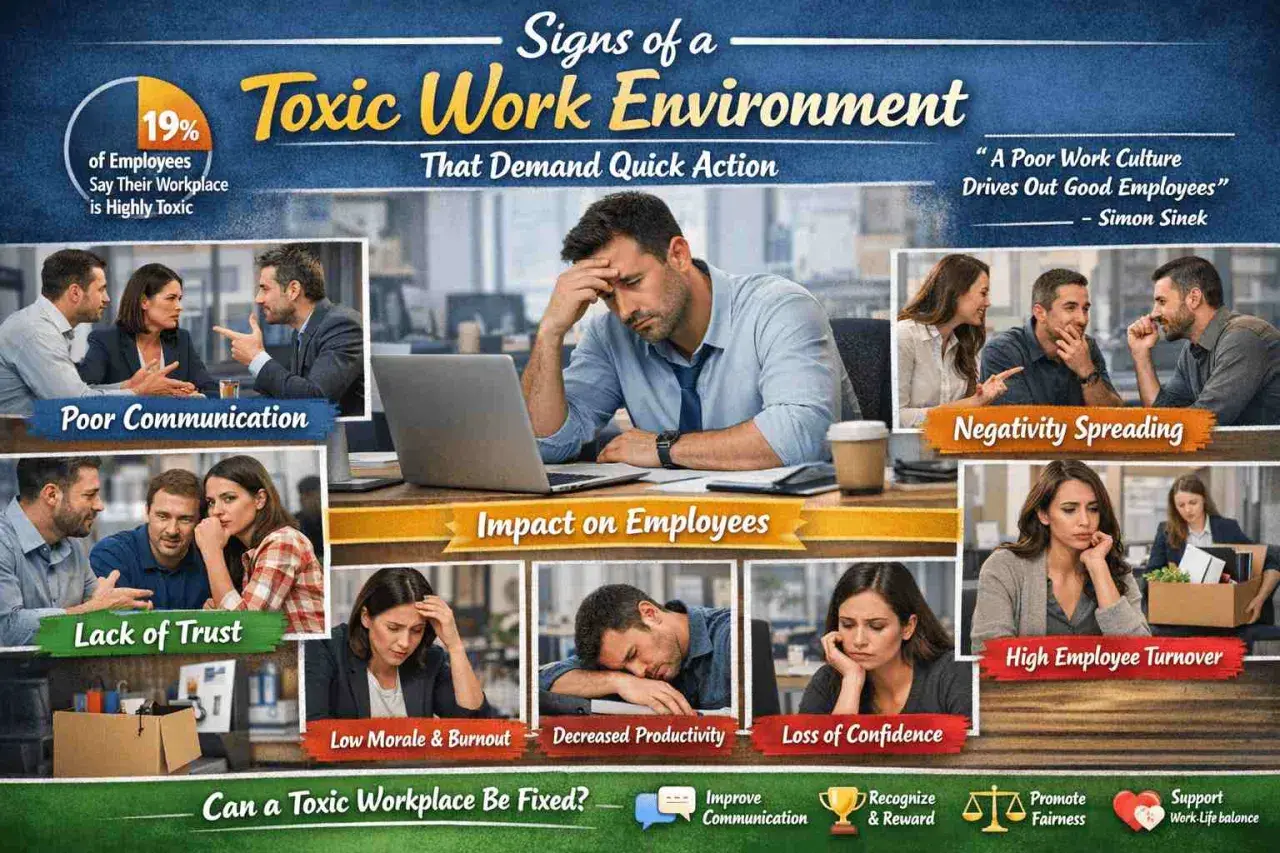
A harmful workplace rarely announces itself with one dramatic incident. It usually shows up through repeated disrespect, unclear rules, favoritism, silence after complaints, and the slow feeling that people are protecting themselves instead of doing good work.
This article breaks down how a toxic work environment actually works, how to tell it apart from normal pressure, what it does to people and teams, and what to do next if you are dealing with one in the United States.
The signs and fixes that matter most
- Look for patterns, not isolated bad days: public humiliation, exclusion, favoritism, and fear are stronger signals than one tense meeting.
- Burnout is usually the result of chronic stress that never gets managed, not a personal weakness.
- Not every unpleasant workplace is illegal, but harassment tied to protected traits and retaliation for speaking up can cross a legal line.
- Documentation matters: dates, screenshots, witnesses, and exact language help more than general complaints.
- Leaders change culture faster when they fix reporting paths, manager behavior, workload, and follow-through at the same time.

The signs that tell me this is more than a bad week
When I look at a workplace like this, I do not start with personality conflicts. I look for repeated patterns: people who are afraid to ask questions, managers who use humiliation as a tool, employees who never know which rules apply, and teams that have learned silence is safer than honesty.
Common warning signs usually cluster together rather than showing up alone.
- Public criticism or humiliation, especially when it happens in front of peers.
- Favoritism, where the same people get opportunities, flexibility, or protection every time.
- Gossip and blame that replace direct feedback and problem-solving.
- Exclusion from meetings, information, or decisions that affect the work.
- Impossible workload with no room to say no, renegotiate, or ask for help.
- Fear after speaking up, which is often the clearest signal that the culture is already unhealthy.
Burnout is what chronic stress looks like when nobody manages it. People often read the symptoms as a personal issue, but the pattern is usually organizational: too much pressure, too little control, and no meaningful support.
Once you can read the pattern, the next question is why it keeps spreading.
Why harmful cultures spread faster than leaders expect
Bad behavior is contagious when the system rewards it or ignores it. People copy the tone that gets promoted, they stay quiet when complaints disappear into a black hole, and they disengage when rules are applied unevenly.
I usually see a few accelerants:
- Unclear authority, where no one knows who decides what.
- Manager favoritism, which turns trust into politics.
- Overwork without control, which pushes people into survival mode.
- Job insecurity, which makes employees tolerate behavior they would normally reject.
- Weak inclusion, especially when the same voices dominate every room.
Recent APA work on toxic workplaces has pointed to failures in equity, diversity, and inclusion, overwork, and poor leadership as recurring contributors. That fits what I see in practice: when people do not feel respected or protected, they stop contributing fully, even if they never say it out loud.
OSHA cites survey data showing that 65% of U.S. workers said work was a very significant or somewhat significant source of stress in recent years, and 54% said work stress affected home life. That matters because a damaged culture rarely stays at the office. It follows people home, where it turns into sleep problems, irritability, and mental fatigue.
That is why the legal line matters.
How to separate a bad culture from a legal problem
Not every miserable workplace is unlawful, and that distinction matters. In the U.S., the legal line usually appears when conduct is tied to a protected characteristic, when it becomes severe or pervasive enough to create a hostile work environment, or when someone is punished for reporting a problem.
The EEOC looks at these cases in context, not as one-off moments in isolation. A rude comment may be unprofessional, but repeated targeting, coercion, exclusion, or punishment can change the meaning of the same behavior very quickly.
| Pattern | What it usually means | Smart next move |
|---|---|---|
| Public humiliation, sarcasm, or shouting | A control problem that can quickly poison trust | Document it and do not treat it as a one-off if it repeats |
| Comments tied to race, sex, age, religion, disability, or national origin | Possible unlawful harassment | Report it promptly through the proper channel |
| Punishment after a complaint | Retaliation risk | Keep records and escalate early |
| Rules applied selectively | Favoritism, bias, or both | Compare treatment with written policy |
| Impossible workload with no control | Burnout risk and broken operations | Push for scope, staffing, or priority changes |
Deadlines are another point people miss. In many cases, filing a charge with the EEOC has a 180-day window, and federal employees generally have 45 days to contact an EEO counselor, though state rules can extend some deadlines. The safest move is to act early instead of waiting for the situation to become undeniable.
If you are still inside the problem, the next step is protecting yourself.
What to do if you are still inside the problem
The goal is not to build a dramatic case overnight. It is to protect yourself, make the pattern visible, and keep your options open.
- Write down dates, names, exact words, and witnesses as soon as possible.
- Save emails, chat logs, performance notes, schedule changes, and screenshots.
- Use the right channel: manager, HR, ethics line, union rep, ombuds, or a trusted executive if the normal path is compromised.
- Ask for follow-up in writing after any verbal conversation.
- Limit one-on-one exposure when that is practical, especially if conflict or intimidation keeps escalating.
- Get medical or mental health support if sleep, appetite, concentration, or panic are slipping.
When the issue involves safety or health hazards, OSHA lets workers file a confidential complaint and says retaliation for protected complaints is illegal. That does not solve every culture problem, but it matters when the workplace has crossed from unpleasant into unhealthful or unsafe.
If the problem is discrimination or harassment, use the internal process and the external deadlines together. Waiting for the perfect explanation usually helps the employer, not the worker.
Leaders are the ones who can stop the cycle at the source.
What leaders need to change first
Inclusive leadership is not a slogan; it is the daily system that tells people whether fairness is real. If I were brought into a team with a rotten culture, I would start with the mechanics that shape behavior, not with posters on the wall.
- Make reporting safe - Employees need a clear way to speak up, a timeline for response, and a visible ban on retaliation.
- Train managers on behavior - Good training is not just policy reading; it covers feedback, conflict, bias, and how to respond when someone raises a concern.
- Audit workload and role clarity - Chronic overwork and vague authority create the perfect conditions for blame and burnout.
- Measure inclusion - If the same people are interrupted, sidelined, or promoted less often, the culture is already speaking.
- Correct fast and visibly - A quiet, delayed response teaches everyone that the rule is optional.
Federal guidance is consistent on this point: prevention, prompt correction, and a real complaint process matter more than polished values statements. If people do not trust the process, they stop using it, and the culture gets worse by default.
Leaders usually get better results when they treat culture as an operating system. If the incentives reward domination, speed at all costs, or silence, the worst behavior will survive the cleanest policy language.
Leaving may be necessary, but recovery also needs attention.
How to recover without carrying the damage into your next job
People often leave a harmful workplace and assume the hard part is over. In practice, the nervous system takes longer to reset than the resignation letter takes to write.
What helps most is boring and specific: regular sleep, fewer after-hours checks, honest conversations with people you trust, and a full debrief of the patterns you do not want to normalize again.
- Name the behaviors, not just the feeling. “My manager changed expectations without telling me” is more useful than “the job was bad.”
- Notice what you began tolerating. That is usually where the boundary was already leaking.
- Watch for signs of burnout such as exhaustion, cynicism, and reduced effectiveness.
- Use interviews to screen for culture, not just compensation. Ask how feedback works, how complaints are handled, and what happens when a manager is the problem.
Rebuilding trust is slower than spotting red flags. That is normal. The point is not to become suspicious of every workplace; it is to become precise about the conditions that keep people healthy and honest.
The culture signals I would never ignore again
After enough cycles of watching good people get drained, I have learned that the earliest warnings are usually small: jokes that target the same group, praise that only goes to the loudest voice, meetings where dissent disappears, and managers who ask for transparency but do not practice it themselves.
- If complaints disappear, the problem will grow.
- If only a few people feel safe speaking, the culture is already uneven.
- If overwork is treated as loyalty, burnout will follow.
- If fairness depends on who is in the room, trust will erode fast.
The healthiest organizations do not eliminate conflict; they make conflict usable. That means clearer norms, better manager habits, real accountability, and enough psychological safety for people to tell the truth before damage turns into turnover. That is the standard I use when I decide whether a culture is healthy enough to trust.
