
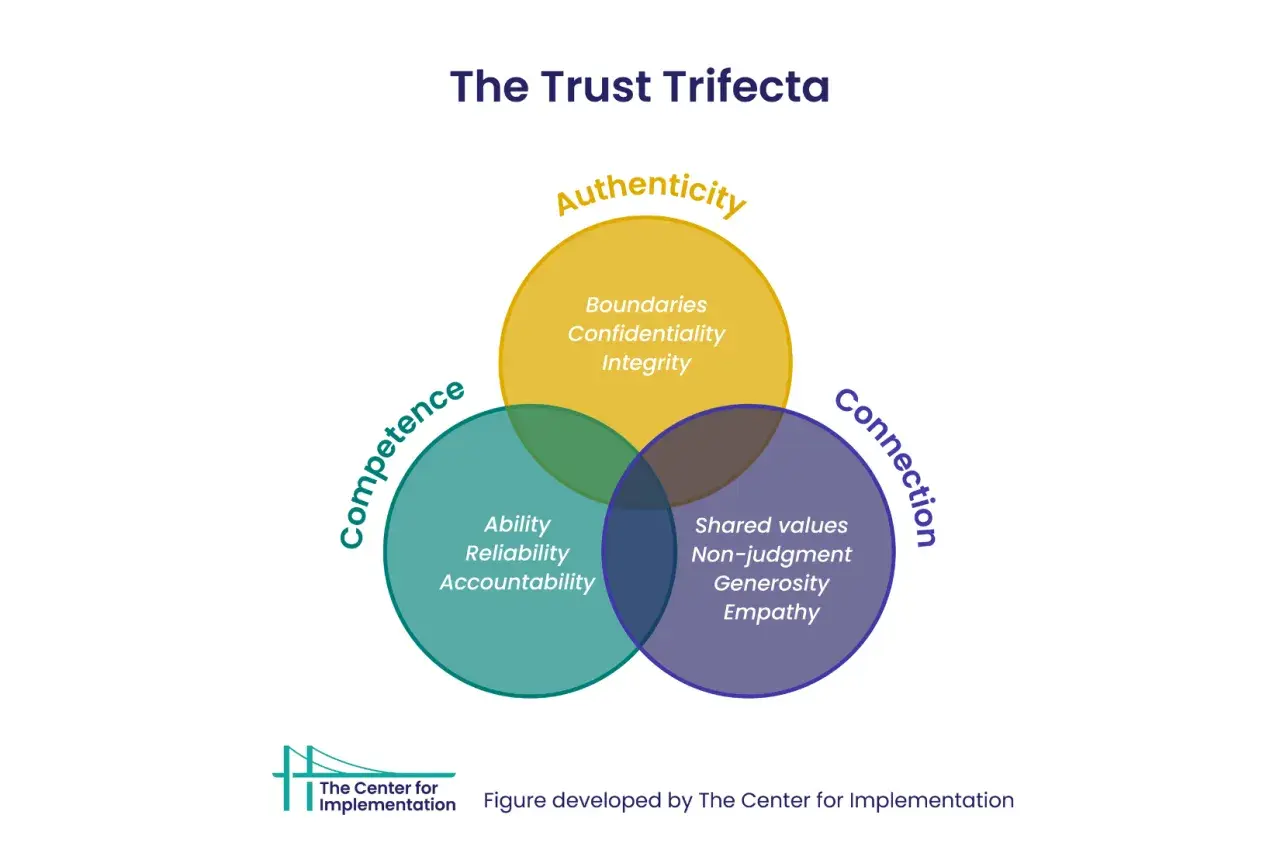
This article breaks down the three drivers of trust, shows how they surface in meetings and feedback, and explains how to use the model to support inclusion, clarity, and better day-to-day culture.
Key takeaways for stronger workplace trust
- Trust is built on three perceptions: authenticity, logic, and empathy.
- When trust breaks, the weak spot is usually one of those three drivers, not all of them at once.
- A team’s culture changes quickly when people stop believing leaders are genuine, competent, or caring.
- The best repairs are specific: improve the message, the reasoning, or the relationship, depending on the wobble.
- Inclusive cultures depend on trust because people only speak up when they believe their voice will be received fairly.

What the trust triangle says about trust at work
The core idea is simple: people trust leaders when they feel they are seeing the real person, when the reasoning holds up, and when they believe the leader actually cares about them and their success. If any one of those perceptions weakens, trust starts to wobble. That is why the framework is so useful in workplace culture work: it turns a vague feeling into something you can observe, name, and fix.
| Driver | What people need to believe | What strong behavior looks like | What usually breaks it |
|---|---|---|---|
| Authenticity | I am seeing the real you. | Messages are consistent, honest, and not overly scripted. | People sense spin, performance, or hidden motives. |
| Logic | Your judgment is sound. | Decisions are clear, reasoned, and tied to evidence or priorities. | Plans feel vague, contradictory, or made up on the spot. |
| Empathy | You care about me and my success. | You listen, respond to context, and show that people matter. | Communication feels cold, rushed, or purely transactional. |
The important thing is not perfection. It is pattern recognition. A leader can be strong in two drivers and still lose trust if the third keeps failing in predictable situations. Once you can name the wobble, the conversation gets much more honest, which is where the practical work begins.
How authenticity, logic, and empathy change team behavior
Trust is not just a warm feeling. It changes what people do on Monday morning. In a trust-rich team, people ask questions earlier, raise risks sooner, and commit to decisions without dragging their feet. In a trust-poor team, the opposite happens: people wait, edit themselves, and keep their real concerns private.
- Authenticity shapes whether people believe the message or just the role. When it is strong, updates feel grounded and human. When it is weak, even neutral announcements can sound political.
- Logic shapes whether people can follow the decision. When it is strong, they may disagree, but they understand why the choice was made. When it is weak, they start guessing what is really going on.
- Empathy shapes whether people feel safe enough to engage. When it is strong, people assume their experience matters. When it is weak, they comply without contributing much else.
That is why the triangle matters more than a personality label. A leader does not have to be universally liked to be trusted. People can trust a difficult message if the message is honest, the reasoning is clear, and the care is visible. I find that distinction especially useful in workplaces where managers confuse being liked with being effective.
How to find your own wobble before the team does
The fastest way to use the model is to stop talking about your intentions and start reviewing your actual behavior. I usually suggest looking at three recent interactions: one one-on-one, one team meeting, and one situation where the stakes were higher than usual. Then ask what people were most likely to question.
- Did they doubt your honesty or suspect you were holding something back?
- Did they question your reasoning, your priorities, or your competence?
- Did they wonder whether you understood their reality, pressure, or constraints?
- Did the problem show up with every audience, or only with a specific group?
That last question matters more than people expect. A leader may look highly logical to senior executives and still feel dismissive to direct reports. Someone may sound warm in informal settings but become rigid when challenged. Those differences are not random; they are clues. The goal is to find the pattern, because a repeated pattern is where trust is actually being lost.
How managers can use the framework in meetings, feedback, and change
The framework is most useful when it changes daily habits, not when it becomes a poster on the wall. If I were coaching a manager, I would start with three situations where trust is won or lost quickly: meetings, feedback, and change conversations.
In meetings
Lead with the point, then explain the reasoning. That structure helps logic. It also reduces the confusion that happens when leaders meander through context and only reveal the decision at the end. If people interrupt, they should still leave the room knowing what was decided and why.
In feedback
Feedback lands better when people can feel both care and honesty in the same sentence. I would avoid the false choice between being kind and being clear. Say what you saw, say why it matters, and say what better looks like. That combination protects empathy without diluting accountability.
Read Also: Growth Mindset Culture - Build Real Development, Not Just Slogans
During change
Change is where trust usually gets tested hardest. People do not need every detail, but they do need a coherent story about what is changing, what is staying the same, and what the next step is. Gallup has shown that when employees believe they have chances to give honest feedback about organizational changes, they are far more confident in their leaders’ ability to manage emerging challenges. That lines up with what I see in practice: trust increases when people are treated as participants, not as recipients of a finished decision.
These habits are small, but they are repeated many times a week. That repetition is what turns a leader’s personal style into a culture signal.Where trust fails fastest in inclusive workplaces
Inclusive workplaces are especially sensitive to trust problems because employees notice quickly when the rules feel uneven. If one group gets more context, more patience, or more grace than another, people do not just notice the inconsistency. They start updating their entire view of the organization.
- Performative transparency sounds open but hides the actual decision logic.
- Selective empathy shows care only when the issue affects the people already closest to power.
- Polite avoidance keeps meetings calm while unresolved tension keeps growing underneath.
- Inconsistent follow-through teaches people that promises are not binding.
- Feedback theater asks for honesty, then quietly punishes the people who use it.
In a culture like that, trust does not fail in a single dramatic moment. It erodes through pattern recognition. Employees learn what happens when they speak up, what happens when they disagree, and what happens when they need support. That is why the triangle is such a practical inclusion tool: it reveals where the workplace is asking people to believe more than the organization has earned.
Why trust and inclusion rise or fall together
Trust is the condition that lets inclusion become real. People cannot contribute fully if they are constantly calculating whether their ideas will be dismissed, copied, ignored, or punished. When trust is low, employees filter themselves before they ever speak. When it is high, they bring better information into the room.
That matters in the U.S. right now because the numbers show a real gap between what organizations ask for and what employees experience. In Gallup’s midyear 2025 data, only 28% of employees strongly agreed that their opinions count at work, and overall engagement sat at 32%. Those figures do not mean trust work is impossible. They mean many workplaces still expect participation without building the conditions that make participation feel safe.
This is where Frances Frei’s model becomes more than a leadership lesson. Authenticity makes room for difference, logic makes decisions legible, and empathy tells people they are not disposable. When those three are aligned, belonging stops being a slogan and starts showing up in everyday behavior.
A 30-day trust reset that fits a busy team
If I were resetting trust in a team over the next month, I would keep the work simple and visible.
- Week 1: ask your team which of the three drivers feels weakest and where it shows up.
- Week 2: fix one communication habit, such as opening decisions with the conclusion first.
- Week 3: add one listening ritual, such as ending meetings with “What are we missing?”
- Week 4: close the loop publicly on one issue so people can see that feedback changed something.
