
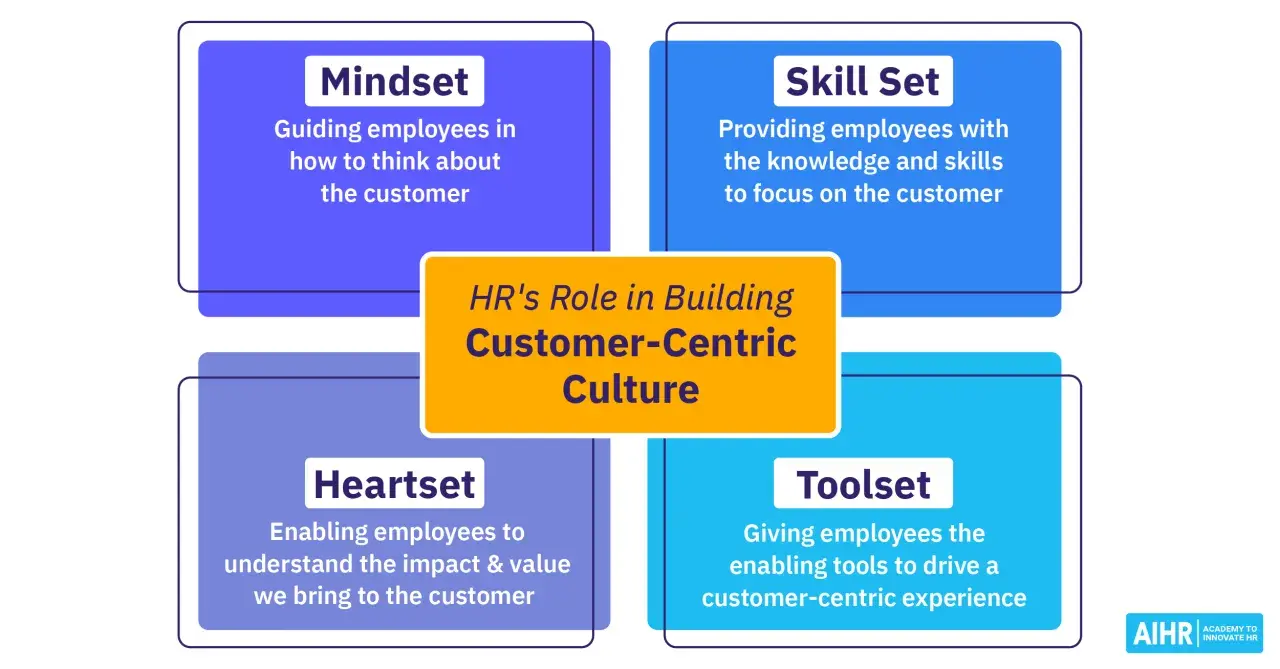
A customer centric culture is not a slogan on the wall; it is the way decisions, habits, and trade-offs show up when no one is watching. In practice, it shapes how quickly teams solve problems, how much judgment frontline employees are allowed to use, and whether customers experience the company as easy to work with. This article breaks down what that looks like, why it matters for workplace culture, how leaders build it, and where organizations usually get it wrong.
These are the points that matter most when customer needs shape daily work
- Customer focus has to show up in decisions, not just in messaging.
- The strongest cultures give frontline teams clear authority and simple guardrails.
- Employee experience and inclusion are part of the customer experience, not separate projects.
- Progress should be measured with both customer signals and internal behavior.
- The biggest failure mode is performative customer care with no real change behind it.
What a customer-centric culture looks like at work
When I look for this kind of culture inside a company, I do not start with slogans. I look at whether people can explain the customer impact of their work, whether escalation paths are short, and whether different teams are solving the same problem in the same direction. In a healthy organization, customer insight does not sit in one department; it moves through product, operations, service, HR, and leadership.
| Area | Healthy signal | Warning sign | What it means |
|---|---|---|---|
| Decision rights | Frontline employees can resolve common issues within clear limits | Every exception needs manager approval | Speed and trust improve, or they disappear |
| Feedback loop | Customer, employee, and operations data are reviewed together | Insights stay in separate dashboards | Patterns are easier to spot, or easier to miss |
| Policies | Rules guide judgment | Scripts replace judgment | Service becomes consistent, or robotic |
| Inclusion | Different customer segments are considered in planning | An “average customer” drives every choice | More needs are included, or quietly excluded |
A healthy culture does not mean every request gets a yes. It means there is a visible, fair process for deciding what helps the customer without harming employees or the business. Once that distinction is clear, the next question is why this matters beyond better service.
Why it matters beyond customer service
This is bigger than support tickets. When the culture works, teams waste less time redoing work, customers face fewer handoffs, and employees can act instead of waiting. I have found that the biggest gain is not only loyalty, but clarity: people stop optimizing their local metric and start making decisions that hold up across the whole journey.
McKinsey makes a point I agree with: customer centricity starts at the top, and tools only help once purpose, structure, and behavior are aligned. That matters in real workplaces because culture is what turns a strategy into something employees can actually use on a Monday morning. If the organization says customers come first but the internal incentives reward speed, volume, or silence, the message breaks down quickly.
I also see a direct link to workplace culture. People stay more engaged when they see that customer feedback changes something real, not just a slide deck. That is especially important in U.S. organizations, where customers expect fast, low-friction service and teams are often spread across functions, locations, and time zones. The culture has to help people work together, not just serve politely.
Once the business case is clear, the real leverage point is leadership behavior.
The leadership behaviors that make it real
Leaders do not create this culture by repeating “customer first” in meetings. They create it by showing employees how to think, what to prioritize, and when to push back. The most effective leaders make customer impact visible, not abstract.
Translate the purpose into trade-offs
I want leaders to name the trade-offs out loud. If we add this feature, what do we stop doing? If we shorten this process, what guardrails keep quality high? Customer focus becomes real when people can answer those questions without guessing. Without that clarity, teams end up improvising, and improvisation is expensive.
Reward good judgment, not just heroics
I prefer systems that celebrate solved problems over dramatic rescues. If the only way to help customers is for one overworked employee to bend every rule, the culture is not customer-centric; it is fragile. Good judgment should be repeatable, teachable, and supported by policy, not dependent on a few stars.
Read Also: Improve Your Work Ethic - Real Habits, Real Results
Make the customer visible in ordinary meetings
Bring actual customer stories, call clips, or journey maps into planning meetings. Small rituals matter more than big speeches because they train the organization to think from the outside in. I also like hearing from employees who are close to the customer but come from different roles or backgrounds, because they often notice friction that leadership would otherwise miss.
Once those leadership habits are in place, the next step is turning them into a repeatable operating model.

How to build it in 90 days
I like a 90-day approach because it is long enough to change habits and short enough to keep urgency. In my experience, the teams that move fastest do not start with a giant transformation program; they start with one journey, one metric, and one decision right.
-
Map the journeys that matter most.
Start with two or three customer journeys that drive revenue or risk, such as onboarding, issue resolution, or renewal. Identify where customers get stuck, where employees lose time, and where decisions bounce between teams.
-
Compare customer feedback with employee feedback.
Qualtrics recommends looking at both, and I agree. The gap between what customers feel and what employees experience often shows where the real friction lives. Use pulse surveys, service logs, and frontline notes together instead of treating them as separate worlds.
-
Assign one owner and one outcome.
Each pilot needs a clear owner and a single measurable outcome, such as fewer handoffs, faster resolution, or lower complaint volume. If you track too much at once, the team learns to manage reports instead of behavior.
-
Give frontline teams decision rights with guardrails.
For example, let a team solve routine issues up to a defined limit, such as a small refund, a fee waiver, or an expedited replacement. The exact amount matters less than the principle: people closest to the problem should not have to beg for permission to fix it.
-
Review progress every week.
Use a short weekly meeting to remove blockers, share customer examples, and confirm what changed. A 30-minute review is usually enough if it ends with one decision, one owner, and one follow-up.
The important part is consistency. If the pilot never changes a policy, a training step, or a decision right, the organization learns that customer feedback is ceremonial. If it does change one real process each month, the culture starts to move in a visible way.
How to measure progress without gaming the numbers
Measurement should tell you whether the culture is working, not whether people have become skilled at chasing a score. I look for a mix of customer metrics, operational metrics, and employee signals, because one dashboard rarely tells the whole story.
| Metric | What it tells you | Common pitfall |
|---|---|---|
| NPS or loyalty score | Relationship health over time | It is too slow to guide daily action on its own |
| CSAT | Satisfaction after a touchpoint | It can hide deeper process problems |
| Customer effort score | How hard it is for people to get help | It is not enough if used without operational context |
| First contact resolution | How often the organization solves a problem in one pass | It can encourage speed over accuracy |
| Employee pulse on customer focus | Whether the culture is landing internally | Anonymous feedback gets ignored until it is too late |
| Time from insight to action | How quickly the company turns feedback into change | Insights pile up if no one owns the follow-through |
If customer scores improve while attrition rises or quality suffers, the organization is probably optimizing the metric, not the culture. I care more about whether employees can act on customer issues quickly, whether the same complaint shows up less often, and whether visible changes happen within weeks instead of quarters. That is the difference between reporting and progress.
Once you measure the right things, the next step is to avoid the mistakes that make a customer-focused brand sound better than it behaves.
Common mistakes that make the culture look stronger than it is
- Turning customer focus into a support-team slogan instead of a company-wide responsibility.
- Over-relying on scripts and automation, then acting surprised when employees stop using judgment.
- Celebrating heroic one-off recoveries while leaving the broken process untouched.
- Listening to feedback but never closing the loop with employees or customers.
- Ignoring accessibility, language clarity, and fairness, which creates a better experience for some people than others.
- Confusing “the customer is always right” with good service, even when a request is unreasonable or harmful.
I am careful with that last point. A customer-focused company is not one that says yes to everything; it is one that solves problems fairly, consistently, and within clear boundaries. If leaders miss that distinction, they often create burnout, inconsistent service, and a team that quietly stops believing the message.
That is why inclusion belongs in the same conversation, not as a side topic but as part of the operating system.
What inclusive workplaces add to customer focus
This is where workplace culture and customer experience meet most clearly. Diverse teams notice different friction points: an accessibility issue, a confusing policy, a language gap, or a form that assumes one kind of customer. Inclusive leadership matters because people only surface these problems if they feel safe enough to speak, and they only stay engaged if they believe their insight will matter.
For me, this is one of the strongest arguments for linking employee experience to customer experience. When people feel respected, heard, and able to contribute, they are more likely to challenge bad assumptions, prevent blind spots, and solve problems that would otherwise show up as customer frustration. In a U.S. workplace, where the customer base is rarely uniform, that breadth of perspective is not optional.
In practice, the organizations that do this well do not treat employee well-being as a separate project from customer outcomes. They recognize that exhausted or excluded employees cannot deliver consistent judgment, and that a more equitable workplace usually produces a better, more reliable customer experience.
From there, I use a very simple test to decide whether the change is real.
What I check before saying the culture has changed
- Can a frontline employee solve a common problem without asking three different managers?
- Did one customer insight change a policy, workflow, or decision right in the last 30 days?
- Can employees explain, in plain English, how their work affects the customer?
- Do customer and employee signals get reviewed together instead of in separate silos?
If the answer is yes to all four, customer focus is probably becoming part of the operating system. If not, the company may have good intentions but not yet a durable customer-centric culture. The useful part is that this usually changes through a series of small decisions, not a single rebrand, and that gives leaders a practical place to start.
