What you need to know before you try to change the culture
- Psychological safety is about interpersonal risk, not comfort or forced agreement.
- It grows when leaders respond well to questions, mistakes, and honest disagreement.
- It matters for inclusion because people cannot contribute fully if they do not feel they belong.
- Hybrid and remote teams need clearer norms, not looser ones.
- You can measure progress with simple pulse questions and visible team behaviors.
What it really means on a team
Google's re:Work team describes this as a shared belief that the team is safe for interpersonal risk-taking. In plain English, that means people can speak up without expecting embarrassment, rejection, or punishment. I find that definition useful because it draws a sharp line between a team that feels safe enough to be honest and a team that is merely polite.
| Concept | What it means | What it does not mean |
|---|---|---|
| Psychological safety | People can ask, challenge, admit, and contribute without fear of social punishment | No standards, no accountability, or endless agreement |
| Trust | People believe others will act fairly and reliably | Everyone thinks the same way |
| Comfort | People feel at ease in the room | There are no hard conversations |
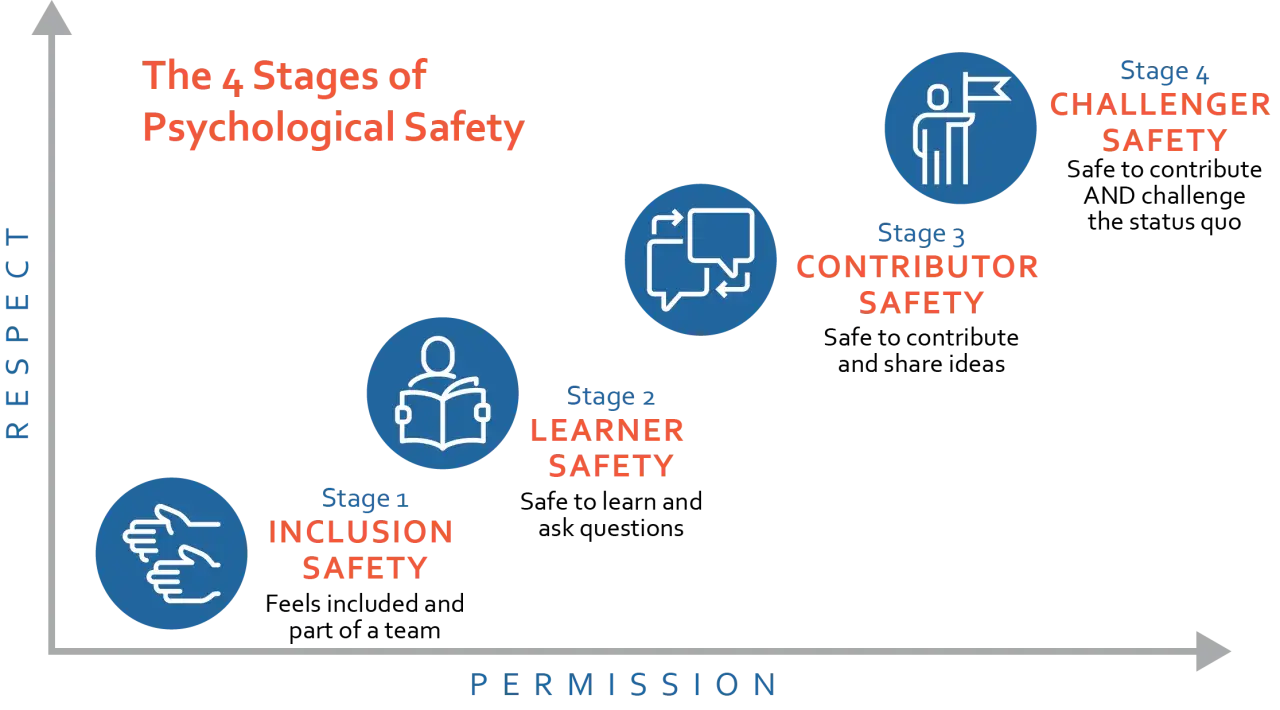
I also like the four-stage model because it shows that teams do not jump straight to challenge. They usually move through inclusion, learning, contribution, and only then constructive challenge. That sequence matters in inclusive leadership: people first need to feel that they belong, then that questions are welcome, then that their skills matter, and finally that disagreement will be respected rather than punished.
- Inclusion safety means people feel accepted for who they are.
- Learner safety means people can ask questions, experiment, and make mistakes while learning.
- Contributor safety means people feel their skills and effort can make a real difference.
- Challenger safety means people can challenge the status quo when they think something should improve.
Once the difference between safety and comfort is clear, the next question is whether it actually changes how people feel about work.
Why it changes culture, performance, and retention
According to APA's 2024 Work in America survey, workers with higher psychological safety reported stronger job satisfaction, better relationships with managers, and much lower day-to-day stress. I would not treat those numbers as proof that safety is the only driver of performance, but they do show a consistent pattern: when people feel safe, they are more willing to stay engaged and less likely to mentally check out.
| Outcome in the survey | Higher safety | Lower safety |
|---|---|---|
| Overall job satisfaction | 95% | 85% |
| Relationship with managers | 97% | 78% |
| Feeling tense or stressed on a typical workday | 27% | 61% |
| Intent to look for a new job within the next year | 19% | 41% |
That pattern matters because culture is not a poster on a wall; it is the repeated experience people have when they speak, disagree, or need help. When the workplace is psychologically safe, employees are more likely to surface problems early, share half-formed ideas, and tell the truth before small issues become expensive ones. For underrepresented employees in particular, that can be the difference between contributing fully and staying quiet to avoid attention.
There is also a practical leadership lesson here: if you want better decisions, you need more honest information. That becomes easier to see once we look at the everyday signals people pick up in meetings, one-on-ones, and feedback conversations.
What it looks like in day-to-day work
Safe teams sound different. In one room, people ask clarifying questions without apology, disagree without personal heat, and mention concerns early enough for action. In another, the real conversation happens after the meeting, usually with the person who feels safest to talk to. I usually look for those small behavioral shifts first, because they tell me more than any culture statement ever will.
- People ask questions before they pretend to understand.
- Minor mistakes are discussed as process problems, not character flaws.
- Disagreement is treated as useful data, not as disloyalty.
- Quieter voices speak because the room makes space for them.
- Feedback moves upward as well as downward.
- Bad news reaches managers early instead of being softened for days.
In remote and hybrid teams, those signals can get blurred. A text channel can make it easier for some people to speak up, but it can also hide tone, shut down nuance, and reward the fastest responders rather than the most thoughtful ones. The healthiest teams do not assume that digital convenience equals openness; they build clear norms for who speaks, how dissent is handled, and what happens after someone raises a concern.
That is the point where leadership behavior starts to matter more than team slogans or morale exercises.

How leaders build it without turning it into a slogan
If I were coaching a manager from scratch, I would not start with a big culture program. I would start with the few moments people remember: the first response to a risky comment, the way mistakes are handled, and whether feedback changes anything. Those moments teach a team what is actually safe.
- Name the norm clearly. Say that questions, disagreement, and honest mistakes are expected. People should not have to guess whether candor is welcome.
- Respond well to the first risky comment. When someone shares a concern, avoid sarcasm, interruption, or quick correction. A calm response teaches more than a speech.
- Separate the mistake from the person. Focus on what happened, what the process missed, and what should change. Blame makes people hide the next problem.
- Invite dissent on purpose. Ask, "What are we missing?" or "Who sees this differently?" That is especially important in leadership meetings, where agreement can become performative.
- Rotate who speaks first. If the same confident voices always set the tone, quieter people learn to stay quiet. Written input before discussion can help.
- Close the loop after feedback. If employees raise an issue and nothing changes, the lesson is that speaking up is performative. Even a partial fix is better than silence.
- Protect dignity under pressure. A leader who stays respectful during a hard quarter or a bad launch does more for psychological safety than a leader who is only pleasant when things are easy.
I also think leaders underestimate how much follow-through matters. A team does not become safer because one workshop was inspiring; it becomes safer when people see that speaking honestly leads to action, not retaliation. Once that habit is in place, the next thing to watch is what quietly destroys it.
The mistakes that quietly undo progress
The fastest way to weaken trust is to praise candor and then punish the messenger. I see that pattern more often than most leaders admit. Teams also lose confidence when they confuse safety with harmony, because healthy cultures can handle friction while unhealthy ones simply hide it.
- Treating safety as niceness. Politeness is not the goal. People still need direct feedback and real standards.
- Rewarding speed over honesty. When only fast answers get attention, thoughtful people stop contributing.
- Assuming silence means alignment. Silence often means uncertainty, caution, or fatigue.
- Letting only extroverts define the room. If the loudest person sets the tone, the culture is already uneven.
- Using surveillance as a management style. Heavy monitoring signals mistrust and makes people more self-protective.
- Ignoring group differences. If some teams, roles, or identity groups feel less safe than others, the culture is not consistent.
The last point is especially important for inclusive workplaces. A culture can look healthy to leadership and still feel risky to people with less power, newer employees, caregivers, or workers who have been marginalized elsewhere. If that is happening, the issue is not a communication problem alone; it is a belonging problem.
That is why measurement needs to be simple enough to use and specific enough to show where the gaps are.
How to measure it without turning it into a bureaucracy
I would not wait for an annual engagement survey to tell me whether a team feels safe. I would use short pulse questions, manager observation, and a few visible indicators that reveal whether people are actually speaking up. The goal is not to create another dashboard; it is to catch drift before the culture hardens.
| What to measure | What it tells you | What good looks like |
|---|---|---|
| Speak-up rate in meetings | Whether people contribute before the decision is already made | More than one voice, including quieter roles |
| Quality of questions | Whether people are learning or just performing agreement | Clarifying and challenging questions appear early |
| Response time to bad news | Whether managers reward early honesty | Issues are addressed quickly and calmly |
| Gaps across teams or groups | Whether safety is consistent or uneven | Similar experiences across roles, demographics, and locations |
| Turnover intent | Whether people expect the culture to improve | People want to stay and contribute |
Three pulse questions are enough to start: "I can raise a concern without negative consequences," "People on my team respect different viewpoints," and "When mistakes happen, the focus is on learning rather than blame." If the scores vary sharply by team, location, or employee group, that is not noise. It is a signal that the culture is experienced differently depending on where someone sits.
Measurement only helps when it leads to a small number of visible changes, which is why I like to end with a 30-day plan that a real team can actually follow.
The first 30 days that make the biggest difference
If I had to improve a team’s culture in one month, I would keep it narrow. One meeting norm, one manager habit, and one feedback loop is enough to create momentum. Small changes work because they are repeated in the exact moments when people decide whether it is worth speaking up again.
- Change one meeting so that written input comes before live debate.
- Ask managers to respond to the first risky comment with curiosity, not correction.
- Replace one status update with a short discussion of what is not working.
- Review whether any approval process, policy, or monitoring practice is signaling distrust.
- Ask one quiet employee, in private, what makes it harder to speak honestly.
Psychological safety is not a soft extra. It is the operating condition that decides whether people share what they know, challenge what is wrong, and stay long enough to improve the place they work. The teams that get this right do not eliminate disagreement; they make disagreement useful, respectful, and visible before it turns into disengagement.