
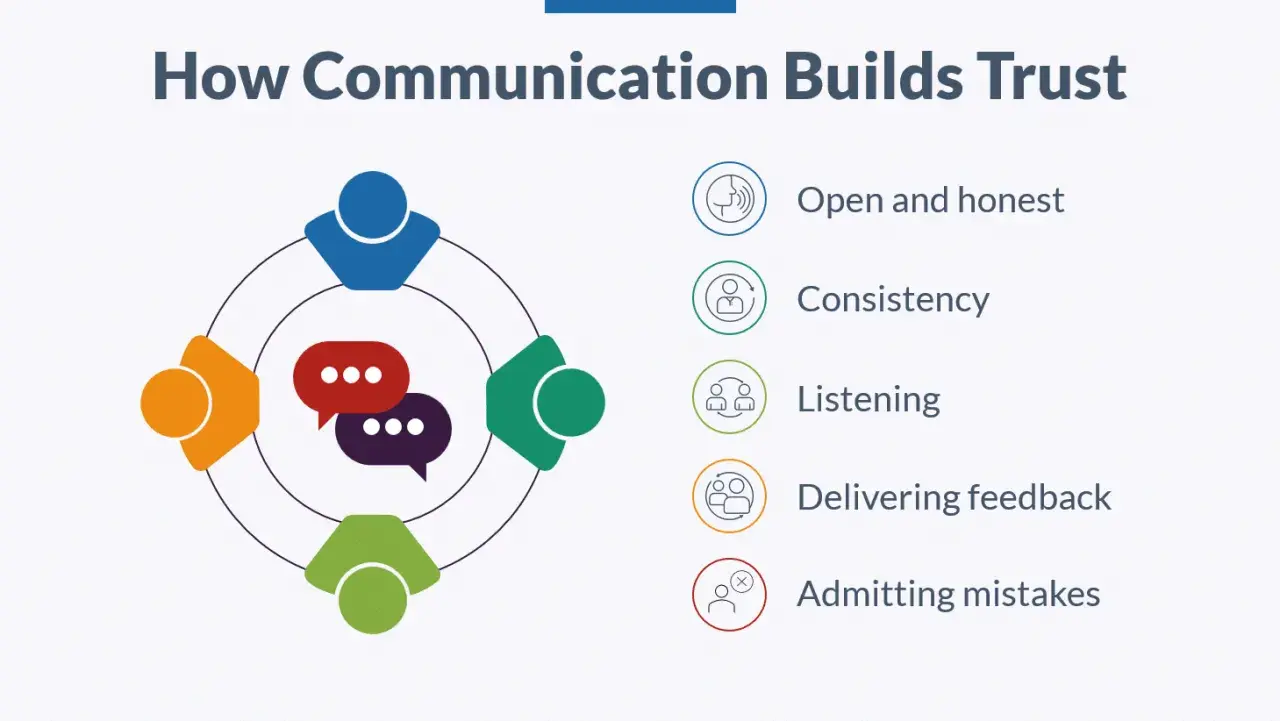
Key points at a glance
- Credibility comes from consistency, clarity, and evidence, not confidence alone.
- The strongest signals are specific: accurate updates, transparent limits, quick corrections, and respectful tone.
- People judge credibility differently in meetings, emails, and presentations, so the channel matters.
- Inclusive leaders build more trust when they explain decisions, invite dissent, and share context without jargon.
- When credibility slips, visible behavior change rebuilds trust faster than a polished apology.
What credibility actually means in communication
I treat credibility as a three-part test: accuracy, consistency, and intent. Accuracy means your facts hold up. Consistency means your words and actions match over time. Intent is the part many people miss: listeners can usually tell whether you are trying to inform them or manage them.
Harvard DCE describes credibility as believability, and that is the right frame for communication. People are not only asking, “Is this true?” They are also asking, “Can I rely on this person next time?” That is why trusted leaders tend to get more engagement. Harvard DCE cites Gallup data showing that trusted leaders can see six times the engagement of leaders people do not trust.
That gap is the real story. A message can be correct and still fail if the audience thinks the speaker is vague, defensive, or inconsistent. Once you see credibility as a pattern rather than a personality trait, the useful question becomes which behaviors create that pattern in real life. The most convincing examples are usually the simplest ones.

Credibility examples that people notice immediately
If you want concrete workplace behaviors that build trust fast, start with the moments people can verify in one conversation. These are small moves, but they do more for credibility than a polished personal brand ever will.
| Example | Why it works | What to watch |
|---|---|---|
| “I do not have that answer yet, but I will confirm it and send the source by 3:00.” | It shows honesty, restraint, and accountability instead of bluffing. | Only use it if you really do follow through at the promised time. |
| “Here is what the data supports, and here is what it does not prove.” | It signals judgment. You are not overselling the evidence. | Do not hide behind statistics that are too weak for the decision at hand. |
| “I made the deadline mistake. The corrected timeline is Friday, and I own the delay.” | Direct ownership is more credible than a long explanation that sounds like self-defense. | Repair has to include a real correction, not just an apology. |
| “Before we decide, let me restate the goal and the trade-off.” | It shows that you are thinking about the logic of the decision, not just the optics. | Keep it brief; overexplaining can make the room lose focus. |
| “I want to hear from the people who have not spoken yet.” | It builds credibility in groups because it signals fairness and shared air time. | Only say it if you are actually willing to slow down and listen. |
| “These are the assumptions behind my recommendation.” | It helps others test your logic instead of guessing at it. | Assumptions should be explicit, not buried in fine print. |
These examples work because they are testable. People can check whether you sent the follow-up, admitted the limit, or corrected the record. That is what makes trust feel real instead of performative, and it leads directly to the habits that quietly damage it.
Where credibility breaks down fast
Most credibility problems do not come from one dramatic lie. They come from small habits that make people feel managed instead of informed. I see the same patterns again and again in teams, and they are usually more damaging than people expect.
- Overpromising - Saying “I’ll have it done by tomorrow” when you know the work needs two more reviews tells people your estimate is not reliable.
- Hiding uncertainty behind jargon - If you cannot explain the idea in plain English, the audience will often assume you do not fully understand it yourself.
- Changing the story for each audience - When executives hear one version and the team hears another, trust drops immediately.
- Apologizing without correcting - A polished apology is weak if the process stays broken.
- Taking credit for collective work - People notice when the “we” becomes “I” the moment the outcome looks good.
- Using silence as a strategy - Withholding context may feel safer in the moment, but it usually creates rumors and harder questions later.
How to build credibility in meetings, emails, and presentations
I usually coach people to treat each channel as a different trust test. The same person can sound credible in a meeting and weak in an email if the structure changes. The fix is not to become more formal everywhere. It is to become more deliberate.
In meetings
Open with the point of the discussion, not the backstory. State what is decided, what is still open, and what you need from the group. If you do not know something, say so early. Waiting until the end makes uncertainty look like avoidance.
- Lead with the decision or question.
- Say what you know and what you still need to verify.
- Close with owners, deadlines, and the next checkpoint.
In emails
Email credibility is mostly about clarity. Put the main point in the first sentence, keep one request per message when possible, and do not bury the action item under three paragraphs of context. If the message depends on a date, number, or policy, make that fact easy to scan.
- Use a specific subject line.
- State the ask in the first two lines.
- Mark uncertainty clearly instead of implying certainty you do not have.
Read Also: How to Moderate a Panel - Make Your Discussion Engaging
In presentations
A credible presentation does not try to sound exhaustive. It sounds logical. That means a clear claim, a few solid supporting points, and one honest counterargument. I also like presenters who say where their confidence comes from. That could be internal data, customer feedback, or direct experience, but it should be visible.
- Start with the conclusion, then explain the reasoning.
- Show the evidence, but do not overload the audience with slides.
- Address the strongest objection before someone in the room has to raise it.
When communication is this structured, people spend less energy decoding your message and more energy evaluating the actual idea. That matters even more in inclusive workplaces, where trust has to survive different perspectives, communication styles, and power dynamics.
Why inclusive teams judge credibility differently
In inclusive environments, credibility is not just about how confidently someone speaks. It is also about who gets heard, who gets credited, and whether people feel safe enough to disagree. Psychological safety, which means people can speak up without fear of punishment or embarrassment, is a big part of that equation.
Deloitte’s research on inclusive leadership points to six traits, and the practical lesson is simple: inclusion is not accidental. It is created by repeated behaviors. If a leader only sounds credible to the loudest people in the room, the team is probably missing important voices. Real credibility shows up when people with different roles, backgrounds, and communication styles all experience the leader as fair and dependable.
Here are the signals I look for in credible inclusive communication:
- They rotate airtime instead of letting the same voices dominate every discussion.
- They name the person who contributed an idea, especially when that person is easy to overlook.
- They explain decision criteria before announcing the final choice.
- They invite questions in more than one format, including async comments when needed.
- They treat disagreement as useful data, not as disrespect.
- They follow up when someone says a process felt unfair or exclusionary.
This is where credibility and culture meet. A leader can be technically correct and still lose trust if the process feels opaque or selective. The more diverse the team, the more important it is that credibility is visible in behavior, not just asserted in words. If that trust has already been damaged, the repair has to be equally visible.
How to rebuild trust after your credibility slips
When credibility takes a hit, the instinct is often to explain more. I think that is usually the wrong move. People do not need a stronger story first; they need a clearer pattern of change. The repair process is boring, but it works.
- Name the issue plainly. Do not soften the mistake until it sounds harmless.
- Correct the facts or the plan. If the numbers, timing, or scope changed, state the new version clearly.
- Explain what will be different next time. One behavior change is better than a vague promise to “do better.”
- Show follow-through quickly. A small, visible win rebuilds more trust than a long apology.
If I had to reduce the whole topic to one rule, it would be this: say only what you can support, then support it with behavior people can see. That is the foundation of credible communication, and it is especially important in workplaces that depend on trust, inclusion, and consistent leadership. When people can predict how you will communicate, they usually start believing what you say a lot faster.
