
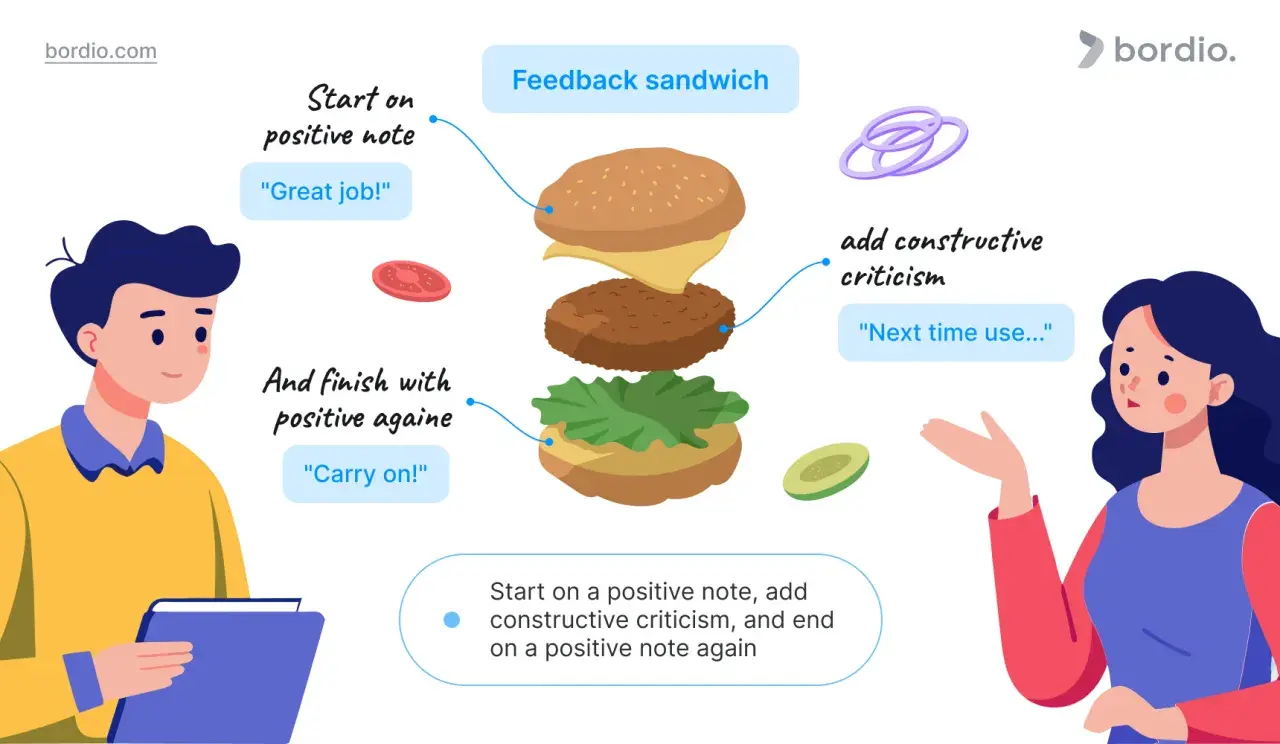
The sandwich method is a feedback pattern that starts with a genuine positive note, moves into the concern, and closes with encouragement or support. It is popular because it can lower defensiveness without pretending the problem does not exist. In inclusive workplaces, though, the real test is not whether it sounds nice; it is whether the person leaves with a clear, actionable message they can actually use.
A useful feedback frame, but only when the praise and the concern are both specific
- It follows a simple structure: positive point, constructive point, positive or supportive close.
- It works best for small-to-moderate feedback when there is already some trust.
- Vague praise makes the middle message feel hidden or fake.
- For urgent, serious, or repeated problems, direct feedback is usually clearer.
- In inclusive teams, the goal is to be kind without making the message ambiguous.
What is the sandwich method and why it became popular
The sandwich method, often called the compliment sandwich or feedback sandwich, is a way of delivering criticism between two positive remarks. The idea is simple: soften the emotional impact of the correction so the other person can hear it without shutting down. I think of it as a pacing tool, not a disguise for criticism.
That is why it shows up so often in management, coaching, teaching, and performance reviews. It gives the speaker a structure to follow when a conversation feels tense. Used well, it can make feedback feel less abrupt. Used badly, it becomes predictable, and the listener starts waiting for the real point instead of hearing the opening praise.
The technique exists for a reason, but it is not magic. The moment the praise feels generic, the whole pattern starts to lose credibility, and that is where the practical details matter.
How the structure works in a real conversation
The method is straightforward on paper, but it only works when each part earns its place. I usually break it into three moves:
- Open with specific positive feedback. Name one real thing that worked, such as a clear report, a calm meeting tone, or a thoughtful client update.
- State the concern plainly. Keep the middle section focused on observable behavior and its impact, not on personality or intent.
- Close with support or a next step. End by making the path forward visible, whether that is a suggestion, a resource, or a follow-up conversation.
A strong version sounds like this: “Your presentation was clear and well paced. The one part I would change is the data section, because the team needed one more sentence explaining what the chart meant. If you add that in, the whole message will land better.”
That is much more effective than a vague round of praise followed by a vague complaint. The middle message has to be strong enough to stand on its own, because that is the part people actually need to act on.
When the method helps and when it backfires
The feedback sandwich is not automatically good or bad. It depends on the relationship, the size of the issue, and how much clarity the person needs. One reason it can fail is that people tend to remember the first and last parts of a message more strongly than the middle. That is the primacy and recency effect in plain language: openings and closings stick more easily than the section in between.
Research in workplace and training settings has been mixed. In one randomized crossover study involving 640 healthcare students, the sandwich technique did not improve pass rates compared with a learning conversation. That does not mean the method is useless, but it does show that polite packaging alone does not improve outcomes.
| Situation | Why it can help | Why it can fail |
|---|---|---|
| A small correction with a trusted colleague | It can keep the tone light while still naming the issue. | If the praise is too broad, the person may not know what really matters. |
| A repeated performance problem | Very little, unless the person is unusually receptive. | The concern can feel buried, and the receiver may focus on the compliments instead of the fix. |
| A high-stakes issue such as safety, ethics, or deadlines | Usually not much. | Clarity matters more than cushioning, and indirectness can delay action. |
| A cross-cultural or mixed-communication team | It may soften tone for people who value diplomacy. | Some teammates read indirectness as confusion, not kindness. |
My rule is simple: if the message is serious, recurring, or time-sensitive, I lean toward direct feedback instead of a sandwich. The technique is best when the relationship is already solid and the issue is modest enough that tone matters as much as speed.
How to adapt it for inclusive workplaces
In inclusive leadership, the aim is not to make every conversation feel comfortable. It is to make feedback clear, respectful, and usable for different people with different communication styles. That means the sandwich method should be adjusted to the person, not copied like a script.
- Keep the praise earned. Specific feedback like “your summary made the decision easier” carries more weight than generic praise like “great job.”
- Talk about behavior, not identity. Comment on the meeting interruption, the missed deadline, or the incomplete handoff, not on the person’s character.
- Check the preference when you can. Some people want direct feedback with no cushion; others prefer a softer opening. Asking once can save a lot of confusion later.
- Use plain language. If someone has to decode your message, you have already weakened it.
- Follow up with one next step. A supportive close should lead somewhere concrete, not just sound pleasant.
I have seen too many managers use the sandwich method to avoid discomfort instead of improving clarity. That is where trust starts to erode. Inclusion is not about making hard messages disappear; it is about delivering them in a way people can actually hear.
Examples that sound natural instead of scripted
The difference between useful and awkward feedback is usually specificity. When people complain that the compliment sandwich feels fake, they are often reacting to vague praise that only exists to cushion the criticism. These examples show the gap more clearly.
| Situation | Scripted version | Stronger version | Why it works better |
|---|---|---|---|
| A presentation that was good but too long | “You did a great job overall. The pacing could improve. Nice work.” | “Your opening was strong and the examples were clear. I would tighten the middle section so the main point lands faster. The structure is already good, so this would be a small but valuable adjustment.” | It names a real strength, a real issue, and a specific fix. |
| A missed deadline | “You’re a valuable part of the team. The deadline slipped. Keep up the good work.” | “Your analysis was solid. The deadline slip created work for the rest of the team, so next time I need an earlier update if you see a delay coming. The quality is there; now we need more predictable timing.” | It explains impact, not just disappointment. |
| Interrupting in meetings | “You’re very engaged. Just try to be a little more mindful. You’re doing well.” | “You bring energy to the discussion, and that helps. In the last two meetings, though, you cut in before others finished, and it made it harder for them to speak. I want you to pause a beat longer so everyone gets space.” | It stays respectful while naming the behavior precisely. |
Notice the pattern: the stronger versions do not hide the message. They make the correction easier to accept because the speaker is specific, calm, and concrete. That is usually what people are really asking for when they search for a feedback technique.
Choosing the right feedback style for the moment
Not every conversation needs the same shape. I would rather use the right structure once than force the sandwich method into a situation where it weakens the message. A quick comparison helps:
| Method | Best for | Watch out for |
|---|---|---|
| Sandwich method | Low-stakes corrections, decent rapport, and moments when tone matters | It can sound scripted or bury the main point |
| Direct feedback | Urgent, serious, or repeated issues | It can feel harsh if it is not specific and calm |
| Ask-Tell-Ask | Coaching, reflection, and collaborative problem-solving | It takes longer and may not suit a fast correction |
If you want a practical shortcut, use this rule: choose the format that makes the next action clearest. For routine coaching, the sandwich method may work. For a problem that has consequences, clarity usually beats cushioning. For development conversations, a more collaborative model can be better than either extreme.
Use the structure only if the middle still stands on its own
The simplest test I use is this: if I removed the opening praise and the closing encouragement, would the middle sentence still be useful, respectful, and specific? If the answer is no, then the feedback is too dependent on the sandwich framing and needs to be rewritten.
That is the real lesson behind the sandwich method. It is not about hiding criticism inside kindness. It is about pairing clear direction with a tone the other person can receive. When both parts are strong, the conversation feels human instead of mechanical.
So the method is worth keeping in your toolkit, but only as one option among several. The best feedback is the kind people understand, trust, and can act on the same day.
