
Strong listening changes the quality of communication faster than most people expect. It lowers friction in meetings, makes feedback less defensive, and helps teams surface problems before they turn into avoidable work. If the goal is to improve communication at work, this is a practical guide to how to improve listening skills without making the process feel stiff or performative.
Key takeaways for stronger workplace listening
- Listening is active. It includes attention, interpretation, and a useful response.
- Reduce distractions before the conversation starts; attention is easiest to lose when the environment is noisy.
- A simple rhythm of pause, paraphrase, question, and confirm prevents most misunderstandings.
- Inclusive listening makes it easier for quieter, newer, or less senior colleagues to contribute honestly.
- The biggest mistakes are interrupting, multitasking, and solving too early.
- Small daily practice is more effective than waiting for the perfect moment to listen well.
What strong listening actually looks like at work
I like to separate hearing from listening. Hearing is passive; listening is a decision to track the words, tone, and intent behind them, then respond in a way that proves understanding. In a workplace setting, that difference shows up quickly: a heard message is often forgotten, while a well-listened-to message is clarified, acted on, and remembered.
| Mode | What it looks like | Result |
|---|---|---|
| Hearing | Waiting for your turn to talk | Information passes through, but trust does not grow |
| Active listening | Paraphrasing, asking clarifying questions, checking understanding | Fewer mistakes and cleaner decisions |
| Inclusive listening | Making room for quieter voices and noticing who has not spoken | Broader participation and stronger psychological safety |
Clear the noise before the conversation starts
Most listening problems begin before the first sentence is spoken. If your phone is buzzing, three tabs are open, or your mind is still stuck on the last meeting, your attention is already divided. I usually treat preparation as part of listening, not as a separate step.
- Silence notifications and close anything that does not belong to the conversation.
- If the topic is sensitive, do not start while you are rushed or irritated.
- Write down the one thing you need to understand, decide, or resolve.
- If you feel defensive, take 30 to 60 seconds to reset before you respond.
That reset is not about being calm in a fake, polished way. It is about being available. A distracted listener hears fragments; a prepared listener hears patterns. Once the room is clearer, you can use a repeatable routine that keeps you from drifting back into old habits.

Use a simple active listening routine you can repeat
I prefer a four-step loop because it is easy to remember under pressure. It does not require perfect empathy or theatrical nodding. It just gives the other person proof that their message landed.
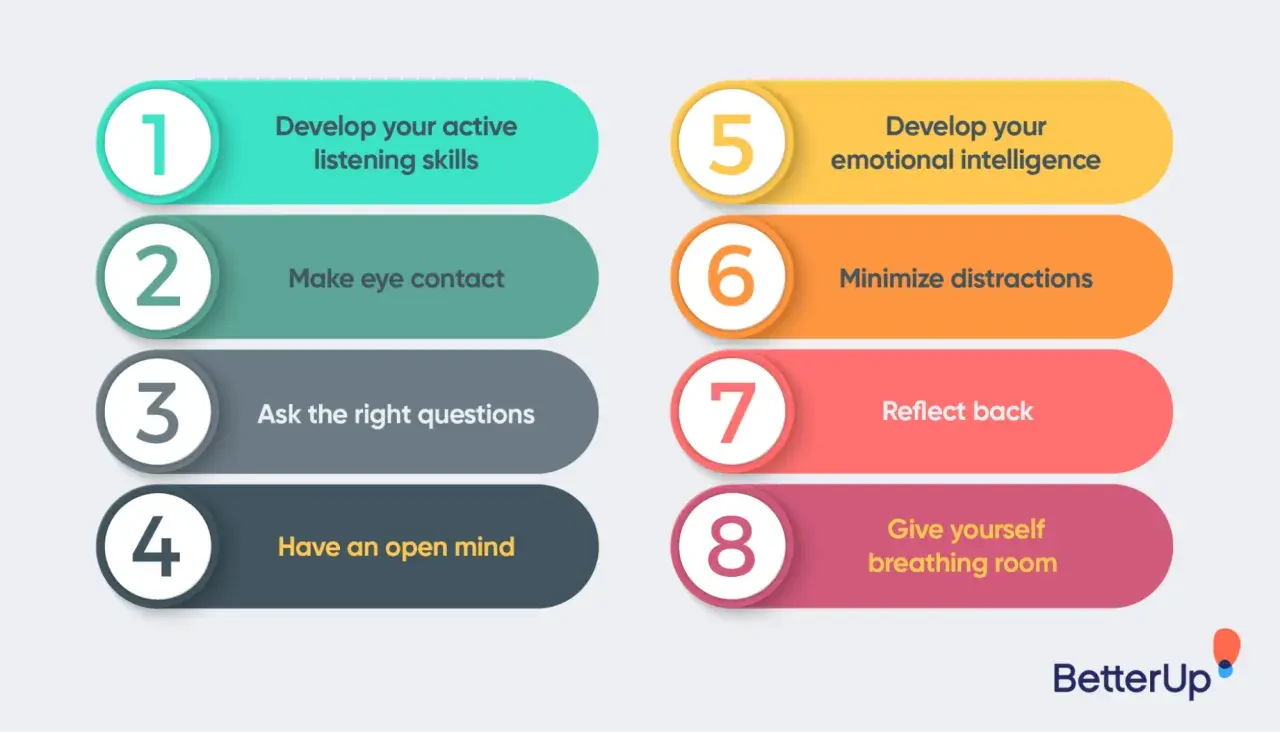
- Pause. Let the speaker finish before you jump in. Even a short pause signals that you are thinking, not competing.
- Reflect. Paraphrase the core idea in your own words. For example: “What I’m hearing is that the timeline is less the issue than the handoff between teams.”
- Ask. Use one open question to deepen the point instead of closing it too early. “What would make this workable?” is better than “Have you tried X?”
- Confirm. End by checking the next step, owner, or decision so the conversation leaves with clarity.
This routine works especially well in feedback conversations and problem-solving meetings, where people often move too fast and miss the real issue. It also helps in hybrid calls, where delay and overlap make interruptions easier. Once the structure is in place, the next challenge is making sure the room itself is inclusive enough for different voices to enter it.
Listen inclusively when power dynamics are in the room
In inclusive leadership, listening is not just about being polite. It is about noticing who is shaping the conversation and who is staying quiet because the room does not feel equally safe or equally welcoming. In a mixed-seniority team, the fastest speaker is not always the most thoughtful one, and the first answer is not always the most complete.
When I listen inclusively, I watch for a few signals:
- Hesitation that might mean someone is choosing their words carefully, not lacking ideas.
- People speaking only after being invited directly.
- Colleagues who get interrupted more often than others.
- Feedback that appears in chat, email, or follow-up messages instead of live conversation.
My response is usually simple: I rotate who speaks first, I ask quieter people to weigh in without putting them on the spot, and I leave space after a question before filling the silence myself. In practice, that builds psychological safety far more effectively than saying, “All voices matter” and then letting the loudest person drive the meeting. The next step is avoiding the habits that quietly undo all of this work.
Common mistakes that make people stop opening up
Many listening problems are not dramatic. They are subtle enough to feel harmless in the moment and costly only later, when trust drops or a small misunderstanding turns into rework. I see the same mistakes repeat across teams, even in organizations that value communication.
| Mistake | Why it hurts | Better move |
|---|---|---|
| Interrupting to correct details | It tells the speaker that accuracy matters more than understanding | Let the person finish, then clarify the point that actually matters |
| Jumping to advice too early | It can feel dismissive when the person wanted to be understood first | Reflect the issue before suggesting a fix |
| Listening to rebut | You hear the part you want to answer and miss the real message | Repeat the concern in your own words before responding |
| Multitasking during serious conversations | The other person can tell, and the conversation becomes smaller | Give the discussion full attention or reschedule it |
| Treating silence as agreement | People may be unsure, cautious, or uncomfortable rather than aligned | Ask for confirmation and invite a second view |
These mistakes are most damaging in feedback, conflict, and decision meetings, where people are already judging whether it is worth speaking honestly. If you want better communication, removing those habits will often do more than adding new ones. From there, the fastest way to make progress is a short practice plan that turns listening into a daily routine.
A one-week practice plan that turns listening into a habit
I do not recommend trying to fix everything at once. A small, repeatable practice works better than a big promise you cannot sustain. If you want to build better listening over the next seven days, use this:
- Day 1. Remove one distraction before your first important conversation.
- Day 2. Paraphrase one colleague’s point before you share your own.
- Day 3. Ask two open questions instead of giving one immediate answer.
- Day 4. Hold a five- to ten-minute conversation with no interruptions.
- Day 5. Invite input from someone who has not spoken much in the room.
- Day 6. Notice one moment where you got defensive and reset faster next time.
- Day 7. Write down what changed: fewer clarifications, better tone, or more honest feedback.
If you keep only two habits after the week, keep the pause and the paraphrase. Those two moves alone will improve most workplace conversations, and they matter even more in diverse teams where people are watching to see whether their perspective will be taken seriously. Better listening is not a personality trait; it is a set of choices, and once those choices become routine, communication becomes clearer, faster, and more inclusive.
