
Strong team communication is less about sounding polished and more about making work easier to act on. In a U.S. workplace that is often hybrid, fast-moving, and cross-functional, the best leaders use clear messages to reduce confusion, build trust, and keep people moving in the same direction. Good leadership communication is not about talking more; it is about helping people understand what matters, why it matters, and what happens next.
What matters first
- People need context, decisions, and next steps more than long explanations.
- Clarity improves when leaders repeat the same message in the right channel, not when they add more words.
- Listening and follow-through are part of the message, not afterthoughts.
- Inclusive communication makes it easier for quieter, remote, and less dominant voices to participate.
- The fastest trust killers are mixed signals, vague urgency, and feedback that disappears.
- Measure success by understanding and behavior change, not by how often you sent an update.
What leaders really need to communicate
I think of leader messaging as three jobs at once: orient, enable, and steady. Orient means people know the goal and the priority. Enable means they know what to do, by when, and with whom. Steady means they understand what is changing, what is not, and where the guardrails are.
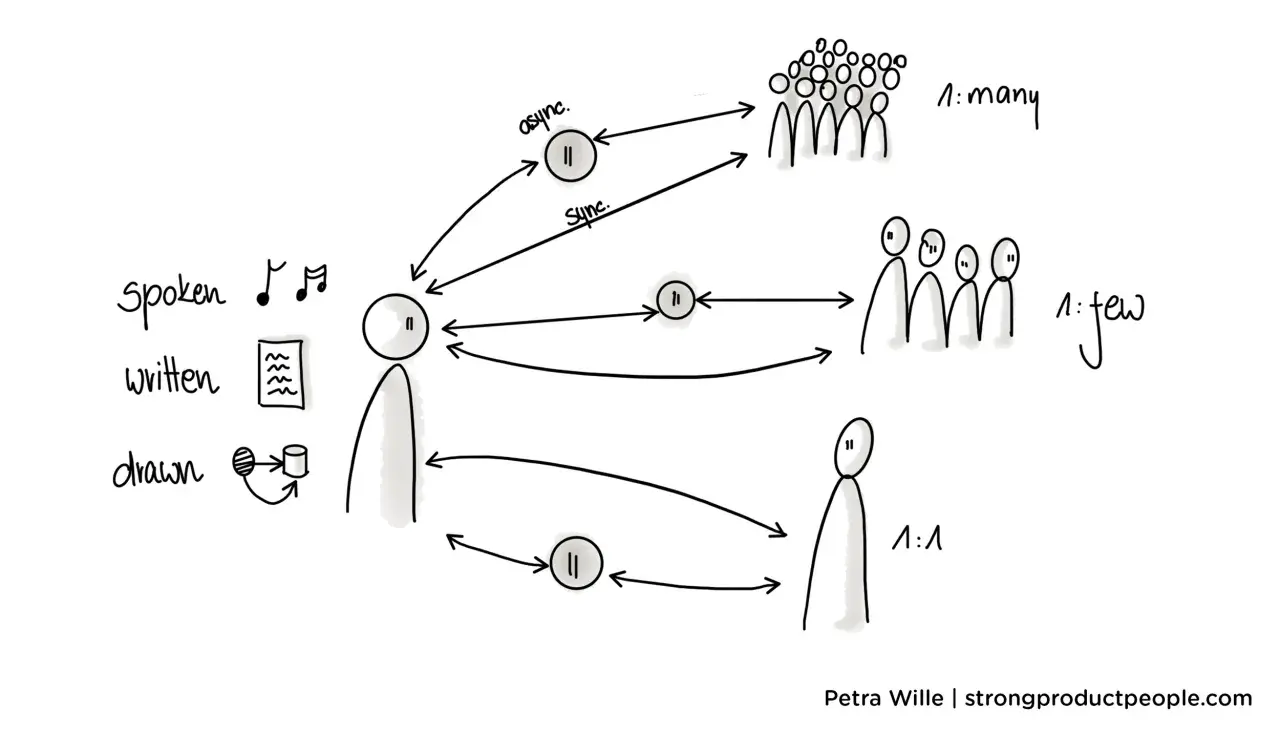
The Center for Creative Leadership describes leader messages as verbal, nonverbal, and written, and that framing is useful because teams do not experience a message in just one channel. They read your tone in a meeting, your wording in Slack, and your follow-through after the call. If those signals conflict, the written message matters less than the behavior people see.
That is why I ask simple questions before I speak: What decision am I trying to move? What uncertainty am I removing? What action should people take after they hear me? If I cannot answer those questions cleanly, the message is probably still too broad.
Once that purpose is clear, the next step is to shape the message so people can act on it immediately.

A simple message framework that keeps people oriented
When I need a message to land quickly, I use a four-part structure. It works in live meetings, email, and written updates because it matches how people process change: first the reason, then the decision, then the impact, then the next step.
| Part | What I include | Why it helps |
|---|---|---|
| Context | What changed and why the topic matters now | Reduces rumor and speculation |
| Decision | What has been decided and what is still open | Prevents people from guessing at scope |
| Impact | Who is affected, what changes, and what stays the same | Makes the message concrete |
| Action | Owner, deadline, and where to go with questions | Turns information into execution |
If a message does not fit this structure, I usually shorten it instead of adding more detail. That sounds counterintuitive, but clarity almost always wins over completeness in the first pass.
Still, structure alone is not enough. The channel you choose changes how people interpret the message and how quickly they can respond.
How channel choice changes the message
For important news, I prefer two steps: say it live first, then repeat it in writing within 24 hours. That gives people a chance to ask questions in real time and then revisit the details later, which is especially useful when teams are spread across time zones or working different schedules.
| Channel | Best for | Strength | Watch out for |
|---|---|---|---|
| 1:1 conversation | Sensitive feedback, conflict, career decisions | Private, responsive, human | Follow with a short recap the same day |
| Small team meeting | Planning, tradeoffs, problem solving | Lets people react and clarify | Limit to 30-45 minutes and end with owners |
| Email or memo | Decisions, policy changes, durable reference | Creates a record | Use headings and one clear ask |
| Slack or Teams | Quick clarification, light coordination | Fast and visible | Do not use it for complex or emotional issues |
| All-hands | Shared direction, company-wide narrative | Aligns a broad audience | Pair with local manager follow-up |
My rule is simple: if the message could change someone’s workload, confidence, or sense of safety, I do not leave it in a chat thread. I move it to a channel that lets people slow down, ask a question, or hear the context properly.
That becomes even more important when the team is diverse, because inclusive communication is not a separate skill. It is part of the same job.
Why inclusive communication belongs inside the strategy
SHRM connects inclusivity with trust and psychological safety, and that matches what I see in practice: people contribute more when the message is understandable, respectful, and easy to respond to. In mixed teams, the problem is often not disagreement. It is that one group heard the message clearly while another group had to decode it.
I try to remove that gap in a few concrete ways:
- I use plain English and avoid idioms that only make sense to people steeped in U.S. corporate culture.
- I repeat the same point in different forms, because not everyone absorbs information best in a live discussion.
- I invite written input after the meeting so people who think more slowly, or who are less comfortable speaking up, still have a path in.
- I share criteria, not just decisions, so employees understand how choices were made.
- I make room for time zones, captions, and readable docs when the team is hybrid or distributed.
Inclusivity also means knowing when silence is not agreement. A room full of nods can still hide confusion, caution, or fear. If I want honest feedback, I have to make it easier to give than to avoid.
Once communication is clearer and more inclusive, the next challenge is avoiding the habits that quietly undo that progress.
The mistakes that quietly damage trust
- Calling everything urgent. People stop reacting when every update feels high stakes. Reserve urgency for real deadlines or risks.
- Explaining the decision without the reason. Teams can accept hard news more easily when they understand the tradeoff behind it.
- Asking for input and then disappearing. If you collect feedback, close the loop within a clear window, ideally within 24 to 48 hours.
- Using a public channel for private issues. Feedback, conflict, and performance conversations belong in a setting that protects dignity.
- Changing the story from one audience to another. People compare notes. If the message shifts too much, trust drops fast.
The pattern underneath all five mistakes is inconsistency. People do not expect leaders to know everything, but they do expect the message to be coherent, repeatable, and honest about what is known versus still in motion.
That is also why I measure understanding, not just broadcast volume.
How to know the message actually landed
| Signal | What it means | What to do |
|---|---|---|
| People can restate the decision in their own words | Clarity is working | Keep the structure and repetition |
| Questions focus on execution, not basic meaning | Context is sufficient | Shift attention to owners and timing |
| The same question keeps returning in different channels | The original message was too dense or too scattered | Simplify and reissue one clean version |
| Feedback is quiet or delayed | People may not feel safe enough to respond openly | Use smaller groups, anonymous intake, or 1:1 follow-up |
| Status-chasing messages drop over time | Alignment is improving | Document the format so it becomes repeatable |
My favorite quick check is the two-minute recap test. After a meeting, I ask one person to summarize the decision, the owner, and the next deadline in their own words. If they need more than two minutes or cannot do it cleanly, the message needs another pass.
That kind of check is modest, but it keeps communication tied to reality instead of optimism.
A 30-day reset for clearer team communication
- Week 1: Trim every recurring update to context, decision, and action.
- Week 2: Add one line about what is not changing.
- Week 3: Build a 24-hour follow-up habit after meetings with questions.
- Week 4: Review which channels reduce confusion and which only create noise.
If I were coaching a manager starting from scratch, I would not ask them to become more charismatic. I would ask them to become more specific, more consistent, and more willing to listen after they speak. That is the difference between messages people hear and messages people can actually use.
