
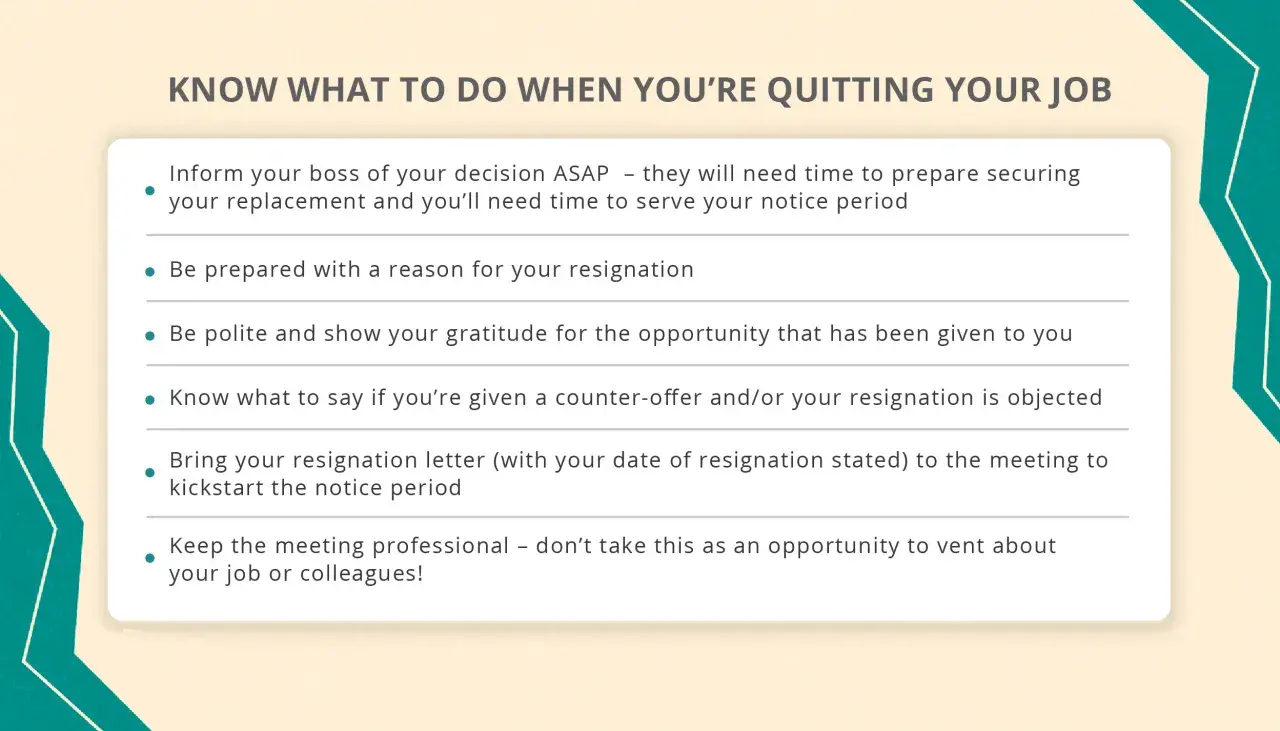
Figuring out how to tell your boss you're quitting is less about finding the perfect sentence and more about handling a professional handoff. The real work is deciding when to speak, what to say, how much detail to share, and what to put in writing. In a U.S. workplace, the cleanest exits are direct, respectful, and brief, and they usually protect your reputation better than a long explanation ever will.
The essentials before you resign
- Tell your direct manager first in a private conversation, then follow up in writing.
- Keep the message short: you are resigning, your last day, and a brief offer to help with the transition.
- Two weeks' notice is the common professional courtesy in many U.S. workplaces, but your contract or handbook may say otherwise.
- You do not owe a long explanation unless giving one helps the relationship or the transition.
- Confirm the logistics after the conversation: final pay, PTO, benefits, access, and equipment return.
Decide the timing before you open the conversation
Before I resign, I want the decision to be real, not emotional. In most U.S. jobs, employment is at-will, which means either side can end the relationship, but contracts, union agreements, and company policies can still add notice requirements or special rules. If you are moving to another role, I would wait until the offer is signed and the start date is stable; if you are leaving because of an unsafe or retaliatory environment, document what is happening before you give notice.
| Situation | What I check first | Why it matters |
|---|---|---|
| New job already accepted | Offer letter, start date, background check, and relocation timing | You want to avoid resigning before the next role is truly secure. |
| Contract, bonus, or commission role | Notice clause, payout rules, and any vesting or clawback dates | A few days can change money you have already earned. |
| Remote or hybrid team | Who needs to hear it first and whether a private video call is possible | The first conversation should still feel direct, not casually dropped into chat. |
| Unsafe or hostile workplace | Retaliation risk, documentation, and any legal or HR concerns | Sometimes the safest exit needs more caution than a standard resignation. |
| Role where you want a counteroffer | Whether the real issue is pay, scope, manager fit, or burnout | If the root problem is not the salary, a counteroffer may only delay the same frustration. |
If your real goal is a better schedule, a fairer workload, or a higher salary, I would raise that before resigning. Once you say you are leaving, the conversation shifts from problem-solving to transition planning, and that changes the tone immediately. Once the timing is clear, the next decision is who should hear it first.
Tell your manager first and keep it private
Your direct manager should hear the news before coworkers, clients, or the wider team. I prefer a private in-person conversation when possible, or a one-on-one video call if the team is remote. Email or Slack is too thin for the first notice unless you have a serious reason to avoid live conversation. This is one of those moments where a workplace culture built on respect actually shows up in practice.
If your manager is hard to reach, schedule a short meeting rather than ambushing them at the end of the day. If the organization is large, HR can be looped in after the manager conversation so the process is documented properly. I would not announce it publicly first, and I would not ask a coworker to carry the message for me. That keeps the news clean and reduces the chance of rumors spreading before the facts are settled.
The goal is not to make the moment dramatic. It is to make it calm enough that the transition can start without confusion.

Use a short script that stays calm and specific
I like a three-part script: state the decision, share the last day, and offer a smooth handoff. You do not need to overexplain why you are leaving, and you definitely do not need to audition for your manager's approval. The cleaner the wording, the easier it is for the other person to hear the message and move straight into logistics.
| Situation | What to say | Why it works |
|---|---|---|
| Standard resignation | "I have decided to resign. My last day will be [date]. I appreciate the experience here, and I will help with the transition." | Direct, respectful, and easy to act on. |
| Leaving for a new opportunity | "I wanted to let you know directly that I have accepted another role. My last day will be [date]." | Clear without oversharing salary, title, or employer details. |
| Leaving for personal reasons | "I am moving on for personal reasons, and I wanted to tell you privately first. My last day will be [date]." | Gives enough context without forcing details you do not want to share. |
| Leaving a difficult job | "I have made the decision to resign, and my last day will be [date]. I will do what I can to make the handoff organized." | Keeps the conversation professional even if the job has not been pleasant. |
If they ask why, I keep the answer to one sentence. Something like, "I am ready for a role that fits my long-term goals better" is enough. The point is to be honest without turning the conversation into a debate or a performance. That leads naturally to the written version, which matters just as much.
Put the resignation in writing and map the handoff
After the conversation, send a short resignation email or letter so there is a written record. Keep it simple: one paragraph that says you are resigning, the date of your last day, and a sentence of thanks. If your role involves clients, projects, or access to sensitive information, I would also include a short transition note with current priorities, deadlines, and any open items someone else needs to own.
- Your resignation date and final working day.
- A brief thank-you for the opportunity.
- A clear statement that you will support transition tasks during the notice period.
- Any immediate handoff items, such as open projects, calendar commitments, or client contacts.
- A request for guidance on final pay, PTO payout, benefits, and equipment return.
For most roles, two weeks remains the standard professional courtesy. For leadership, specialized work, or client-heavy jobs, three to four weeks can be more considerate if your next employer can wait. That said, some employers choose to end access the same day notice is given, especially when a role involves sensitive systems. I plan for that possibility by backing up personal files, documenting my work, and making sure I have what I need before the conversation starts.
After the letter is sent, the next challenge is avoiding the mistakes that make a clean exit messy.
Avoid the mistakes that turn a clean exit messy
The most common mistake is talking too much. People try to soften the blow with a long story, a list of grievances, or a half-apology that invites debate. I would also avoid resigning in anger, threatening to leave unless something changes, or criticizing a manager in the same conversation where you need their cooperation. The goal is not to win the moment; it is to leave with your reputation intact.
- Do not vent about every bad week you have had.
- Do not announce your resignation in a public channel first.
- Do not say yes to a counteroffer on the spot.
- Do not assume PTO, commissions, or benefits will be handled the way you expect.
- Do not leave without cleaning up access to files, accounts, and personal backups.
If a counteroffer comes up, I ask one question: would the underlying problem still exist if the salary changed? If the answer is yes, the new number may only delay the same frustration. If the answer is no, then it is worth discussing seriously, but only after you have stepped back and thought through the tradeoff. A clean resignation is usually less about one perfect script and more about steady judgment under pressure.
Leave the relationship in good shape on the way out
Leaving well is not about pretending everything was perfect. It is about being honest enough to be clear, restrained enough to be professional, and organized enough to make the handoff painless. When you handle the conversation this way, you protect your references, reduce stress for the team, and make your next move easier to start cleanly.
- Be direct with your manager.
- Keep the explanation brief.
- Confirm your last day in writing.
- Leave your work in a state someone else can inherit.
If there is one rule I would keep in mind, it is this: speak once, speak clearly, and then move into transition mode. That is usually the most professional answer to the question of when and how to quit without burning the bridge behind you.
