
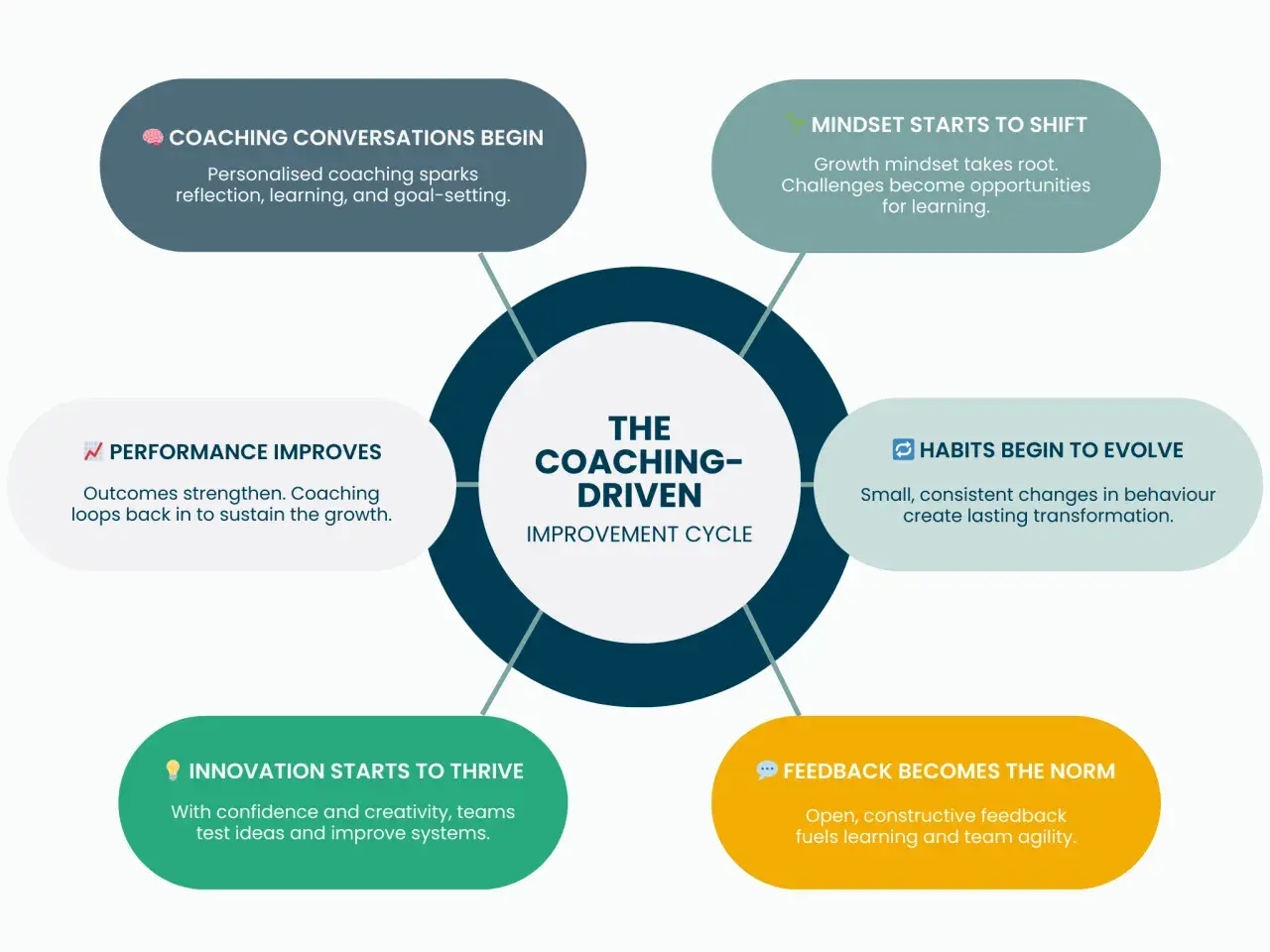
Strong leadership rarely comes from title alone. It grows when people get honest feedback, a clear standard, and enough support to practice new behaviors until they stick. Leadership development coaches help close the gap between knowing what good leadership looks like and actually delivering it in meetings, 1:1s, and high-pressure decisions. That matters even more in the United States right now, where leaders are expected to manage change, inclusion, and performance at the same time.
Coaching works best when it turns leadership goals into observable habits
- It is most useful when a leader needs behavior change, not just more information.
- The strongest engagements combine assessment, one or two clear goals, practice, and accountability.
- In the U.S., many coaching programs run 4, 6, 9, or 12 months; shorter sprints work only for narrow issues.
- The right coach understands business context, not just conversation techniques.
- Inclusive leadership should be part of the coaching brief, not an optional add-on.
- Progress should be measured with behavior, feedback, and team outcomes, not only with satisfaction scores.
What leadership coaching actually changes
I usually separate coaching from advice-giving very quickly. A strong coach does not just tell a leader what to do; the coach helps the leader see the pattern behind the problem, test a better response, and repeat it until it becomes reliable. That means working on the real stuff: how someone gives feedback, handles conflict, delegates, runs meetings, makes decisions, and responds when pressure rises.
In practical terms, the work often falls into four buckets. First is clarity: naming the leadership habit that is helping or hurting. Second is practice: rehearsing hard conversations, stakeholder updates, or decision-making frameworks. Third is accountability: making sure the leader follows through between sessions. Fourth is reflection: helping the leader notice how they are perceived by peers, direct reports, and senior sponsors.
- Self-awareness so leaders can see blind spots instead of defending them.
- Behavior change so new habits show up under stress, not only in calm moments.
- Better relationships because leadership quality is visible in trust, clarity, and follow-through.
- Stronger resilience because leaders need support while they are stretching into bigger roles.
That is why the coaching format matters so much: if the problem is a capability gap, an accountability gap, or a behavior gap, coaching can help; if it is something else, another solution may be better. That brings us to the most useful comparison.
When coaching is the right move and when it isn't
I see a lot of confusion here, especially in organizations that want a quick fix. Coaching is not the right tool for every leadership problem, and using it in the wrong place wastes time and budget. The simplest way to think about it is this: coaching is strongest when a leader already has enough knowledge, but needs help applying it consistently.
| Approach | Best for | What it delivers | Main limitation |
|---|---|---|---|
| Coaching | Behavior change, leadership presence, communication, delegation, inclusion, and decision-making | Personalized feedback, practice, accountability, and sustained change | Works only if the leader is willing to reflect and act on feedback |
| Mentoring | Career navigation, political savvy, and institutional knowledge | Guidance from someone who has already been there | May not challenge habits deeply enough |
| Training | Foundational skill-building for groups or teams | Common language and structured learning at scale | Often too generic to shift an individual leader’s habits |
| Consulting | Strategy, process redesign, or org-level problems | Diagnostic thinking and external recommendations | Does not usually change the leader’s day-to-day behavior |
If the real issue is that the leader lacks basic knowledge, start with training. If they need context and sponsorship, use mentoring. If the organization has a structural or process problem, bring in consulting. Once you know the tool, the next question is what a healthy coaching engagement actually looks like.

What a strong coaching engagement looks like
A good engagement is structured enough to create momentum and flexible enough to stay relevant. In the U.S., I often see coaching programs run in 4, 6, 9, or 12-month formats, and that range makes sense. CCL’s 2026 coaching research points to 4-, 6-, 9-, and 12-month packages as practical options, with six-month journeys common when a leader needs enough time to change real habits, not just talk about them.
- Intake and baseline - The coach clarifies the business context, the leader’s role, and the behavior that needs to change.
- Stakeholder input - Feedback from a manager, peers, or direct reports helps expose the gap between intention and impact.
- Goal setting - The leader and coach define one or two outcomes that are specific enough to measure.
- Practice between sessions - Real progress comes from trying new behaviors in live settings, then reviewing what happened.
- Midpoint review - The coach and sponsor check whether the work is moving the right metric or whether the goal needs tightening.
- Closeout and transfer - The leader leaves with habits, tools, and a plan for sustaining the change without the coach.
The difference between a useful engagement and a feel-good conversation is usually the transfer piece. If the coach does not help the leader build repeatable behavior, the organization gets a burst of insight and very little lasting change. That is why I prefer engagements that are tied to a real role, a real metric, and a real deadline. From there, the next decision is choosing the coach.
How I would choose a coach in the U.S.
I care less about polished branding and more about whether the coach can connect leadership behavior to business results. A coach does not need to have held the same title as the client, but they do need to understand the pressures of the role and the language of the organization. When I evaluate a candidate, I look at three things first: context, method, and fit.
| What to check | Good sign | Red flag |
|---|---|---|
| Business context | Asks about team dynamics, operating constraints, and what success looks like in the role | Talks only in generic self-improvement language |
| Method | Uses assessments, feedback, goal tracking, and follow-up between sessions | Relies on vague conversations with no structure |
| Inclusive leadership skill | Understands bias, psychological safety, and how leadership behavior affects different people differently | Treats inclusion as a separate HR issue instead of part of leadership |
| Measurement | Can explain how progress will be tracked at the midpoint and the end | Promises transformation but cannot define what changes |
| Fit and trust | Creates enough psychological safety to challenge the leader honestly | Feels performative, overly agreeable, or hard to trust |
If I had to reduce it further, I would ask one question: can this person help a leader change behavior under pressure? That is the real test. Credentials matter, but a coach who cannot work in the messy reality of meetings, power dynamics, and accountability will not get far. Once the coach is selected, the organization still has to prove the work is actually moving anything.
How to measure progress without guessing
Coaching fails when it is treated as a feeling instead of a change process. If you want evidence, measure the right things from the start. I prefer to define progress in terms of behavior, not personality. “More confident” is too vague. “Speaks first less, asks more questions, and delegates decisions the team can own” is measurable.
- 360 or stakeholder feedback to see whether peers and direct reports notice a change.
- Manager check-ins to confirm whether the leader is applying new habits in real work.
- Team signals such as engagement, retention, and psychological safety.
- Operational signals such as faster decisions, cleaner delegation, or fewer escalations.
- Goal completion on the business priorities tied to the role.
In 2026, this is even more important because leadership itself is shifting. Deloitte’s 2026 Global Human Capital Trends, based on a survey of more than 9,000 business and HR leaders across 89 countries, shows how AI, human-machine relationships, and cultural debt are shaping what leaders are asked to do. In that environment, coaching is not only about confidence; it is about helping leaders think clearly, act fairly, and adapt fast enough to stay useful.
My rule is simple: if I cannot name the target behavior before the engagement starts, I do not call it a serious coaching strategy. That becomes even more true when inclusive leadership is part of the outcome.
Why inclusive leadership belongs in the coaching brief
For the kind of workplace culture this site cares about, inclusive leadership is not a side topic. It is central. A leader can be technically strong and still damage trust if they interrupt certain voices, overreward people who look like past high performers, or delegate in ways that quietly exclude others from stretch opportunities.
One useful lens comes from Deloitte, whose inclusive-leadership framework highlights commitment, courage, cognizance of bias, curiosity, cultural intelligence, and collaboration. I find that framework useful because it moves the conversation away from vague good intentions and toward specific observable behaviors. That is exactly where coaching can help.- Meeting behavior - Does the leader hear the quietest person in the room?
- Feedback behavior - Is feedback distributed fairly, or only given to people who are already visible?
- Opportunity behavior - Who gets stretch work, exposure, and decision-making authority?
- Bias interruption - Does the leader pause long enough to question first impressions?
- Conflict behavior - Can the leader hold disagreement without making people feel unsafe?
The mistakes that quietly waste a coaching budget
Most bad coaching investments fail for predictable reasons. The coach is not always the problem; the setup is. I see the same errors again and again, and they are easy to avoid if you are disciplined upfront.
- No business problem - The organization wants “better leadership” but never defines the actual behavior to change.
- No sponsor support - The leader is coached in isolation, then sent back into a manager relationship that reinforces the old pattern.
- Too many goals - The engagement tries to fix communication, delegation, confidence, executive presence, and culture at once.
- No follow-through - The leader has good sessions but no accountability between them.
- Inclusion is treated as optional - The coaching improves polish but leaves bias, exclusion, or inequity untouched.
- No transfer plan - The leader ends the engagement without a way to sustain the change.
When organizations avoid those mistakes, coaching becomes much more than a perk. It becomes a leadership system that strengthens performance and culture at the same time. That is the standard I would use before signing an engagement.
The decision rules I use before I recommend coaching
When I evaluate leadership development coaches, I start with a short checklist. If the answer is weak on any of these points, I slow down before saying yes. The best engagements are specific, measurable, and tied to a real leadership challenge, not a vague desire for “executive presence” or “polish.”
- Start with one behavior gap, not five.
- Use a 4- to 12-month window when the goal is durable change.
- Build in feedback from the manager or other stakeholders early.
- Make inclusive behavior part of the success criteria.
- Define how progress will be measured at the midpoint and end.
- Plan for handoff so the leader can sustain the habit after coaching ends.
That is the practical answer: the right coach helps a leader become more consistent, more accountable, and more inclusive in the way they lead. In a year like 2026, that combination matters because leadership pressure is no longer just about speed or authority; it is about judgment, fairness, and the ability to help other people do their best work.
