
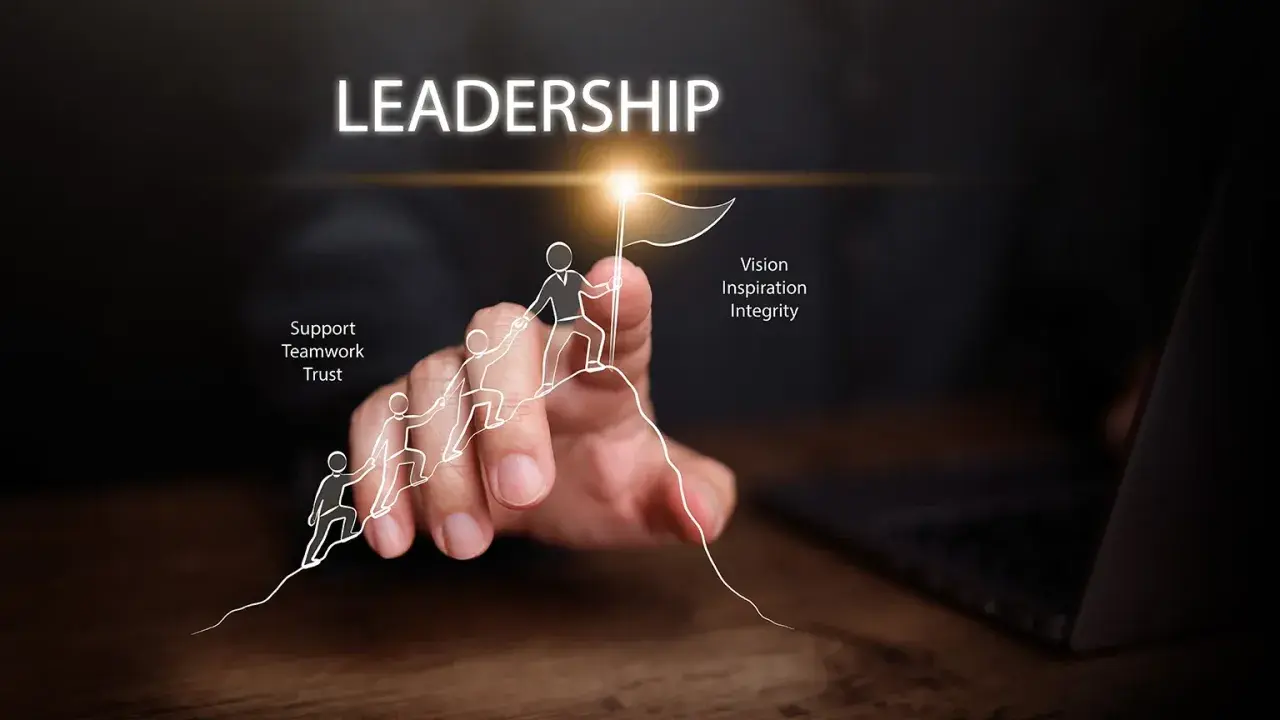
Key takeaways on leadership development
- Leadership development is a process, not a single workshop.
- It works best when it builds judgment, self-awareness, and behavior together.
- Real change comes from practice in live work, not theory alone.
- Inclusive leadership improves trust, belonging, and team performance.
- Good measurement tracks both personal growth and business outcomes.
Leadership development is more than training
SHRM describes leadership and management development as initiatives and processes that improve competencies, knowledge, and behaviors. That definition is useful because it keeps the focus where it belongs: on capability, not just content. A leader can attend a course and still struggle with delegation, feedback, or conflict; development only matters if it changes what happens in real situations.
I also think it helps to separate leadership development from promotion. A title does not create leadership skill, and skill does not always arrive when someone first manages people. Good development can start early, continue through mid-career, and extend to senior leaders. It is really about preparing people to handle ambiguity, earn trust, and guide others through change. Once that is clear, the next question is why this work has become so urgent now.Why it matters in the current workplace
In the U.S., leaders are operating in a climate shaped by hybrid work, faster change cycles, tighter retention pressure, and much higher expectations around fairness and communication. Teams are less likely to be physically co-located, so managers need to lead across schedules, locations, and communication styles without losing clarity or cohesion. That makes leadership behavior more visible, not less.
Weak leadership shows up quickly. People disengage when decisions feel inconsistent, when feedback is vague, or when some voices carry more weight than others. Strong leadership, by contrast, creates a sense of direction and psychological steadiness. It also gives people a better reason to stay, because development, recognition, and fairness stop feeling accidental.
I see this as more than an HR issue. Leadership shapes culture every day through small choices: who gets heard, how conflict is handled, whether mistakes become learning or blame, and whether people feel safe enough to contribute honestly. That is why the design of the development effort matters just as much as the goal behind it.
The building blocks of a program that actually changes behavior
The best programs are not built around one method. They combine a few elements that reinforce each other, so leaders can learn, test, reflect, and improve. I like to think of it as a loop: awareness first, then practice, then feedback, then repeat.
| Method | What it does | Where it works best | Common limitation |
|---|---|---|---|
| 360-degree feedback | Shows how a leader is experienced by peers, managers, and direct reports | When self-awareness is the first gap to close | Can become a report that never turns into action |
| Coaching | Helps leaders translate insight into behavior change | When a person already has potential but needs structure and accountability | Works poorly if the business context is ignored |
| Mentoring | Provides perspective, career guidance, and pattern recognition | When someone needs a broader view of leadership beyond their own role | Can drift into advice that is too generic |
| Stretch assignments | Forces leaders to practice new behaviors in real conditions | When the organization needs visible growth on live work | Can overwhelm people if support is too light |
| Peer learning | Lets leaders compare experiences and normalize difficult situations | When the challenge is shared across a cohort | Can stay theoretical unless it is tied to action |
If I had to choose only one principle, it would be this: development must be close to the work. Classroom learning can help, but behavior changes when a leader has to apply the lesson in a real meeting, a tense performance conversation, or a moment of uncertainty. That is why the next step is always to design the plan around a real business need.

How I would build a leadership development plan step by step
Start with a real business problem
Good leadership development begins with a gap that matters. Maybe the issue is manager turnover, weak cross-functional collaboration, poor succession readiness, or low trust in a hybrid environment. If the business problem is vague, the program will be vague too. I would start by asking what the organization needs leaders to do more reliably in the next 6 to 12 months.
Define the behaviors you actually want
People often say they want “better leaders,” but that is too abstract to build around. I would translate that into visible behaviors: giving clearer feedback, involving quieter voices, delegating with accountability, resolving conflict directly, or making decisions faster with less rework. Once the behaviors are specific, measurement becomes much easier.
Match the method to the person and the moment
Not every leader needs the same intervention. A new manager may need coaching, basic people-management skills, and practice with delegation. A senior leader may need more work on influence, systems thinking, or leading through ambiguity. One-size-fits-all programs are convenient, but they usually miss the point.
Reinforce the learning in live work
This is where many programs fall apart. Participants attend a session, feel energized, and then go back to the same environment without reinforcement. I would build in manager check-ins, action plans, and live experiments so the leader has to try the new behavior before the memory fades. A development plan should alter behavior between meetings, not only during the training itself.Measure adoption, not attendance
Attendance tells you who showed up. Adoption tells you whether anything changed. I would track whether the leader is using the new skill, whether the team experiences a difference, and whether the business outcome improves over time. That is a much better signal than course completion alone.
When a plan is built this way, leadership development stops feeling abstract. It becomes a working system. The next risk is assuming that any program will work if it has enough content, which is where teams usually get themselves into trouble.
Common mistakes that quietly weaken the results
- Overloading people with theory and underinvesting in practice. Leaders do not change because they understand a concept; they change because they rehearse a better response.
- Treating promotion as proof of readiness. A strong individual contributor is not automatically a strong people leader.
- Using the same curriculum for everyone. Different roles require different leadership muscles.
- Skipping manager support. If a participant’s own boss does not reinforce the new behavior, the learning usually fades.
- Measuring only satisfaction. A program can be well liked and still fail to improve leadership quality.
- Ignoring the environment. If the culture rewards speed but punishes candor, leaders will struggle to practice the behaviors the program encourages.
These mistakes are common because they feel efficient. They are not. The most polished program on paper is often the one that changes the least in practice, which is exactly why inclusive leadership belongs at the center of the design, not on the margins.
Why inclusive leadership should shape the design
Inclusive leadership changes the way development is built. A leader who is self-aware, seeks out different perspectives, and makes sure people feel treated fairly and supported tends to get better information and stronger team commitment. That is not just a values statement; it changes the quality of decisions.
I think the practical test is simple. If a development program only teaches decisiveness, it is incomplete. Leaders also need to learn how to invite dissent, notice whose input is missing, and create enough belonging for people to speak honestly. Those are not soft skills in the trivial sense. They are the behaviors that make teams safer, smarter, and more resilient.In a workplace culture focused on inclusion, development should also examine access. Who gets stretch assignments? Who gets visible projects? Whose mistakes are treated as learning opportunities, and whose are treated as confirmation of bias? These are uncomfortable questions, but they are the ones that determine whether leadership growth is distributed fairly or reserved for the already visible.
Once inclusion is part of the design, the final step is to prove that the effort is working in ways people can see.
How to tell whether it is working
A useful lens is the four-level framework often used in leadership research: individual, group, organizational, and societal impact. I like that structure because it keeps measurement from collapsing into one metric. A leader may become more self-aware at the individual level while the team still struggles, and that tells you the program needs refinement rather than abandonment.
| Level | What to track | What improvement looks like |
|---|---|---|
| Individual | 360-degree feedback, confidence, self-awareness, behavior change | The leader communicates more clearly, listens better, and handles pressure with more consistency |
| Group | Team trust, collaboration, meeting quality, conflict resolution | The team speaks up more, resolves issues faster, and wastes less energy on confusion |
| Organizational | Retention, internal mobility, performance outcomes, succession readiness | The organization develops a stronger bench and loses fewer capable people |
| Societal | Broader culture effects, equity in opportunity, leadership pipeline diversity | The organization contributes to healthier norms beyond one team or department |
The Center for Creative Leadership uses a similar logic in its impact framework, and I find that approach useful because it connects individual growth to wider business effects. If the only evidence is that people liked the workshop, the work is not finished. If the evidence shows better decisions, stronger engagement, and more equitable access to opportunity, then the development effort is doing real work.
The most practical way to start this year
If I were starting from zero, I would keep it small and specific. Pick one group of leaders, one business problem, and one or two behaviors that matter most. Then pair a short learning sequence with coaching, real assignments, and feedback from the people they lead. That is enough to get meaningful movement without turning the program into bureaucracy.
The easiest mistake is trying to solve leadership as if it were a one-time event. It is not. Leadership development works when it becomes part of how the organization operates: how it hires, promotes, coaches, corrects, and rewards people. Start there, and the rest becomes much easier to sustain.
