
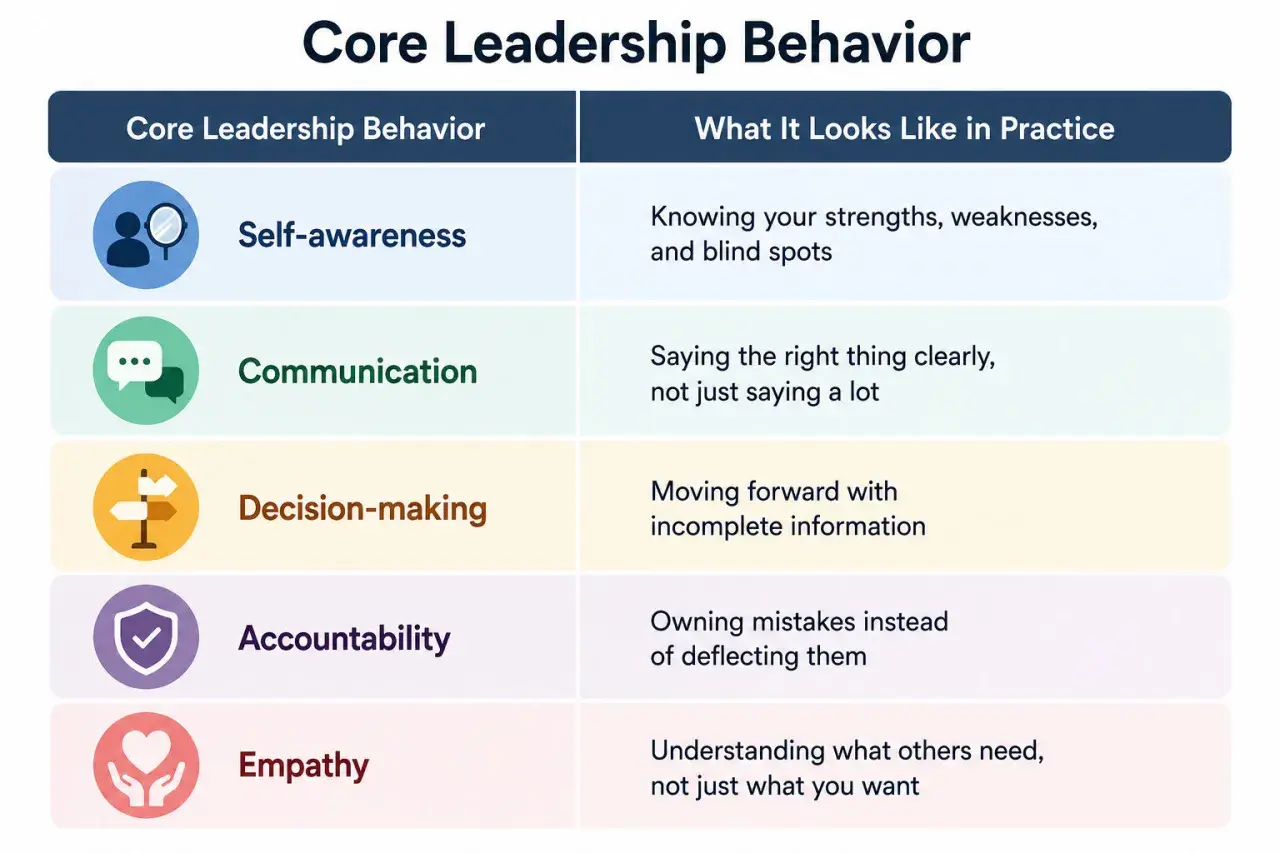
Improving leadership is less about personality and more about repeatable behavior. This article breaks down how to build stronger leadership habits, where to start if you feel stuck, and how to create more trust, clarity, and accountability without turning management into theater. If you want a practical answer to how to improve leadership skills, the fastest gains usually come from a small set of changes you can practice every week.
The essentials at a glance
- Clarity beats charisma when people need priorities, ownership, and deadlines.
- Feedback works best when it is frequent, specific, and tied to real situations.
- Delegation should include outcomes, not just tasks, so people can actually own the work.
- Inclusive leadership matters because more voices lead to better decisions and fewer blind spots.
- Progress is measurable through better follow-through, fewer escalations, and more honest team input.
The skills that move the needle fastest
When I look at leadership growth, I start with the few skills that shape almost everything else. If these are weak, the rest of the job gets harder than it needs to be. If they are strong, people usually experience you as clearer, calmer, and more trustworthy even before they can explain why.
| Skill | What strong leadership looks like | First practice to try |
|---|---|---|
| Clarity | People know what matters, what success looks like, and who owns each next step. | End every meeting with one owner, one deadline, and one sentence about the expected result. |
| Communication | You speak plainly, listen fully, and repeat priorities without adding confusion. | Summarize decisions in one sentence before you leave the room or close the call. |
| Coaching | You ask useful questions before you jump into answers or rescue mode. | In your next 1:1, ask, “What do you need from me right now?” |
| Delegation | You hand over an outcome, not a pile of instructions with no freedom to act. | Define the outcome, the guardrails, and the decision rights before you assign the work. |
| Conflict handling | You address tension early, before it hardens into avoidance or resentment. | Use neutral language to name the issue within 48 hours of noticing it. |
| Inclusion | Quieter voices are invited in, and senior voices do not dominate every discussion. | Ask the least-heard person first in your next meeting. |
Once you know which skills matter most, the next step is to see where your own habits are helping or hiding the real problem.
Start with self-awareness before you change anything else
Leadership growth stalls when people confuse intent with impact. I have seen capable managers assume they are being clear, fair, or supportive, only to discover that the team experiences them very differently. That gap is not a character flaw. It is a signal that you need better data.
- Ask for feedback from three perspectives: one manager, one peer, and one direct report. Keep the questions simple: what should I keep doing, what should I stop doing, and what am I missing?
- Track your triggers for two weeks. Notice when you get rushed, vague, defensive, or overly technical.
- Write down the three situations that create the most friction. For many leaders, they are ambiguity, conflict, and performance conversations.
- Turn each blind spot into one observable behavior. For example, if you tend to be vague under pressure, practice naming the decision, the deadline, and the owner.
Self-awareness is not self-criticism. It is a working model you can update. The more honestly you see yourself, the easier it becomes to change what others actually experience. That baseline makes the next step easier, because daily habits turn insight into visible behavior.
Build weekly habits that people can actually feel
Gallup has repeatedly shown that managers have a huge effect on engagement and performance, with one widely cited finding that 70% of the variance in team engagement is determined by the manager. In practice, that means your weekly habits matter more than your occasional speeches. The tone of the team is built in ordinary moments, not only in big moments.
I prefer habits that are small enough to keep and strong enough to matter:
- Run short 1:1s consistently. Fifteen to 30 minutes is often enough when the conversation is focused, and Gallup notes that only 16% of employees describe the last conversation with their manager as extremely meaningful. That gap is a problem you can fix with better structure.
- Close every meeting with decisions. Who owns the next step, what is due, and what is still undecided should be obvious before people leave.
- Delegate outcomes, not chores. If someone only receives tasks, they do not really get to lead their part of the work.
- Keep a decision log for important calls. A short note on why you chose something saves time later and reduces second-guessing.
- Protect one reflection slot each week. A 20-minute review is enough to notice patterns before they become habits.
Good leadership is often quieter than people expect. You do not need a heroic routine. You need enough structure that your team can predict how you will operate. Habits get you repeating the right things; feedback tells you whether those things are landing.
Use feedback and coaching instead of waiting for annual reviews
Feedback is where leadership becomes measurable. If people only hear from you when something is broken, they learn to hide problems. If they only hear from you during formal reviews, they learn to wait instead of improve. Neither pattern helps the team move.
I like to treat coaching conversations as short, focused problem-solving sessions. The goal is not to perform certainty. The goal is to create movement.
- Ask, “What is one thing I did this week that helped your work?”
- Ask, “Where did I create confusion or slow you down?”
- Ask, “What decision do you wish I would make faster?”
- Ask, “What conversation am I avoiding that the team actually needs?”
One useful tool is feedforward, which means asking what to do differently next time instead of dissecting the past for too long. That keeps the conversation useful and reduces the urge to defend yourself. I also recommend tying feedback to a specific meeting or project, because vague questions produce vague answers.
If you want people to be honest, show them that you can listen without turning every comment into a debate. The same discipline matters even more when the team is diverse, hybrid, or simply not hearing every voice.

Lead inclusively so more people can contribute
Inclusive leadership is not a separate soft skill. It is how strong leadership scales in a mixed team. The Center for Creative Leadership links psychological safety to better collaboration, learning, and innovation, and that matches what I see in practice: if people do not feel safe speaking up, the team loses information before it ever reaches the table.
Psychological safety simply means people can ask questions, raise risks, and challenge ideas without expecting embarrassment or punishment. That does not mean every opinion is equally useful. It means the room stays open long enough for the best idea to surface.
- Invite dissent early. Ask “What are we missing?” before the group settles too quickly.
- Rotate airtime. Do not let the loudest person become the default source of insight.
- Explain decision criteria. People accept outcomes more easily when they can see how the call was made.
- Credit ideas by name. This matters in mixed-seniority rooms where attribution is easy to lose.
- Intervene when someone is interrupted or dismissed. Silence in that moment teaches the wrong lesson.
- Design for hybrid reality. Written pre-reads, chat prompts, and round-robin input help remote voices enter the discussion.
Inclusion is also a fairness issue. A leader who only hears from people who resemble them will make narrower decisions. A leader who creates room for different perspectives gets better data and usually better trust. From there, you can turn the ideas into a short, repeatable plan instead of another motivation spike.
A 30-day plan that turns advice into practice
If you want this to stick, do not try to fix every weakness at once. Pick a small set of behaviors and run them like an experiment. I usually recommend one communication habit, one inclusion habit, and one coaching habit for the first month.
| Week | Focus | What to do | How you will know it is working |
|---|---|---|---|
| 1 | Baseline and feedback | Talk to three people, write down repeated themes, and note where your team seems unclear. | You can name your top two blind spots without guessing. |
| 2 | Clarity and delegation | Rewrite one recurring meeting and delegate one outcome with clear limits and a review date. | You get fewer follow-up pings about the same issue. |
| 3 | Inclusion and meeting design | Use round-robin input, ask for dissent, and make sure one quieter person speaks early. | More than the usual voices enter the conversation. |
| 4 | Review and reset | Compare your notes, keep what worked, and choose the next two habits to practice. | You can point to concrete behavior changes, not just good intentions. |
The point of a 30-day sprint is not to become a different person. It is to create enough proof that your habits change how the team works. Even with a plan, progress slows when leaders fall into a few predictable traps.
The mistakes that keep capable managers stuck
Most leadership problems are not mysterious. They are usually a few habits repeated long enough to become normal. The good news is that once you can name the pattern, it is much easier to interrupt it.
| Common mistake | Why it hurts | Better move |
|---|---|---|
| Talking more to seem decisive | People hear noise instead of direction. | Say less, ask one sharp question, then summarize the decision. |
| Waiting too long to address conflict | Small issues turn into team friction and avoidance. | Use neutral language and name the issue early. |
| Delegating tasks without authority | The work still bounces back to you for every decision. | Delegate the outcome, the limits, and the decision rights. |
| Copying another leader’s style | You sound polished but not authentic, so trust stays shallow. | Borrow tactics, not someone else’s personality. |
| Treating inclusion like a slogan | People hear the message but do not feel it in meetings. | Change airtime, attribution, and decision transparency. |
| Measuring yourself by confidence alone | Confidence can hide confusion, avoidance, or poor listening. | Measure results, follow-through, and team clarity instead. |
The pattern behind these mistakes is simple: leaders often try to look effective before they build effective routines. The encouraging part is that this is fixable, and the fix is usually more specific than people expect.
What steady leadership growth looks like when it is working
You will usually notice progress in the team before you notice it in yourself. Meetings become shorter and clearer. People raise risks earlier. Fewer issues bounce back to you because someone else already made a decision within the guardrails you set.
- People know what matters this week without asking three times.
- Quiet team members speak earlier and more often.
- Feedback conversations feel normal instead of dramatic.
- Delegated work comes back with fewer surprises.
- Conflicts get named sooner and handled with less heat.
- You spend less time clarifying the same point over and over.
If you are serious about how to improve leadership skills, treat every week as a feedback loop: notice, adjust, repeat. That is usually where the real gains happen, especially in teams that need both strong direction and a culture where people can actually speak up.
