
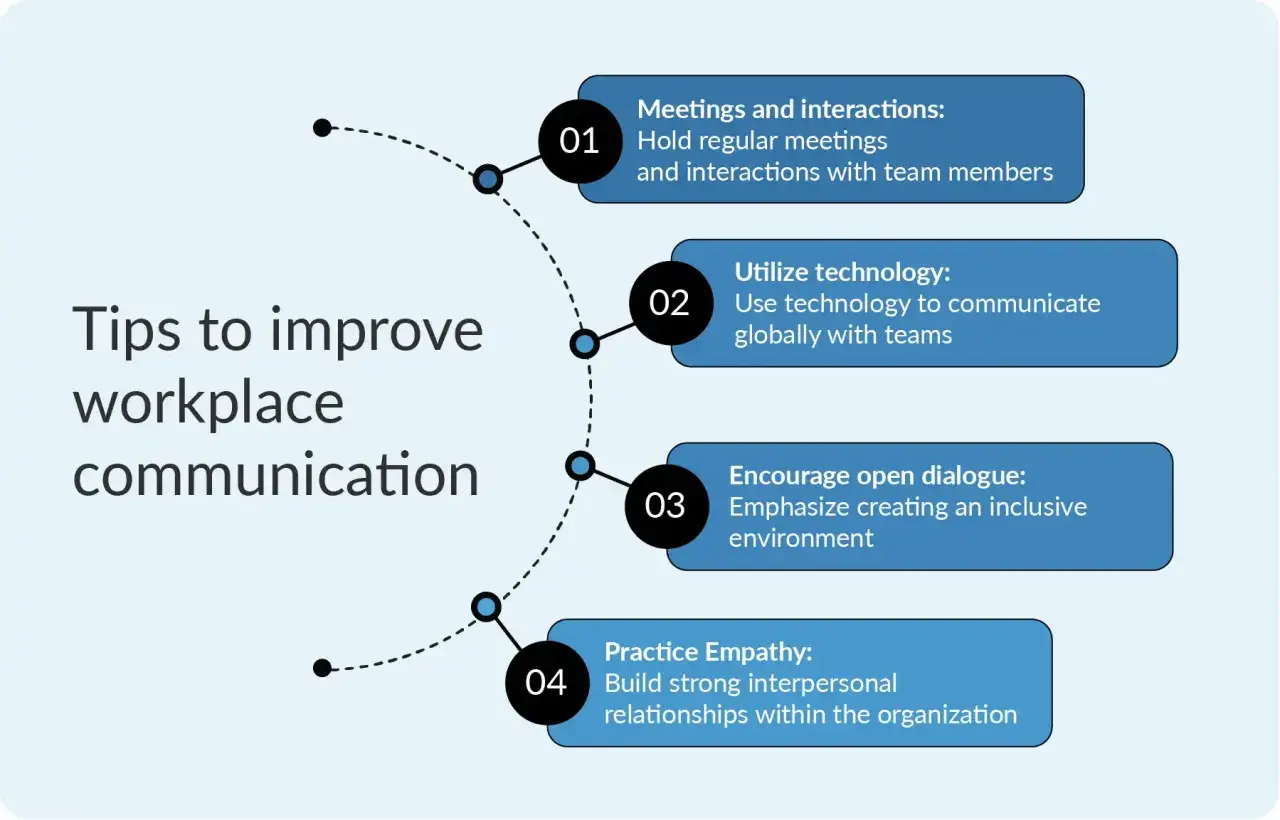
Strong communication in the workplace is less about sounding polished and more about making work easier to do. I see the same pattern again and again: when people understand priorities, ownership, and timing, they move faster and argue less. When they do not, even a capable team starts losing time to follow-up messages, duplicated work, and avoidable tension.
What matters most in workplace communication
- Clarity beats volume. People need to know what matters, who owns it, and what happens next.
- Different messages belong in different channels. Sensitive feedback and complex decisions need more nuance than chat can give.
- Inclusive communication gives more people room to contribute, especially in hybrid or cross-functional teams.
- Weekly manager check-ins create more clarity than occasional big meetings.
- Plain language and written recaps reduce confusion, especially when teams are busy or distributed.
- Improvement is measurable. Fewer repeated questions, cleaner handoffs, and faster decisions are good signs.
What strong workplace communication actually does
Good team communication does three jobs at once: it shares information, shapes decisions, and keeps relationships usable under pressure. I like to think of it as a coordination tool, not a personality trait. If a message is clear, the next step is obvious; if it is vague, people end up inventing their own version of the work.
In practice, strong communication answers the questions people are already asking in their heads: What changed? What do I need to do? By when? Who else needs to know? What tradeoff are we making? A message that answers those questions upfront saves more time than a longer meeting ever will.
- For updates, the goal is shared awareness.
- For decisions, the goal is a clear owner and a clear rationale.
- For feedback, the goal is behavior change, not winning the conversation.
- For conflict, the goal is to reduce uncertainty and restore trust.
That distinction matters because many teams try to use the same tone and format for everything. Once you separate the purpose, it becomes much easier to choose the right way to say it.
Where communication breaks down most often
Most communication failures are not dramatic. They are small mismatches that compound: a message lands in the wrong channel, no one says who owns the follow-up, a manager assumes silence means agreement, or a team uses jargon that only half the room understands.
Gallup reports that 29% of employees say they lack clear, honest, or consistent communication from leaders. I do not read that as a sign that people want more messages; they want fewer gaps between the message and the reality behind it.
The most common failure points I see are predictable:
- Vague ownership, where everyone thinks someone else is handling it.
- Too many channels, which spreads context across email, chat, meetings, and DMs.
- Late clarification, which turns small misunderstandings into rework.
- Fear of speaking up, especially when people worry they will look difficult or uninformed.
- Uneven airtime, where the most confident voices dominate the discussion.
Once you name the failure mode, the fix gets simpler. The next question is not “How do we communicate more?” It is “Which channel gives this message the best chance of being understood?”

Choose the right channel for the message
Channel choice is one of the fastest ways to improve team communication. A chat message is fine for a quick check, but it is a poor place for emotional feedback or a decision that will affect several people. I usually separate communication by urgency, complexity, and sensitivity.
| Channel | Best for | Strength | Main risk |
|---|---|---|---|
| Live meeting or call | Sensitive feedback, alignment on complex work, fast clarification | Nuance, immediate questions, tone, and relationship repair | Can become rambling or dominated by the loudest voices |
| Updates, decisions, policy changes, summaries | Creates a record and can be read later | Too slow for urgency and too flat for emotional topics | |
| Chat | Quick checks, status pings, lightweight coordination | Fast and low friction | Fragments attention and loses context easily |
| Shared doc or memo | Proposals, planning, decisions that need review | Supports thoughtful feedback and a written trail | Requires discipline to read and comment consistently |
| One-to-one conversation | Coaching, concerns, career conversations, trust-building | Private, direct, and more honest | Fails if it is rushed or treated as a formality |
A useful rule: if the message needs discussion, use a live format; if it needs a record, put it in writing; if it needs both, do the conversation first and the written recap second. That keeps the burden on clarity, not memory.
Make the message easier to understand for everyone
This is where inclusive leadership becomes practical. Teams are not made up of one type of reader or listener, and communication gets better when it reflects that reality. The U.S. Office of Personnel Management’s plain-language guidance points in the same direction: people should be able to understand content the first time they read or hear it.
Plain language is not simplified thinking. It is precise thinking. The best way to use it at work is to reduce the number of things people have to infer.
- Put the request, decision, or purpose in the first sentence.
- Use one main idea per paragraph or message block.
- Define acronyms the first time you use them.
- Name the owner, deadline, and next step explicitly.
- Avoid idioms, sarcasm, and culturally loaded shorthand when the room is mixed.
- Repeat key decisions in writing after the conversation ends.
- Give people a way to respond asynchronously if they need more time to think.
I also watch for accessibility and language differences. In hybrid teams, not everyone has the same audio quality, not everyone speaks with the same confidence, and not everyone processes live discussion at the same speed. When communication leaves room for those differences, more people can contribute without feeling exposed.
Those habits help everyone, but managers have to set the tone or the system slips back to old patterns.
What managers need to do differently
Managers are the communication bottleneck in most organizations, for better or worse. Gallup has found that one meaningful conversation each week with each team member is a strong driver of performance, and that matches what I see in practice: people do better when they know their manager is paying attention before something goes wrong.
For managers, the job is not to broadcast more. It is to create more clarity.
- Start 1:1s with priorities, blockers, and decisions.
- Mirror back what you heard before you close the conversation.
- State whether you are informing, asking, deciding, or delegating.
- Invite quieter team members directly instead of waiting for them to jump in.
- Separate performance feedback from public group discussion when the topic is sensitive.
- Close the loop after decisions so people know what changed and why.
This is where inclusive leadership becomes measurable. People are more likely to contribute when the leader makes it safe to ask for clarification, disagree respectfully, or admit they need more time. If the manager only rewards speed and volume, the team will optimize for speed and volume, not for understanding.
That leads to the final question: how do you know whether communication is improving or just getting noisier?
How to tell whether it is actually getting better
You do not need a perfect dashboard, but you do need a few signals that tell the truth. If communication is improving, people should spend less time interpreting messages and more time doing the work.
| Signal | Healthy sign | Warning sign |
|---|---|---|
| Repeated questions after meetings | Rare and specific | The same basic question keeps coming back |
| Time to decision | Shorter because the owner and criteria are clear | Decisions keep reopening |
| Handoff accuracy | Fewer mistakes and fewer “I thought someone else had it” moments | Work returns with missing context |
| Participation mix | More voices, especially from quieter team members | The same few people answer every time |
| Employee feedback | Clarity and trust rise together | People feel informed but not included |
I also watch for one subtle warning sign: if meetings get shorter but follow-up chatter goes up, the team has not become clearer; it has only become quieter in the room. Real improvement shows up when people ask fewer basic questions because the original message already did its job.
The changes that usually pay off first
If I were tightening a team’s communication system from scratch, I would start with five moves: choose one default channel for decisions, write down ownership every time, summarize meetings in plain language, protect weekly manager check-ins, and collect feedback from people who usually speak least. Those changes are not flashy, but they remove the friction most teams live with every day.
- Use chat for speed, not for decisions.
- Use email or a doc for anything that needs a record.
- Use meetings for nuance, disagreement, and alignment.
- Use direct one-to-one conversations for sensitive feedback.
- Use written recaps so no one has to guess what was decided.
The teams that communicate well are rarely the ones that talk the most. They are the ones that make the next step obvious, the message easy to absorb, and the room safe enough for people to ask for clarity before mistakes spread.
