
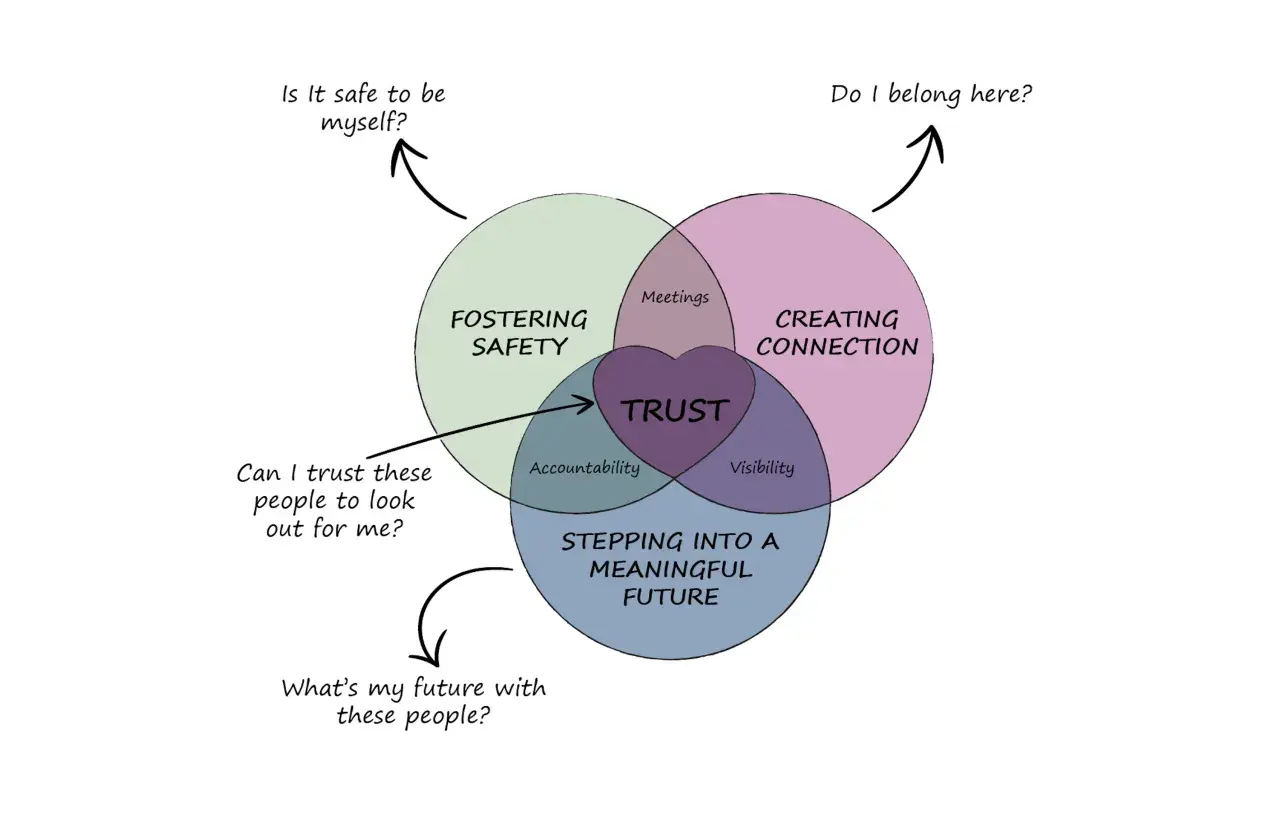
The power of connection is most visible when a conversation turns into real follow-through. In workplaces, that means clearer messages, faster trust, better feedback, and fewer moments where people feel left out of the loop. This article breaks down why connected communication matters, what it looks like in practice, and how to build it in diverse teams without adding noise.
The essentials behind stronger workplace communication
- Connection makes communication easier because people share context, not just updates.
- Gallup research shows managers account for about 70% of the variance in team engagement, which makes relationship quality a major leadership lever.
- Inclusive communication improves belonging, psychological safety, and participation across hybrid and diverse teams.
- The most effective habits are practical: clearer context, better listening, visible follow-up, and consistent decision-making.
- The biggest mistake is confusing more messages with better communication.
Why connection changes the quality of communication
I usually think of connection as the channel that carries meaning. When people trust one another, they ask better questions, share unfinished ideas earlier, and admit uncertainty before small problems turn into expensive ones. That is where communication improves: not because people talk more, but because they stop spending energy decoding tone, intent, and status signals.
There is also a psychological reason this matters. Connection lowers defensiveness, and lower defensiveness makes honesty possible. When people feel safe enough to speak plainly, you get fewer vague updates, fewer hidden objections, and fewer surprises at the end of a project. In practice, that means a manager who listens well, remembers context, and follows through is not being “soft”; they are reducing friction.
This is why the best communicators rarely sound the most polished. They sound the most grounded. Once that foundation is in place, the real difference shows up in day-to-day team behavior.
What connected teams do differently
Connected teams do not communicate perfectly. They simply recover faster, clarify earlier, and waste less time on misread signals. I see the difference most clearly when I compare how low-connection and high-connection teams handle the same situations.
| Situation | Low-connection team | High-connection team |
|---|---|---|
| Meetings | People report status and leave with little clarity. | People discuss implications, owners, and next steps. |
| Feedback | Feedback is delayed, vague, or softened until it loses value. | Feedback is specific, timely, and tied to shared goals. |
| Conflict | People avoid tension or turn disagreements personal. | People surface disagreement early and keep it focused on the work. |
| Decisions | Decisions are announced, but ownership stays fuzzy. | Decisions are documented with clear owners and deadlines. |
| Inclusion | The same voices dominate and quieter people adapt or disappear. | More voices enter the room, and the team learns from the difference. |
Gallup has found that managers account for 70% of the variance in team engagement, and that engaged teams are linked with growth, profitability, and retention. I take that as a blunt reminder that communication is not a side skill; it is one of the main ways managers shape performance. If a team is disengaged, unclear, or fragmented, the issue is often less about talent and more about the relationships carrying the work.
That leads naturally to the question of how to build these habits without turning every interaction into a workshop.

How to build stronger communication habits
The best habits are simple enough to repeat and specific enough to matter. I would start with the following:
- Start with context. Before the task, explain why the conversation matters. People communicate better when they know what decision, risk, or outcome is at stake.
- Listen for the real question. A lot of workplace tension is disguised as a process issue when it is actually about uncertainty, priority, or respect. If you only answer the surface request, the underlying problem stays active.
- Close the loop. Follow-up is where trust is either built or lost. If you say you will send a note, clarify an owner, or revisit a decision, do it quickly enough that people notice.
- Match the channel to the message. Not every topic belongs in chat. Sensitive feedback, disagreement, and decisions with tradeoffs usually need a live conversation, then a written recap.
- Invite dissent on purpose. Good communicators do not wait for objections to appear. They ask, “What am I missing?” or “Who sees this differently?” and make silence less convenient than honesty.
- Make priorities visible. A shared document, recap email, or decision log reduces memory gaps and gives everyone the same source of truth.
I would also separate responsiveness from connection. Fast replies can feel efficient, but they do not automatically create alignment. Connection is stronger when people know how decisions are made, what changed, and why something matters. That distinction becomes even more important in diverse workplaces, where one communication style will never fit everyone.
Why inclusive communication matters in diverse US teams
In the United States, many teams are multigenerational, hybrid, and culturally mixed. That is a strength, but only if communication is designed to include different working styles, not just reward the most assertive voice in the room. Inclusive communication asks a simple question: can everyone participate with equal dignity and equal clarity?
That is where small details matter more than most leaders expect. Pronouncing names correctly, respecting self-identification, avoiding deficit-oriented language, and giving people enough context to contribute well all change how safe a team feels. APA guidance on inclusive communication emphasizes respect, self-identification, and the need to avoid language that frames people through limits instead of capability. In practice, that means inclusive leaders do not just “be nice”; they remove avoidable barriers to participation.
Inclusive communication also has a structural side. If meetings are always centered on whoever speaks first, the team will miss quieter but valuable perspectives. If every important update happens in a live call with no notes, remote employees and caregivers are penalized. If feedback only happens informally, people without access to hallway conversations are left behind. Strong connection is built when communication norms are explicit enough to serve everyone, not just the people closest to power.
When inclusion is built into the communication system, people spend less time translating the room and more time contributing to it. That is when trust becomes durable.
The mistakes that quietly break trust
Most communication failures do not come from dramatic conflicts. They come from patterns that look harmless until they repeat often enough to shape culture.
- Confusing volume with clarity. Sending more messages can still leave people unsure about priorities, ownership, or timing.
- Using meetings as a substitute for alignment. A calendar full of calls does not mean the team understands the same thing.
- Rewarding only extroverted participation. Some of the best ideas come from people who think before they speak, especially in inclusive teams.
- Skipping follow-up after tense conversations. Unresolved conversations do not vanish; they become assumptions.
- Making inclusion optional. If people have to ask for basic accessibility or clarity every time, the system is already too fragile.
- Overpolishing feedback. When criticism becomes so cautious that it loses meaning, people cannot improve from it.
These are fixable problems, but only if leaders treat communication as a discipline instead of a personality trait. A team does not become connected because it has one charismatic manager. It becomes connected when good behavior is repeated often enough to become the norm.
The habits that turn relationships into results
If I were helping a team strengthen communication this month, I would not start with a grand strategy deck. I would start with three practices: hold shorter but better one-on-ones, write down decisions with owners, and ask at least one person in every important meeting who has not spoken yet. Those three moves alone can change the tone of a team quickly.
The bigger lesson is that connection is not decoration around the work. It is the operating system that lets people share information honestly, disagree without damage, and move faster with less rework. That is the real value hidden inside strong relationships: not just a better atmosphere, but better decisions, better inclusion, and better results.
When communication feels heavy, the answer is usually not more polish. It is more clarity, more consistency, and more human contact where it actually counts.
