
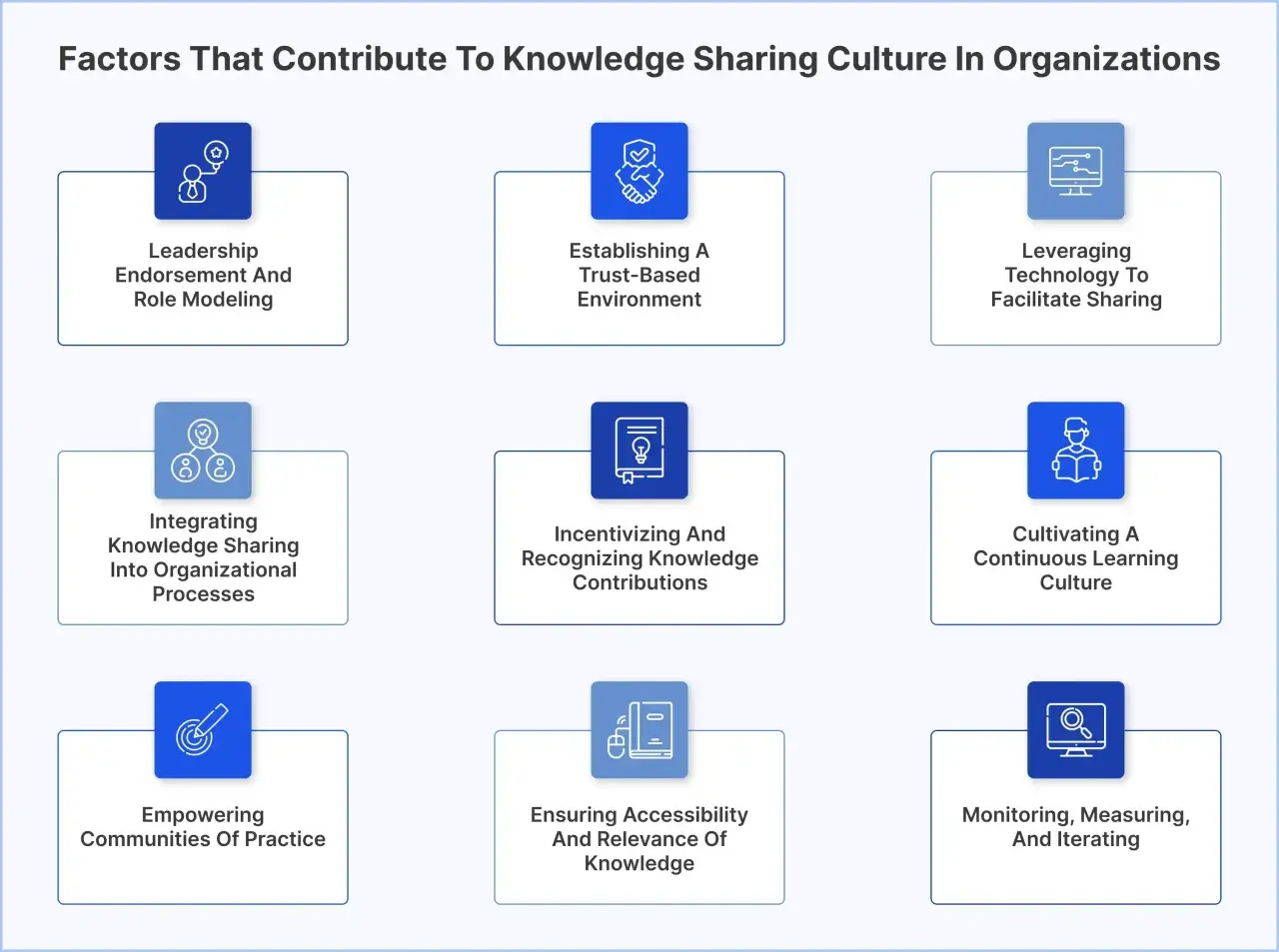
Strong workplace culture is not built on slogans. It is built on whether people can pass on what they know quickly, safely, and without friction. When knowledge sharing in organizations works well, teams solve problems faster, new hires ramp up sooner, and expertise does not disappear every time someone changes roles.
This article breaks down what actually makes that happen: the channels people use, the cultural conditions that keep them open, and the practical systems that stop useful know-how from getting trapped in one person’s head. I am focusing on what matters most in real workplaces, especially where inclusion, hybrid work, and cross-functional collaboration shape the day-to-day experience.
The strongest sharing cultures make expertise easy to find, trust, and reuse
- People share more when the process is simple, visible, and clearly rewarded.
- Useful knowledge usually moves through a mix of documents, conversations, and peer-to-peer teaching.
- Psychological safety matters because people rarely share what they do not feel safe explaining, questioning, or correcting.
- Inclusive leadership increases the chance that quieter, newer, or less senior employees contribute what they know.
- Systems age quickly unless someone owns them, reviews them, and keeps them searchable.
What happens when expertise stays trapped
When know-how sits with one person, the organization pays for it in small, recurring ways that add up. Work takes longer because colleagues have to rediscover the same shortcuts, decisions get made with incomplete context, and onboarding turns into improvisation. In practice, that means the company is not just losing information; it is losing speed, consistency, and resilience.
I usually separate knowledge into two kinds. Explicit knowledge is easy to write down, like a payroll process or an onboarding checklist. Tacit knowledge is the harder layer: the judgment calls, timing, and social cues that people build through experience. Tacit knowledge is where a lot of value hides, and it is also where teams get stuck when they assume documentation alone will solve the problem.
The real risk is dependency. If only one manager knows how to handle a difficult customer escalation, or only one analyst knows how a report is assembled, you do not have a robust process. You have a bottleneck with a job title attached to it. That is why the first task is not collecting everything. It is identifying which pieces of expertise matter enough to circulate before they become a problem. From there, the next question is how to move that expertise through the company without making the process feel like extra work.

The channels that make sharing practical
Different kinds of knowledge need different channels. A clean procedure can live in a document. A tricky client conversation needs a live debrief. Strategic judgment is often easier to transfer through examples, discussion, and repetition than through a static manual. SHRM’s guidance on organizational culture is useful here because it treats idea-sharing as both formal and informal work, not as a one-off initiative.
| Channel | Best for | Strengths | Limitations |
|---|---|---|---|
| Playbooks and process docs | Repeatable work, compliance, handoffs | Easy to reference, standardizes quality, helps onboarding | Can go stale quickly and miss context |
| Peer demos and lunch-and-learns | Practical tips, new tools, real examples | Shows how work actually gets done, encourages questions | Depends on attendance and good facilitation |
| After-action reviews | Projects, incidents, launches, client work | Captures lessons while they are still fresh | Weak results if the tone feels punitive |
| Communities of practice | Specialized functions and craft-based teams | Builds shared language and trust over time | Slower to start, needs active coordination |
| Reverse mentoring | Technology fluency, generational gaps, new perspectives | Breaks hierarchy and widens access to insight | Works only when both sides show up with intent |
My rule of thumb is simple: use documents for the stable parts, conversation for the nuanced parts, and recurring rituals for the lessons that should survive staff turnover. A knowledge base without live discussion becomes stale; live discussion without written capture disappears after the meeting ends. The strongest teams combine both. Once those channels exist, culture decides whether people actually use them.
Why culture decides who speaks and who stays quiet
Culture is the filter that tells people whether sharing is appreciated, ignored, or quietly punished. If employees think speaking up will make them look unprepared, they will hold back. If they believe their ideas will be credited to someone else, they will keep the useful part to themselves. That is why knowledge sharing is so closely tied to psychological safety, especially in workplaces that want to be inclusive rather than merely collaborative on paper.
Inclusive leadership changes the tone of the room in a few concrete ways. Leaders ask questions before offering answers. They make space for junior employees, remote employees, and people from underrepresented groups to contribute without having to fight for airtime. They also reward the people who explain, coach, and document, not just the people who appear to have the sharpest individual output. In my experience, that one shift matters more than most expensive tools.
McKinsey’s work on hybrid organizations makes a point I see often in practice: informal interactions and weak ties carry tacit knowledge across silos. That means hallway conversations, open-ended meeting time, and cross-team introductions are not fluffy extras. They are part of the infrastructure. If the only time people interact is in rigid status meetings, the organization loses a lot of the casual exchange that turns isolated expertise into shared capability.
Culture also has to be equitable. If only outspoken employees are heard, the company will mistake volume for value. A better system uses structured turn-taking, async input, and explicit credit for contributions. That makes the knowledge flow broader, which is exactly what you want in a diverse workplace. From there, the next step is to turn that cultural intent into a repeatable operating system.
A simple operating system for turning know-how into a shared asset
If I had to build a durable knowledge-sharing process from scratch, I would keep it simple and repeatable. The goal is not to create a huge library on day one. The goal is to capture high-value knowledge at the moments when people are most likely to forget it or assume everyone already knows it.
- Capture knowledge right after the work ends. Run a 30-minute after-action review within 72 hours of a project, launch, or incident. Ask three questions: what worked, what failed, and what should we repeat next time.
- Use one standard template. Keep it short: context, decision, lesson, owner, and review date. A one-page format is easier to maintain than a polished document nobody updates.
- Assign ownership. Every important document, checklist, or playbook needs one person responsible for keeping it current. Without ownership, “shared” quickly means “unmaintained.”
- Make it searchable. Use consistent tags, plain language, and a central place where people can actually find the material. If employees need to ask around to locate the knowledge base, the system is already failing.
- Build knowledge transfer into transitions. Use 30/60/90-day checkpoints for onboarding, role changes, and departures. The handoff should include context, common mistakes, and the unwritten rules of the role.
- Refresh regularly. Retire outdated guidance every 90 days and review critical content at least quarterly. A stale repository is worse than no repository because it creates false confidence.
I also think AI tools can help here, but only as a support layer. They are good at retrieval, summarization, and surfacing patterns. They are not good at judging whether a process still fits a team’s current reality. Someone still has to decide what stays, what changes, and what becomes obsolete. That is where governance matters as much as technology.
Once the operating rhythm is in place, the remaining problem is usually not effort. It is waste. The next section is about the mistakes that make a sharing program look busy while producing very little value.
The mistakes that make sharing look busy but feel useless
- Turning knowledge sharing into a one-time event. A workshop is useful, but it is not a system. Without follow-up rituals, the knowledge fades fast.
- Rewarding only the visible experts. If promotions and praise go only to individual problem-solvers, people learn to hoard the methods that make them valuable.
- Building a library without a workflow. People do not need more storage; they need a habit for capturing, reviewing, and reusing the right material.
- Asking for sharing on top of full workloads. If there is no time allocated for documentation, mentoring, or debriefs, the request reads like unpaid admin.
- Using jargon-heavy templates. A knowledge base should be understandable by the next person, not just by the author.
- Ignoring hybrid and remote employees. If the best ideas only surface in the office, the company is excluding part of its own expertise.
Most of these mistakes come from treating knowledge as a side activity instead of part of the job. The fix is not complicated, but it does require discipline: schedule the time, assign ownership, keep the language plain, and make contribution visible. That sets up a final question that leaders often skip too quickly: how do you know the system is actually working?
What I would measure in the first 30 days
If I were evaluating a new knowledge-sharing effort, I would keep the first metrics practical and lightweight. I would not start with vanity numbers like how many pages were uploaded. I would look for signs that people are actually using what is being shared.
- How many team members contribute to a shared channel or repository each week.
- How often people reuse existing material instead of recreating it.
- How long new hires need before they can complete core tasks without help.
- How many repeated questions keep showing up in meetings or chat.
- Whether employees say they feel safe asking questions, admitting uncertainty, and offering corrections.
Those indicators tell you more than a large content library ever will. If repeated questions drop, onboarding gets faster, and cross-team handoffs become smoother, the system is doing its job. If the repository grows but no one trusts it or uses it, the organization has created storage, not learning. That is the real test of knowledge sharing in organizations: whether people can teach each other well enough that the company becomes smarter after every project instead of merely busier.
