
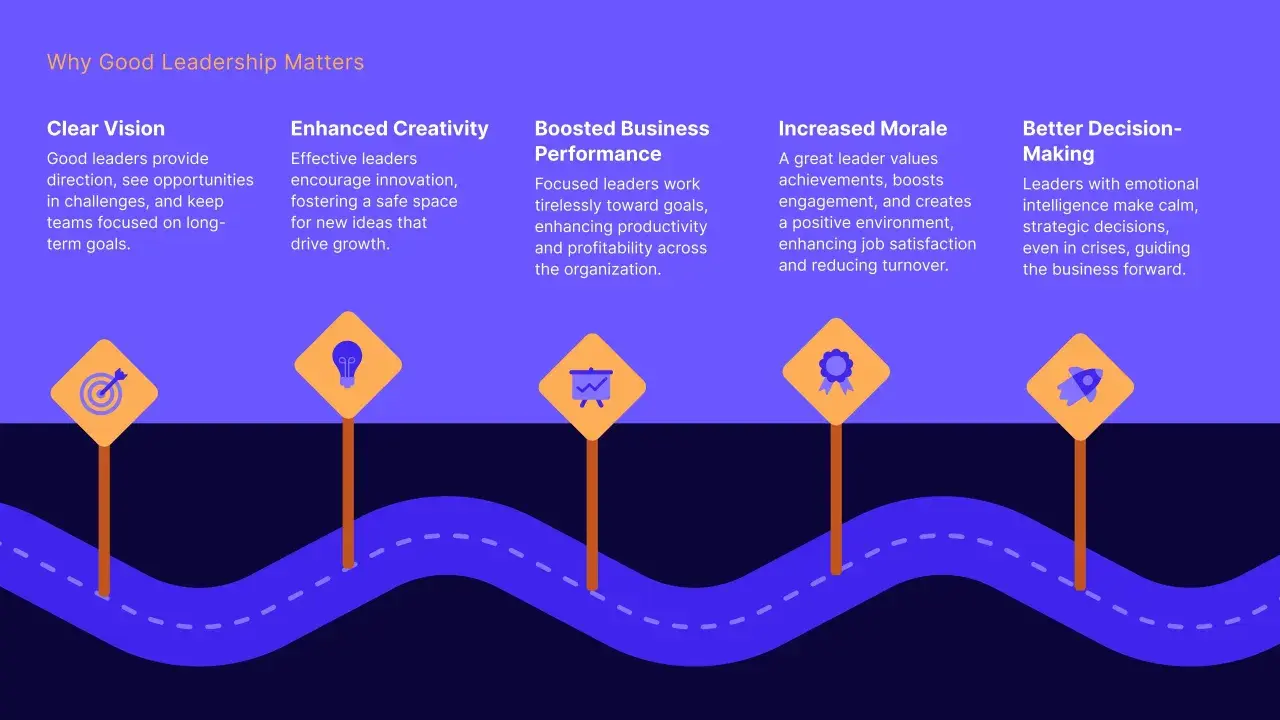
Leadership is the difference between a group of talented people and a team that can actually move in the same direction. It shapes trust, clarity, inclusion, and whether strategy becomes real work or just a deck full of promises. In 2026, the pressure on managers is not abstract; the quality of leadership now affects engagement, retention, and how safe people feel speaking up. That is the real answer to why leadership matters: it sets the daily conditions for performance, culture, and accountability.
Leadership matters because it turns direction into daily behavior
- Strong leaders align priorities so teams stop wasting energy on confusion and rework.
- Trust rises when people get clear communication, consistent decisions, and honest feedback.
- Inclusive leadership helps employees feel welcome, heard, and safe enough to contribute.
- Leadership quality shows up in engagement, turnover, burnout, and execution speed.
- The best leaders do not do everything themselves; they remove friction and develop others.
Leadership sets the pace for performance
I think of leadership as the operating system of a workplace. It decides how priorities are set, how conflict is handled, how information moves, and whether people spend their energy on meaningful work or on guessing what matters this week. Strong individual contributors can still underperform in a disorganized environment; good leadership reduces that drag by creating clarity and rhythm.
That is especially true when a team is diverse in role, location, or background. The leader does not have to be the loudest voice in the room, but they do have to make expectations visible and create enough structure for people to contribute without friction. When that is missing, even a talented team starts to feel slower and smaller than it should. That is why I start with trust before anything else.
Leadership has a direct effect on trust, engagement, and retention
When leadership is working, people know what is expected, believe that decisions are fair, and feel safe enough to raise problems early. When it is not, the damage shows up fast: mistrust, quiet disengagement, and avoidable turnover. The evidence points in the same direction from different angles.
| What leadership changes | What it looks like in practice | Why it matters |
|---|---|---|
| Trust | People believe leaders will listen and act consistently | Employees who trust their leaders are 61% more likely to stay |
| Engagement | Leaders communicate clearly and connect work to purpose | Employees are far more likely to be engaged when leadership is trustworthy and transparent |
| Communication | Updates are direct, timely, and honest about trade-offs | Transparent communication reduces rumors and helps people stay focused |
| Turnover | Managers create regular feedback loops instead of waiting for annual reviews | Problems surface earlier, and people are less likely to leave |
| Business impact | Teams stay engaged instead of drifting into passive disengagement | Low engagement is not just a morale issue; it is a productivity issue |
Gallup’s 2026 workplace report says global employee engagement fell to 20% in 2025 and estimates the cost of low engagement at about $10 trillion in lost productivity. SHRM data adds a more immediate workplace lesson: 85% of employees said they feel more engaged when leaders communicate transparently, and regular feedback mechanisms were linked with 14.9% lower turnover. Once trust is in place, the next question is whether people feel included enough to contribute.

How inclusive leadership shows up in everyday work
Inclusive leadership is not a side project you run after the “real” work is finished. It is the daily habit of making room for different voices, respecting different working styles, and treating fairness as a management discipline rather than a slogan. In U.S. workplaces, especially hybrid teams, that matters because people do not experience culture through policy statements; they experience it through who gets heard, who gets credit, and who gets interrupted.
Psychological safety is the shared belief that people can speak up without being punished or embarrassed. Without it, the smartest people in the room often go quiet, which is a problem no culture deck can fix. I look for inclusive leadership in small behaviors that repeat: who is invited into the conversation, whether disagreement is welcomed, and whether decisions are explained in a way that people can actually follow.
- Welcome dissent before you finalize decisions.
- Explain trade-offs instead of hiding behind vague authority.
- Check whether remote and in-office employees get equal access to information.
- Notice who gets credit, not just who speaks loudest.
- Make room for different communication styles, because not everyone processes ideas in the same way.
When those habits are consistent, inclusion stops being abstract and starts becoming part of how work gets done. That is the bridge to execution, because inclusion only matters if it changes how teams move.
Leadership turns strategy into execution
Good strategy fails when people cannot translate it into habits, decisions, and deadlines. Leadership solves that by making priorities legible and by reducing decision latency, the delay between a problem appearing and someone acting on it. The best leaders do not try to personally own every answer; they create a system where answers can travel quickly.
- They narrow priorities. A team with three clear priorities will usually outperform a team with ten vague ones, because focus is easier to protect than enthusiasm.
- They define decision rights. People move faster when they know what they can decide themselves, what needs escalation, and what should wait for group input.
- They create repeatable rhythms. Weekly 1:1s, short team check-ins, and regular reviews keep issues from piling up until they become crises.
- They remove friction. If the same blocker appears every month, the leadership problem is no longer the blocker; it is the failure to clear it.
What looks like “slow execution” is often unclear leadership. The easiest place to see that failure is in the mistakes teams repeat.
Common leadership mistakes that quietly damage teams
Most leadership damage does not come from dramatic failures. It comes from habits that seem small until they become culture.
- Inconsistency. If the rules change with mood or seniority, people stop trusting the process and start gaming it.
- Micromanagement. Hovering over every task signals low trust and steals time that should go into judgment, not supervision.
- Silence under pressure. When leaders go quiet during uncertainty, people fill the gap with rumor, fear, or their own worst assumptions.
- Favoritism. Favoring the loudest or most familiar voices weakens fairness and makes quieter contributors disengage.
- One-size-fits-all communication. A single style may work for some people, but it will miss others in a hybrid or cross-functional team.
- Avoiding hard conversations. Small tensions that go unaddressed usually turn into performance problems later.
The good news is that better leadership is trainable, which is where most organizations should focus next.
How to strengthen leadership without turning it into a slogan
Leadership improves fastest when it is treated like a skill set with observable behaviors. I would rather see a company define a few non-negotiables than launch a glossy leadership initiative that nobody can measure. If you want stronger culture, make the work concrete.
- Define 3 to 5 leadership behaviors that matter. For example: listen before deciding, explain trade-offs, and follow through on commitments.
- Coach managers on listening and feedback. A manager who listens well is not being soft; they are collecting the information needed to lead well.
- Use a simple measurement rhythm. Weekly 1:1s, a monthly pulse survey, and a quarterly review of turnover, internal mobility, and engagement will tell you more than a once-a-year culture presentation.
- Reward the behaviors you want repeated. If only short-term output gets recognized, people will optimize for speed over trust.
- Track inclusion, not just attendance. Look at who speaks, who gets promoted, who leaves, and who reports that they can be honest at work.
If you are not measuring those signals, you are mostly guessing. The final question is what you should actually look for when leadership is getting better.
The signals I would watch before calling leadership effective
When leadership is effective, the signs are usually visible before the dashboard catches up. People speak more freely, decisions stick, and managers spend less time firefighting because problems are handled earlier. I would watch for a few practical signals rather than rely on vague sentiment.
- Meetings end with decisions, not just discussion.
- People raise issues earlier instead of waiting until they become crises.
- New hires ramp faster because expectations are clear.
- Regrettable turnover drops, especially among strong performers.
- Managers spend more time coaching than rescuing.
- Teams disagree more openly without becoming less respectful.
The practical takeaway is simple: leadership is not important because it sounds noble. It is important because it determines whether people trust the system they work in. If you improve the way leaders communicate, listen, decide, and include others, you usually improve culture and performance at the same time.
