
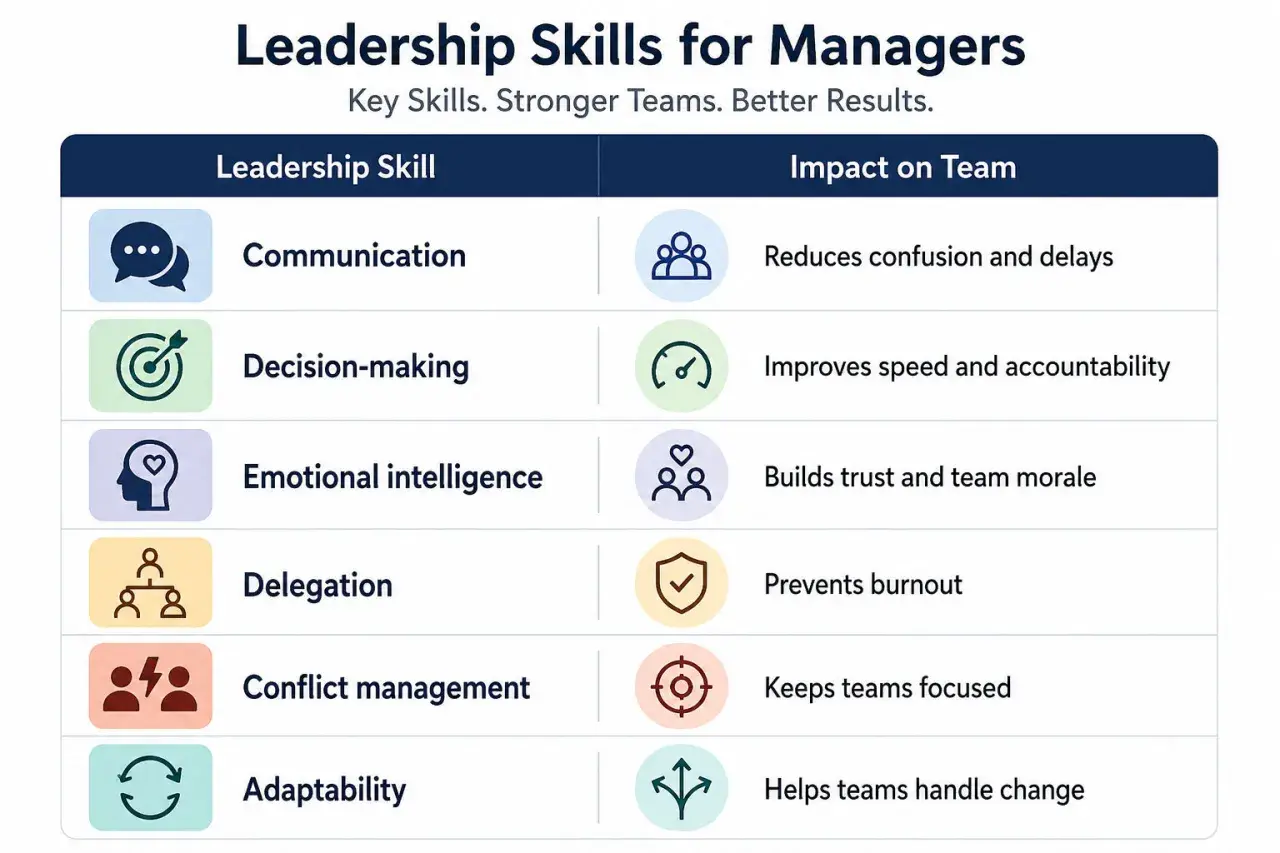
Strong leadership and management training does more than teach people how to sound confident in a meeting. It gives managers a usable playbook for coaching employees, setting expectations, handling conflict, and making faster decisions without losing trust. In a hybrid U.S. workplace, the best programs also strengthen inclusion, so leaders can manage diverse teams with clarity instead of guesswork.
What you need to know before building a leadership program
- The best programs change daily manager behavior, not just knowledge.
- First-time managers need a different curriculum than senior leaders.
- Blended learning usually works better than a single workshop.
- Inclusive leadership belongs in the core curriculum, not as a side module.
- Measure behavior change at 30, 90, and 180 days.
What a strong program is supposed to change
I look at leadership development as a performance tool, not a motivational exercise. Management training should change how people run one-to-ones, delegate work, give feedback, and make decisions when the room is tense or the deadline is real.
That matters even more in 2026. In Deloitte's 2026 Global Human Capital Trends, 7 in 10 business leaders say speed and nimbleness are their main competitive strategy over the next three years. That puts managers in the middle of the action: they have to translate strategy into everyday behavior, often across hybrid teams, multiple generations, and different communication styles.
In practice, I want a program to solve three problems: unclear expectations, weak coaching habits, and inconsistent people leadership across the organization. If the training does not improve those, it is probably informational but not transformational. Once that goal is clear, the curriculum can focus on the skills that move behavior fastest.
The leadership skills that should come first
Not every capability deserves equal attention on day one. The strongest programs start with the skills that have the biggest effect on team performance and morale, especially for first-time and front-line managers who are still shifting from individual contributor to people leader.
| Skill | Why it matters | What good training looks like |
|---|---|---|
| Role clarity and priority setting | Managers need to know what they own and what they should delegate. | Exercises that force tradeoffs, not just abstract goal-setting language. |
| Feedback and coaching | Teams improve faster when feedback is specific, timely, and calm. | Practice with real scenarios, not generic scripts. |
| Delegation and accountability | Good leaders do not become bottlenecks. | Tools that show when to hand off, how to set checkpoints, and how to follow up. |
| Conflict and performance conversations | Most management pain comes from issues that were ignored too long. | Role-play for missed deadlines, tension between peers, and underperformance. |
| Decision-making under pressure | Fast teams still need sound judgment, not rushed instincts. | Case work that teaches managers how to weigh risk, speed, and fairness. |
| Inclusive communication and psychological safety | People contribute more when they feel heard and respected. | Habits for running meetings, inviting dissent, and noticing who is not speaking. |
One detail I would not skip: the role shift from “player” to coach. A manager who used to own the work directly now has to guide other people through it. That shift is where many new leaders stumble, because technical confidence does not automatically become people leadership. The better the program handles that transition, the less damage you get from accidental micromanagement later. The next question is which format helps those skills stick.
Which training format fits which team
There is no single delivery model that wins in every organization. The right choice depends on manager level, budget, time pressure, and how much behavior change you actually need.| Format | Best for | Strength | Limitation |
|---|---|---|---|
| Self-paced learning | Foundational concepts and busy teams that need flexibility | Easy to launch, easy to scale, low scheduling friction | Often weak on practice and follow-through |
| Live workshop | Shared language, energy, and a fast reset for one skill set | Good for alignment and discussion | Fades quickly if nothing happens afterward |
| Cohort program | First-time managers and mid-level leaders who need peer learning | Creates accountability and real practice over time | Requires more coordination and participant commitment |
| Blended academy | Organizations that want both scale and behavior change | Combines live learning, assignments, and reinforcement | Needs solid program design to avoid becoming busywork |
| Coaching-supported action learning | Senior leaders and high-potential managers working on real business problems | Connects learning directly to outcomes | Higher time investment and usually higher cost |
If I had to simplify it, I would say this: use self-paced content for awareness, live sessions for alignment, cohorts for habit change, and coaching when the stakes are high. For many teams, the sweet spot is a blended model that pairs a short live module with follow-up practice. That lines up with CCL's 70-20-10 framework: roughly 70% of leadership growth comes from challenging assignments, 20% from developmental relationships, and 10% from coursework and training. The classroom matters, but it should amplify practice, not replace it.
Once you know the format, the real work is designing the learning so people use it on Tuesday morning, not just remember it on Friday afternoon.
How to design learning that sticks after the workshop
The programs that last are not the ones with the most polished slides. They are the ones that are built around real behavior, repeated practice, and a clear line between the lesson and the job.
- Start with the problems managers actually face, such as missed deadlines, unclear accountability, underperformance, or conflict between teammates.
- Use company-specific scenarios, because managers learn faster when the examples sound like their world, not a generic case study.
- Build practice into every module so participants rehearse feedback, delegation, and tough conversations before they need them live.
- Assign one developmental relationship, such as a mentor, boss, or peer partner, to keep momentum going after the session ends.
- Give each participant one real stretch assignment so the training connects to business work instead of staying theoretical.
- Close the loop with job aids, check-ins, and short reflection prompts, because repetition is what turns insight into habit.
Where inclusive leadership belongs in the curriculum
For the kind of workplace culture Jamstalldhetsbutiken.com cares about, inclusive leadership should not sit in a side module labeled “culture” and never be seen again. It belongs in the core curriculum because it changes who speaks up, who gets heard, and how safely people can disagree.
In my view, inclusive leadership is built from very practical habits. Managers need to run meetings so quieter voices are invited in, distribute opportunities fairly, and give feedback in a way that does not reward only the most visible personalities. They also need to notice when one working style, one accent, one time zone, or one background keeps getting treated as the default.- Invite dissent early, before people feel they need permission to disagree.
- Check for bias in delegation, promotion, and stretch assignments.
- Make decisions transparently so employees understand the logic, not just the result.
- Normalize questions and mistakes so psychological safety becomes real, not decorative.
- Adapt communication for hybrid and distributed teams instead of assuming everyone shares the same context.
This is not about turning managers into policy experts. It is about making them better at leading human beings. When inclusion is real, teams usually surface issues sooner, collaborate with less friction, and waste less energy on guesswork about status or belonging. That makes measurement more meaningful, because you can look for actual behavior shifts instead of just counting attendance.
How to measure whether the training worked
Attendance is not impact. A full room can still produce weak managers. I prefer a simple measurement stack that moves from immediate reaction to visible behavior and then to team outcomes.
| Metric | What it tells you | When to check |
|---|---|---|
| Completion and participation | Whether the program was accessible and engaging | During delivery |
| Self-assessment and confidence | Whether managers feel clearer about the skill | Before and right after training |
| Observed behavior change | Whether leaders are actually using the skill on the job | 30 to 90 days later |
| Team pulse results | Whether direct reports notice better clarity, fairness, and communication | 60 to 90 days later |
| Retention, internal mobility, and conflict escalation | Whether the program is affecting team health and business stability | 90 to 180 days later |
I would keep the measurement window simple: baseline, 30 days, 90 days, and 180 days. That gives enough time to see whether managers are changing behavior without waiting so long that no one remembers what was taught. If those check-ins do not show movement, the issue is usually not the participants. It is the design, the follow-up, or both. Those failures tend to come from a small set of predictable mistakes.
The mistakes that quietly drain training budgets
Most weak programs do not fail because leadership development is a bad idea. They fail because the organization asks too little of the program and then acts surprised when the result is thin.
- One-size-fits-all content that treats a new supervisor and a senior director as if they need the same thing.
- Too much theory and not enough rehearsal of real conversations, decisions, and tradeoffs.
- No manager sponsorship so participants return to a work environment that rewards old habits.
- No reinforcement after the workshop, which turns learning into a one-time event.
- Measuring only satisfaction instead of behavior and team outcomes.
- Treating inclusion as optional even though it shapes whether people actually trust the manager.
The fix is not to make the program longer by default. The fix is to make it more specific, more practical, and more accountable. If the learning is tied to a real role, a real team, and a real follow-up plan, the budget goes further. That is the logic I would use if I had to build a program from scratch for a U.S. organization.
What I would build first for a US organization
If I were designing the first version of a leadership program for a U.S. company, I would start small and go deep. I would pilot with first-time managers, because that is where bad habits form fastest and where clear guidance pays back quickly.- Start with a short diagnostic to identify the top three manager pain points.
- Build one core cohort for new or recently promoted managers.
- Include one module on inclusive leadership and psychological safety.
- Add one stretch assignment per participant so learning connects to real work.
- Schedule follow-up at 30, 90, and 180 days, not just a final session.
- Ask direct reports what changed, because manager self-confidence alone is not enough.
The programs that age well are the ones that respect how adults actually learn: through practice, feedback, and repeated use in real work. If you build leadership and management training that way, it becomes part of the operating system of the organization, not a polished event that people forget by next quarter.
