
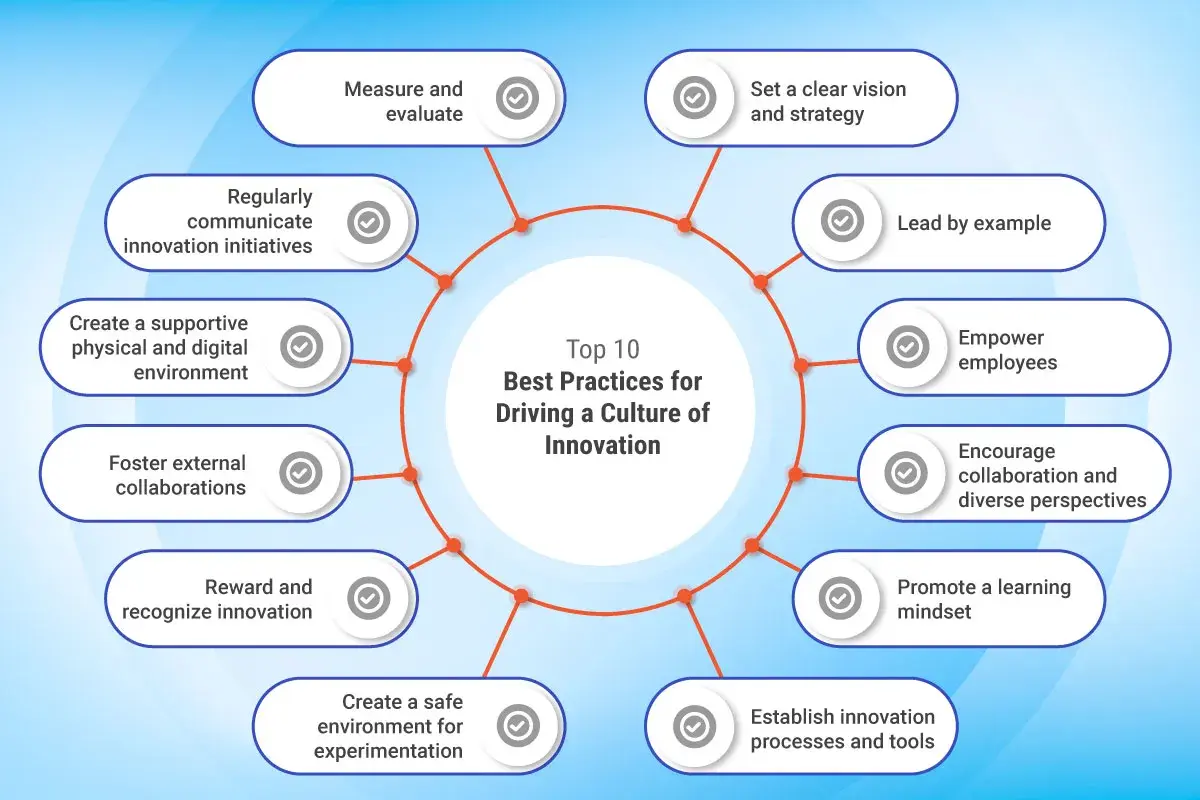
The strongest drivers are culture, strategy, and execution working together
- Innovation is usually triggered by a real business problem, not brainstorming alone.
- People share better ideas when they are not afraid of blame or embarrassment.
- Inclusive leadership widens the pool of ideas and surfaces blind spots earlier.
- Resources, time, and clear priorities separate serious innovation from theater.
- Small experiments and fast feedback matter more than giant, one-shot launches.
- Change fatigue and overloaded managers are among the most common blockers.
Innovation starts with a problem worth solving
I rarely begin with ideas. I begin with friction: a process that wastes time, a customer issue that keeps repeating, a handoff that breaks, or a team that has learned to tolerate a bad workflow because that is just how it works. Strong innovation starts when leaders name the problem precisely enough that people can do something about it.
The best ideas usually live close to the pain. Incremental innovation improves a workflow, product, or service. More disruptive change rewrites the assumptions underneath it. Both depend on the same thing: a clear business case. If the need is fuzzy, teams produce clever solutions to the wrong problem. If the need is sharp, even a small experiment can create real momentum.
That distinction matters because once the problem is clear, the next question is whether the organization has the right conditions to act on it.
The drivers that matter most
Recent OECD analysis is useful because it strips away a lot of the hype. It points to innovation climate, senior leadership, and learning conditions as major drivers of performance. In plain English, organizations do not become inventive because they announce a campaign; they become inventive when the work environment makes it easier to notice problems, share ideas, and act on them.
| Driver | Why it matters | What happens when it is missing |
|---|---|---|
| Clear strategic problem | Focuses energy on something worth changing | Teams build polished solutions to irrelevant problems |
| Psychological safety | Makes it safe to question, dissent, and propose rough ideas | People stay quiet, protect themselves, and avoid risk |
| Inclusive leadership | Pulls more perspectives into the room and into decisions | The loudest voice wins and blind spots stay hidden |
| Learning and development | Gives people the skills to test new approaches well | Teams want change but lack the capability to carry it out |
| Time and resources | Turns innovation from a slogan into actual work | Ideas die as soon as they meet the daily workload |
| Measurement and feedback | Shows what is working, what is not, and what to scale | No one knows whether the change improved anything |
I see these drivers as a system, not a menu. If leadership is strong but teams have no time, ideas stall. If there is energy but no safety, people self-censor. If there is diversity but no learning, the organization has a wider range of views without a better way to use them. That is why innovation is so often easier to admire than to repeat.
The strongest organizations do not rely on one hero element. They align several levers at once, and that brings us to culture.

The culture that lets people share unfinished ideas
Culture is where innovation either becomes normal behavior or remains a poster on the wall. People do not offer bold ideas when every mistake feels permanent or every disagreement feels political. They contribute more when leaders create a workplace where it is safe to speak, safe to be wrong, and safe to say, this will not work.
In practice, that means a few very specific habits:
- Leaders ask for dissent before they ask for agreement.
- Meetings make room for quieter voices instead of rewarding only the fastest speaker.
- Mistakes are reviewed for learning, not used as ammunition.
- Small tests are encouraged before teams commit to large-scale change.
- People are recognized for improvement, not only for flawless delivery.
The smartest teams I see are not the most conflict-free. They are the ones that can disagree without turning disagreement into status damage. That is a subtle but important distinction. Once people trust that disagreement will not be punished, they start to surface half-formed ideas, and that is often where the best innovation begins.
Culture alone is not enough, though. If leaders want ideas to move, they have to turn those ideas into a change process that can survive real work.
Strategy and change turn ideas into results
This is where many organizations lose the plot. They have ideas, pilots, workshops, and enthusiasm, but no real change architecture. The gap is usually not imagination; it is adoption. Deloitte’s 2026 Global Human Capital Trends survey found that 7 in 10 business leaders say their primary competitive strategy over the next three years is to be fast and nimble, and they also point to better orchestration of people and resources as one of the biggest success factors. That lines up with what I see in practice: speed is not a slogan, it is an operating choice.
If I were translating innovation into change discipline, I would start here:
- Choose one strategic problem with a visible business impact.
- Assign one accountable owner and one executive sponsor.
- Set a small budget and a short test window, often 60 to 90 days.
- Define success in operational terms such as adoption, cycle time, quality, or retention.
- Scale only after the idea survives real work, not just internal enthusiasm.
The point is to make change legible. People support innovation more readily when they can see how it connects to goals, who is responsible, and how progress will be judged. Without that clarity, even good ideas drift into the organizational swamp of partial launches and abandoned pilots.
Once the change process is in place, the next question is whose perspective gets to shape it.
Inclusion widens the innovation pipeline
Diversity expands the option set; inclusion decides whether those options enter the conversation. A team can look diverse on paper and still make narrow decisions if the same voices dominate the discussion or if only one style of thinking is rewarded. That is why inclusive leadership matters so much for innovation in the United States, where customer bases, employee expectations, and community needs are highly varied.
I think of inclusion as a practical design choice, not a nice-to-have. It changes who notices friction, who proposes alternatives, and who feels safe enough to challenge a default answer. It also helps organizations avoid one of the most common failure points: solving for a narrow internal logic while ignoring how different employees or customers actually experience the system.
Some of the most effective inclusive practices are simple:
- Build teams with different cognitive styles, not just different job titles.
- Rotate who leads ideation, who documents, and who challenges assumptions.
- Watch airtime in meetings so the same people do not dominate every decision.
- Design hybrid meetings so remote participants are not treated as second-class voices.
- Pair diversity goals with decision rules that make inclusion visible and measurable.
When inclusion is real, innovation becomes less brittle. The organization notices more, adapts faster, and misses fewer problems before they become expensive. That advantage matters even more when change pressure is high.
The mistakes that quietly shut innovation down
The biggest innovation killers are usually ordinary management habits, not dramatic failures. I see the same patterns again and again: teams celebrate creativity, then starve it of time and follow-through; leaders say they want experimentation, then punish the first messy result; managers ask for transformation while keeping every approval layer intact.
The most damaging mistakes are easy to miss because they look like responsible management on the surface:
- Confusing brainstorming with actual innovation.
- Rewarding only perfect execution and discouraging intelligent risk.
- Launching too many initiatives at once and exhausting the organization.
- Measuring idea volume instead of implemented change.
- Putting innovation in a lab that never touches daily operations.
- Expecting middle managers to drive change without training or bandwidth.
These are not small issues. They determine whether innovation becomes part of the operating rhythm or just another cycle of internal excitement followed by disappointment. The good news is that they are fixable, which is where a practical starting point matters most.
What I would prioritize first if innovation feels stuck
If I were helping a US organization reset, I would not start with a flashy innovation lab or a broad cultural slogan. I would start with a few disciplined moves that lower friction and raise trust.
- Pick one problem that matters to customers or employees right now.
- Give a cross-functional team a narrow scope and a 60 to 90 day window.
- Remove one unnecessary approval step so the test can actually move.
- Coach managers to respond to new ideas with questions, not reflexive rejection.
- Share the learning publicly, including what did not work, so the rest of the organization can build on it.
That is the real answer to what drives innovation: a system that makes it easier to notice friction, speak honestly, test small, and scale what works. When those conditions exist, innovation stops feeling like a campaign and starts behaving like part of the culture.
