
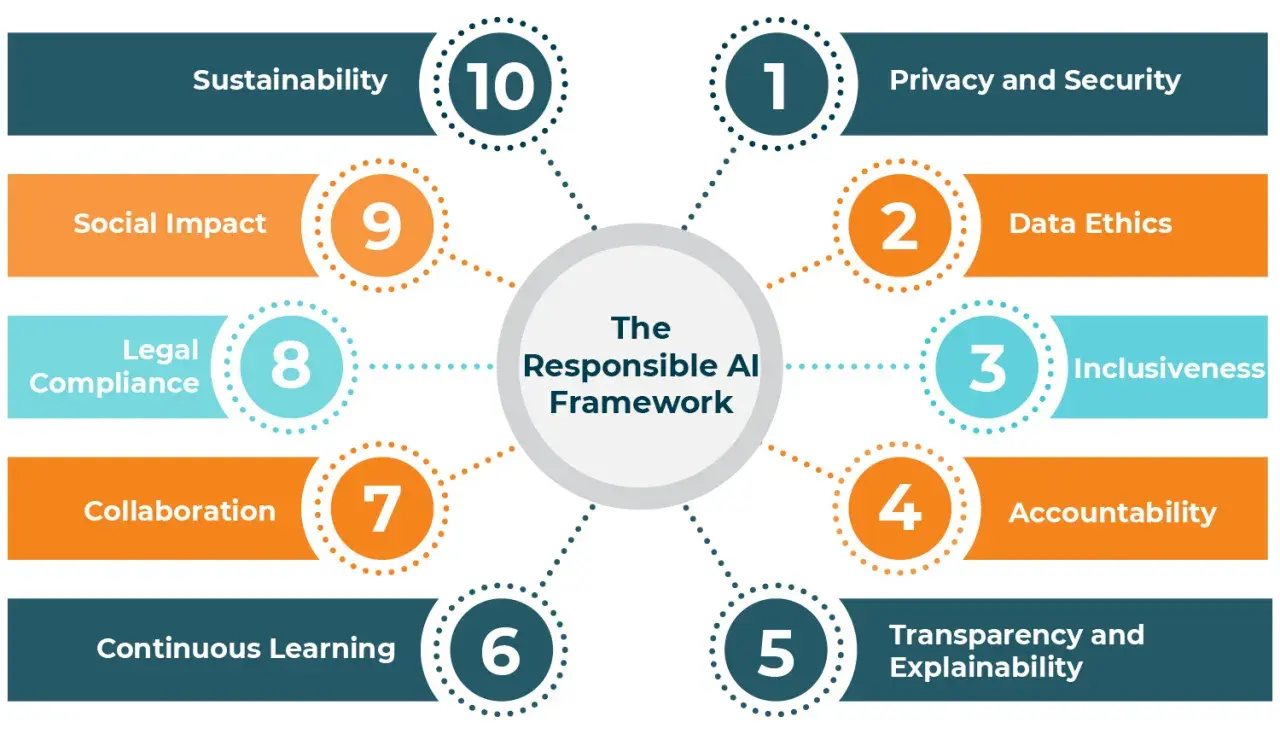
AI can speed up drafting, summarizing, searching, and brainstorming, but speed is not the same as sound judgment. In my view, the real answer to how to use AI responsibly is to treat it as a governed workplace capability, not a shortcut: define the job it should do, decide who reviews the output, and protect the people affected by the decision. In a U.S. workplace, that matters just as much for culture and trust as it does for compliance.
The essentials to keep in mind before AI touches a decision
- AI is safest when it supports people, not replaces judgment. The higher the stakes, the more human review matters.
- Start with a narrow use case. If you cannot explain the purpose in one sentence, the scope is too broad.
- Protect sensitive data. Employee records, customer data, and trade secrets need clear handling rules before anyone pastes them into a prompt.
- Bias is a process risk. It can show up in language, rankings, recommendations, and the way results are interpreted.
- Adoption is a change program. Training, ownership, and feedback loops matter as much as the tool itself.
- Measure and correct. If the workflow produces speed but weakens trust, it is not working.
What responsible AI use means in practice
For me, responsible use starts with a simple standard: the system should make work better without making accountability fuzzy. That lines up with NIST’s AI Risk Management Framework and the OECD AI Principles, which both emphasize trustworthiness, transparency, fairness, robustness, and human-centered design.I do not need AI to be perfect. I need it to be bounded, explainable enough for the task, and easy to stop when it drifts. That is especially important in strategy work, where people can mistake fluent output for sound reasoning. Once that definition is clear, the next question is where AI actually belongs in the workflow.
Start with the use case, not the model
The cleanest way to avoid trouble is to begin with the business problem, not with a shiny tool. I would ask: Is this task repetitive, low-risk, and easy to review, or does it affect people’s pay, access, reputation, or safety?
| Use case | Where AI helps | Where I would add a human check |
|---|---|---|
| Internal emails, policy drafts, meeting summaries | Fast first drafts, better structure, tone options | Final wording, factual accuracy, policy alignment |
| Translation, simplification, accessibility support | Plain-language rewrites and multilingual drafts | Nuance, terminology, and inclusion review |
| Brainstorming and scenario planning | Idea generation, alternative angles, risk prompts | Business judgment and prioritization |
| Hiring, performance, discipline, or pay decisions | Administrative support and note drafting | Formal human review with documented criteria |
| Legal, medical, or financial advice | Research support and outline drafting | Specialist oversight before any action |
If I cannot explain the allowed scope in one sentence, I do not think the use case is ready. That rule sounds simple, but it prevents a lot of accidental overreach. Once the use case is clear, the next job is setting hard boundaries around the information that feeds it.
Draw a hard line around data, privacy, and bias
I would never treat prompt text as harmless just because it feels conversational. Employee records, compensation details, health information, customer data, and trade secrets all deserve a clear handling rule before anyone types them into a model.
- Use anonymized examples when the task does not require identifiers.
- Classify what can be pasted, what must be redacted, and what is off-limits.
- Check whether the vendor stores prompts, trains on them, or exposes them to other users.
- Test outputs for uneven treatment across roles, gendered language, accessibility gaps, and cultural assumptions.
- Keep a documented review path for anything that can affect pay, hiring, promotion, or discipline.
Bias is usually less dramatic than people expect. It often shows up as subtle defaults, such as who gets described as “leadership material,” whose communication gets softened, or which ideas are treated as riskier. That is why I treat bias as an operational issue, not a philosophical one. Once you see it that way, the next step is deciding where human judgment must stay in charge.
Keep humans accountable for the decisions that matter
“Human-in-the-loop” sounds technical, but the practical rule is simple: AI can prepare, suggest, and sort, yet a named person owns the outcome. In high-stakes work, I want the human role to be real, not ceremonial.
- AI drafts, and a manager approves.
- AI flags patterns, and a specialist interprets them.
- AI suggests next steps, and a person decides whether to act.
- AI produces a recommendation, and the recommendation is documented with its limits.
- When confidence is low or the case is unusual, the system escalates instead of guessing.

Build adoption like a change program, not a tool rollout
Most AI failures I see are not caused by the model itself. They come from skipping the change work: no sponsor, no training, no rules, and no feedback loop from the people who actually use the tool.
- Pick one or two use cases that save time without affecting high-stakes decisions.
- Name an executive sponsor and a day-to-day owner.
- Write a short policy with allowed uses, prohibited uses, and escalation steps.
- Train people on prompting, verification, and data handling.
- Pilot with a mixed group so you hear from different roles, not only the enthusiasts.
- Revise the process before broader rollout.
In inclusive teams, I would insist on participation from people with different functions, seniority levels, and communication styles. That is where hidden failure modes surface early. Once the rollout is structured, measurement becomes the difference between a real system and a hope.
Measure what actually tells you the system is working
I like to review AI outcomes on a fixed cadence, because systems drift, people change how they use them, and vendor models update without much warning. If you are not measuring, you are guessing.
| Metric | What it tells you | What would worry me |
|---|---|---|
| Edit rate | How much human cleanup is needed | People are trusting raw output too quickly |
| Override rate | How often humans reject the suggestion | The model is misaligned with the task |
| Complaint or escalation rate | Whether users or affected people see problems | Bias or clarity issues may be hidden |
| Time saved | Productivity value | Speed is rising while quality falls |
| Coverage by role | Who is actually benefiting | Adoption is uneven or exclusionary |
I think of this as a simple loop: map the use case, measure the risk, and manage the outcome. That is very close to the logic in NIST’s framework, and it is the reason I would never declare success the moment a pilot launches. If the numbers look good but trust keeps falling, something else is broken.
The mistakes that erode trust fastest
In my experience, AI trust breaks fastest when people feel the organization is hiding the real tradeoffs. The tool itself is rarely the only problem.
- Using AI without disclosure when people reasonably expect a human.
- Letting polished language stand in for factual accuracy.
- Uploading sensitive data because the task feels routine.
- Allowing one department to set rules for everyone else.
- Ignoring accessibility, tone, or cultural nuance.
- Keeping a pilot alive after the use case no longer fits.
The fastest way to lose credibility is to oversell the tool and underplay the controls. I would rather say “not yet” than turn a weak workflow into a company habit. That discipline is what makes the next phase sustainable.
A small operating model that keeps AI useful over time
If I were setting this up from scratch, I would keep the operating model small and explicit.
- One written policy that defines allowed use, review rules, and red lines.
- One owner for risk, one owner for business value, and one owner for the people affected.
- One pilot with a narrow goal and a clear stop condition.
- One feedback channel where employees can flag errors or unfair outcomes.
- One periodic review to retire uses that no longer justify the risk.
That is the version of responsible AI I trust most: practical, documented, and honest about limits. The goal is not to slow innovation down; it is to make sure the benefits last long enough to matter.
